
What if the most sophisticated analytical tool in your facility is currently operating at a fraction of its engineered capacity? For many industrial quality control and research environments, the acquisition of a Veritas Series or Cube II SEM represents a significant capital investment, yet suboptimal image quality and persistent artifacts often obscure the true precision of these instruments. It’s a common frustration to see sample throughput stagnate because operators lack the technical depth to troubleshoot complex imaging variables independently. Professional on-site sem training addresses these operational bottlenecks by converting high-end hardware into a high-throughput analytical engine. You’ll learn how expert-led instruction enhances data precision, protects your instrumentation from avoidable damage, and secures the longevity of your equipment. This comprehensive guide details the strategic necessity of specialized training in 2026, covering everything from advanced parameter optimization to the meticulous handling of EDS systems. By the end of this article, you’ll understand how to transform your laboratory’s capabilities through a structured, authority-driven approach to microscopy mastery.
Key Takeaways
- Transition from basic operational knowledge to conceptual mastery to eliminate data inconsistencies and prevent accelerated hardware degradation.
- Master the optimization of critical parameters, including accelerating voltage and spot size, to achieve high-resolution imaging suitable for complex failure analysis.
- Discover how on-site sem training maximizes laboratory ROI by providing hands-on instruction tailored to your specific Veritas Series or Cube II instrumentation.
- Identify the direct correlation between operator proficiency and reduced total cost of ownership through enhanced equipment handling and maintenance efficiency.
- Leverage over 30 years of technical expertise to implement customized training protocols that streamline sample throughput in demanding industrial environments.
The Critical Role of Professional SEM Training in Modern Laboratories
Professional scanning electron microscopy represents a sophisticated convergence of electron physics and digital signal processing. While many operators can execute basic imaging tasks, true proficiency requires a transition from rote operation to conceptual mastery. Without comprehensive instruction, the Scanning electron microscope (SEM) remains an underutilized asset, prone to delivering inconsistent data that compromises industrial quality control. The risks associated with a self-taught approach extend beyond poor image resolution; they include accelerated hardware degradation and increased maintenance overhead. As we move through 2026, the demand for actionable industrial intelligence necessitates that laboratory personnel bridge the gap between complex instrumentation and high-fidelity results. Professional on-site sem training ensures that your staff doesn’t merely “use” the equipment but masters the underlying electron optics to maximize the utility of systems like the Veritas Series or Cube II. This advanced proficiency is no longer optional; it’s a prerequisite for maintaining competitive throughput in automated imaging workflows.
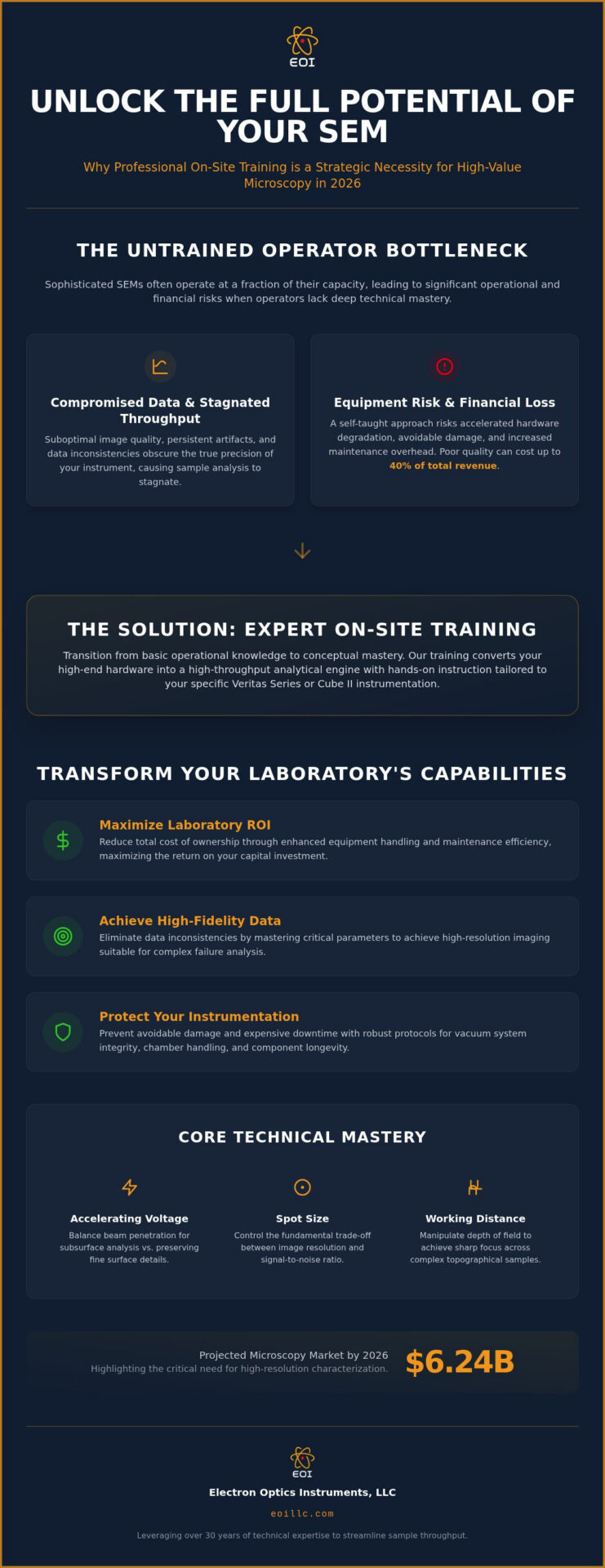
The evolution of the microscopy market, projected to reach USD 6.24 billion in 2026, underscores the increasing reliance on high-resolution characterization for failure analysis and material science. In this context, the cost of poor quality can account for up to 40% of total revenue in some manufacturing settings. Investing in a Veritas Pro or Veritas Ultra SEM without accompanying technical training is a strategic oversight that risks these significant financial losses. Mastery of the electron beam interaction volume and signal detection logic is essential for generating the reproducible data required by modern international production standards.
Why Manuals and Tutorials Are Insufficient
Static documentation often fails to account for the dynamic variables inherent in high-pressure laboratory environments. While a manual provides a baseline for button-pushing, it cannot replicate the nuanced feedback of a seasoned instructor. Mastering complex electron optics requires real-time adjustments based on sample charging or topographical challenges. Many benchtop SEM users fall into a “black box” mentality, relying on presets without understanding the underlying physics. Hands-on instruction dismantles this barrier, allowing operators to troubleshoot imaging artifacts as they occur.
The Impact of Training on Laboratory Safety and Compliance
Rigorous training is fundamental to maintaining vacuum system integrity and ensuring component longevity. In 2026, compliance with laboratory standards like 29 CFR 1910.1200 remains a critical operational pillar. Professional on-site sem training facilitates robust Standard Operating Procedures (SOPs) that mitigate equipment failure risks. These sessions emphasize meticulous chamber protocols, preventing contamination and expensive downtime. There’s also a clear link between operator proficiency and SEM maintenance efficiency, which directly impacts the total cost of ownership.
Technical Core: Mastering Electron Beam Interaction and Imaging
The efficacy of a Veritas Series or Genesis Tabletop SEM is fundamentally tied to the operator’s ability to manipulate the electron beam interaction volume. Mastering the interplay between accelerating voltage, spot size, and working distance isn’t merely a technical requirement; it’s a strategic necessity for high-fidelity data acquisition. On-site sem training provides the specific, hands-on environment required to navigate these variables effectively. While basic operation might yield an image, optimizing these parameters ensures that the resulting data is suitable for rigorous failure analysis or industrial quality control.
Navigating the Imaging Parameter Matrix
Achieving the ideal balance between resolution and depth of field requires a deep understanding of the imaging parameter matrix. Higher accelerating voltages increase beam penetration, which can be advantageous for subsurface imaging but may obscure surface details on sensitive industrial samples. Conversely, reducing the spot size enhances resolution but necessitates a trade-off with the signal-to-noise ratio. Operators must learn to calibrate probe current to maintain imaging clarity without inducing sample damage. These SEM training procedures mirror the rigorous standards found in top-tier research facilities, ensuring that every scan contributes to a broader objective of technical excellence. Laboratories that prioritize these expert-led technical sessions often see a marked improvement in the precision of their topographical analyses.
Advanced Analytical Techniques: EDS and BSE
Compositional characterization relies heavily on the differentiation of electron signals. Backscattered Electrons (BSE) are indispensable for highlighting compositional contrast in multi-phase materials, as the signal intensity correlates directly with the atomic number. When integrated with Energy Dispersive Spectroscopy (EDS), these signals provide a comprehensive elemental profile of the sample. However, capturing accurate EDS data requires meticulous management of dead time and count rates to avoid spectral artifacts. Professional on-site sem training allows operators to develop a real-time checklist for signal optimization, ensuring that analytical results are both accurate and reproducible.
- BSE Applications: Essential for identifying metallic inclusions or phase distributions in alloys where topographical data alone is insufficient.
- EDS Mapping: Requires precise beam positioning and dwell time optimization to ensure representative elemental distribution without excessive dead time.
- Vacuum Optimization: Critical for non-conductive samples where charging can distort both imaging and analytical data; proper vacuum management preserves the integrity of the electron optics.
By mastering these advanced techniques, operators can transform raw signals into comprehensive failure analysis reports that drive industrial progress. This level of proficiency ensures that instruments like the Cube II operate at their peak analytical potential, delivering the reliability that global innovators demand. Meticulousness in these technical core areas directly translates to reduced maintenance costs and extended equipment longevity.
Comparing SEM Training Methodologies: On-Site vs. Virtual vs. Academic
Selecting a training methodology is a strategic decision that directly influences laboratory efficiency and data integrity. While academic institutions like the University of Wisconsin-Madison SEM training program offer rigorous theoretical foundations, industrial environments often require a more pragmatic focus on throughput and specific hardware mastery. Academic courses excel at teaching the fundamental physics of electron-matter interactions but often lack the specialized focus needed for rapid failure analysis in a corporate setting. Conversely, virtual simulators serve as valuable supplemental tools for theoretical reinforcement, yet they don’t replicate the tactile feedback or the nuanced sample preparation required for complex industrial specimens. Determining the best fit for your laboratory’s operational goals involves balancing these theoretical insights with the practical demands of your specific production workflows.
The Logistics of On-Site Technical Training
The implementation of professional on-site sem training provides a localized advantage, as instruction is delivered directly on the facility’s specific instrumentation, including the Cube II or Genesis series. This approach eliminates the variability introduced when training on different models or configurations. It also facilitates the real-time identification and mitigation of environmental factors, including electromagnetic interference (EMI) or floor vibrations, which can severely compromise imaging at high magnifications. By conducting sessions at your laboratory, you maximize staff participation while eliminating the logistical overhead of travel and lodging. This ensures that the entire team benefits from a customized curriculum that prioritizes the unique challenges of your specific industrial applications.
Evaluating Remote and Simulation-Based Options
Virtual platforms and simulation-based learning provide a risk-free environment for onboarding new hires or reinforcing basic concepts. These tools allow beginners to familiarize themselves with the user interface without the risk of equipment damage. Continuous education is further supported by comprehensive SEM operation guides, which act as a technical bridge between formal training sessions. A hybrid model, combining online theoretical modules with intensive on-site sem training, represents a balanced approach that ensures both conceptual depth and practical proficiency. It’s a methodological synergy that allows laboratories to maintain high standards of accuracy while optimizing their long-term operational ROI and reducing the total cost of ownership.
Optimizing Laboratory ROI Through Advanced Operator Proficiency
The acquisition of a Veritas Series or Cube II SEM represents a significant capital commitment that necessitates a corresponding investment in human capital. Maximizing the return on this investment requires more than basic operational knowledge; it demands a level of proficiency that directly influences the Total Cost of Ownership (TCO). Professional on-site sem training acts as a strategic lever, reducing long-term service contract costs by empowering staff to handle instrumentation with technical meticulousness. When operators understand the delicate physics of the electron column, they make informed decisions that prevent the subtle mismanagement leading to systemic failures. This advanced proficiency accelerates imaging cycles, allowing for higher data throughput without compromising the resolution required for rigorous industrial standards.
Training as a Preventative Maintenance Strategy
There’s a critical, often overlooked synergy between operator expertise and SEM maintenance efficiency. Expertly trained staff significantly extend the operational life of consumable components, such as filaments and apertures, by optimizing emission settings and beam alignment. Meticulous sample preparation protocols, a core component of professional instruction, prevent vacuum system contamination that would otherwise lead to expensive de-gassing procedures or pump repairs. By identifying early indicators of system drift or astigmatism, proficient operators can perform basic troubleshooting that maintains peak performance and avoids the downtime associated with emergency service calls. This proactive approach ensures that the hardware remains a reliable asset within the production chain.
Quantifying the Value of High-Quality Data
The financial impact of operator skill is most evident in the quality of the generated data. In quality control environments, poor image quality leads to expensive re-work and potential imaging errors that can derail product development cycles. High-resolution data, characterized by superior signal-to-noise ratios, provides the clarity needed for definitive failure analysis. While the initial electron microscope cost is a fixed variable, the value derived from that instrument is highly elastic, scaling directly with the technical maturity of the user base. Laboratories that integrate on-site sem training into their operational strategy consistently report higher precision in their analytical outputs. To secure the future of your laboratory’s analytical capabilities, consider the benefits of customized technical instruction from industry veterans.
Customized SEM Training Solutions from Electron Optics Instruments
Electron Optics Instruments, LLC delivers a pedagogical approach that is as rigorous as the instrumentation it supports. By aligning instructional modules with the specific capabilities of the Cube II, Genesis, and Veritas Series, we ensure that your team achieves a level of proficiency that translates into immediate operational gains. This specialized on-site sem training is backed by over 30 years of industry experience, providing a foundation of technical authority that is essential for complex industrial characterization. We don’t offer a generalized curriculum; instead, we design flexible training sessions that adapt to the current skill levels of your operators while targeting the specific analytical requirements of your sector. This tailored methodology ensures that every hour of instruction contributes directly to the precision and reliability of your laboratory’s output.
A strategic advantage of our program lies in the integration of operator instruction with preventative maintenance protocols. This holistic support model ensures that your staff doesn’t just learn to capture high-resolution images, but also understands the mechanical and electronic nuances required to maintain peak system performance. By combining on-site sem training with regular maintenance visits, laboratories can significantly reduce their long-term service expenditures while securing the longevity of their Veritas or Genesis systems. This synergy between human expertise and hardware health is a hallmark of our commitment to industrial excellence.
The Electron Optics Instruments, LLC Training Philosophy
Our philosophy is anchored in the pragmatic realities of modern microscopy. We prioritize practical application over abstract theory, focusing on solving the specific imaging challenges your team encounters daily. Whether you’re analyzing metallic inclusions or characterizing non-conductive polymers, our instructors provide the technical depth required to optimize your results. While we are the sole US distributor for EmCraft, our expertise extends across all major manufacturers. This brand-agnostic technical depth allows us to provide comprehensive support for facilities with diverse hardware portfolios. We view training not as a one-time event, but as the beginning of a long-term service partnership focused on continuous improvement and technical mastery.
Requesting a Customized Training Consultation
The process begins with a detailed assessment of your team’s current proficiency and your facility’s specific analytical goals. We design multi-day sessions that balance foundational theory with intensive, hands-on operation and maintenance instruction. This structured approach ensures that both new hires and seasoned analysts gain the insights needed to push the boundaries of what’s possible with electron optics. Our national on-site support ensures that laboratories across the United States have access to world-class technical instruction without the logistical burden of travel. To transform your laboratory’s capabilities and protect your investment in high-end hardware, contact Electron Optics Instruments, LLC to schedule your customized technical consultation.
Securing the Future of Industrial Microscopy Mastery
The transition from basic operation to conceptual mastery is a strategic imperative for laboratories that prioritize analytical precision and operational reliability. By mastering the intricate physics of electron beam interaction and signal differentiation, your team can transform high-end hardware into a high-throughput engine for industrial intelligence. Professional on-site sem training ensures that this expertise is developed within the specific environmental context of your facility, directly addressing the unique challenges of your production workflows. This proactive approach not only enhances data fidelity but also secures the longevity of your instrumentation through meticulous handling and preventative care.
Electron Optics Instruments, LLC brings over 30 years of industry expertise as the sole US distributor for EmCraft Scanning Electron Microscopes, providing unparalleled national on-site service and support. We’re committed to helping you unlock the full analytical potential of your Veritas Series or Cube II systems through expert-led instruction. Request a Customized On-Site SEM Training Consultation today to establish a new standard of technical excellence in your facility. We look forward to partnering with your team to advance the boundaries of what’s possible in high-resolution characterization.
Frequently Asked Questions
How long does professional SEM training typically take?
Professional SEM training sessions typically span two to three days, though the exact duration depends on the complexity of the instrumentation and the team’s existing proficiency. To maintain focus during these intensive technical blocks, you might explore Sale of specialized visual timer hardware to help manage session pacing and transition times. A multi-day session allows for a balanced integration of theoretical electron physics and intensive, hands-on practical operation. This timeframe ensures that operators can move beyond basic imaging to master advanced troubleshooting and parameter optimization without overwhelming the laboratory’s production schedule.
Specialized on-site sem training is designed to be conducted directly on your facility’s specific hardware, including benchtop models like the Cube II or Genesis series. Training on your own equipment is critical because it accounts for the unique environmental variables and configuration nuances of your laboratory. This localized approach ensures that the skills your team develops are immediately applicable to their daily analytical workflows, eliminating the disconnect often found in generalized manufacturer courses.
What are the prerequisites for staff attending an SEM training course?
Comprehensive technical instruction always includes a rigorous focus on sample preparation and coating techniques. Achieving high-resolution imaging on non-conductive or sensitive industrial samples requires meticulous preparation to prevent charging and vacuum contamination. Operators learn to select appropriate coating materials and thicknesses to enhance signal-to-noise ratios. Mastering these preparatory steps is essential for protecting the electron column and ensuring the long-term integrity of the vacuum system.
How often should laboratory staff undergo refresher SEM training?
We recommend that laboratory personnel undergo refresher technical sessions every 12 to 24 months to maintain peak operational proficiency. This cadence ensures that staff stay current with evolving imaging techniques and software updates that can improve data throughput. Regular training also acts as a preventative measure against the development of suboptimal habits that could lead to equipment mismanagement or inconsistent data quality across different operator shifts.
Is on-site training more cost-effective than sending staff to a manufacturer facility?
Implementing on-site sem training is generally more cost-effective because it eliminates the substantial overhead associated with staff travel, lodging, and lost productivity. It allows for a larger group of operators to receive instruction simultaneously on the exact Veritas Series or Genesis units they use daily. Additionally, training within your specific environment allows the instructor to identify and mitigate localized issues like floor vibrations or electromagnetic interference that wouldn’t be addressed at an off-site facility.
What certification or documentation is provided upon completion of the training?
Upon successful completion of the curriculum, participants receive a formal certificate of technical proficiency that documents their mastery of specific operational and analytical modules. We also provide detailed training logs and updated Standard Operating Procedures (SOPs) that align with the latest industry standards for 2026. This documentation is essential for maintaining laboratory compliance and serves as a verified record of professional development for internal quality audits and personnel records.
Does training include instruction on EDS analysis and elemental mapping?
Instruction on Energy Dispersive Spectroscopy (EDS) systems is a core component of our advanced analytical training programs. Operators learn the technical nuances of elemental characterization, including the management of dead time, count rates, and spectral artifacts. We emphasize the integration of EDS mapping with Backscattered Electron (BSE) imaging to provide a holistic compositional profile of industrial materials. This ensures that your team can produce comprehensive failure analysis reports with high confidence.