

The sticker price of a scanning electron microscope is frequently the least significant figure in a decade-long capital expenditure strategy. For procurement officers and laboratory directors, the primary challenge lies not in the initial acquisition, but in the subsequent fifteen years of operational integration and technical maintenance. You likely recognize that manufacturer quotes often obscure the true SEM total cost of ownership, leaving your budget vulnerable to unexpected downtime and fluctuating consumable burdens.
This article provides a rigorous framework to master these complexities, ensuring you can evaluate the full lifecycle costs from initial capital outlay to long-term operational stability. We will analyze the financial profiles of the Cube II benchtop system, the Genesis tabletop model, and the high-performance Veritas Series. By the end of this guide, you’ll possess a defensible budget for a fifteen-year lifecycle and the technical confidence to select a microscope that aligns with your organization’s financial and analytical requirements.
Key Takeaways
- Evaluate the comprehensive fifteen-year lifecycle of instrumentation rather than relying on initial acquisition quotes as a primary decision metric.
- Compare the operational efficiencies of the Genesis tabletop series and the Cube II benchtop SEM to identify the most sustainable entry point for your laboratory.
- Quantify the impact of secondary technical integrations, such as EDS and vacuum system architecture, on the long-term maintenance burden of the system.
- Master the SEM total cost of ownership through the strategic deployment of multi-tiered service contracts that safeguard against the volatility of repair costs.
- Leverage over thirty years of technical expertise to align your procurement strategy with the unique financial and engineering requirements of your industrial application.
Defining SEM Total Cost of Ownership (TCO) in 2026
In the precision-driven environment of 2026, the initial acquisition price of a Scanning electron microscope (SEM) serves as a deceptive vanity metric that frequently obscures the fiscal realities of long-term instrumentation. Procurement strategies that prioritize the “sticker price” often fail to account for the cumulative financial burden of operational integration and technical maintenance. A comprehensive SEM total cost of ownership analysis must encompass the entire lifecycle of the asset, beginning with capital expenditure and extending through operational stability, preventative maintenance, and eventual decommissioning. As industrial standards evolve to demand higher throughput and sub-nanometer accuracy, the synergy between technical performance and financial predictability becomes the primary benchmark for institutional success.
Infrastructure and Facility Preparation Costs
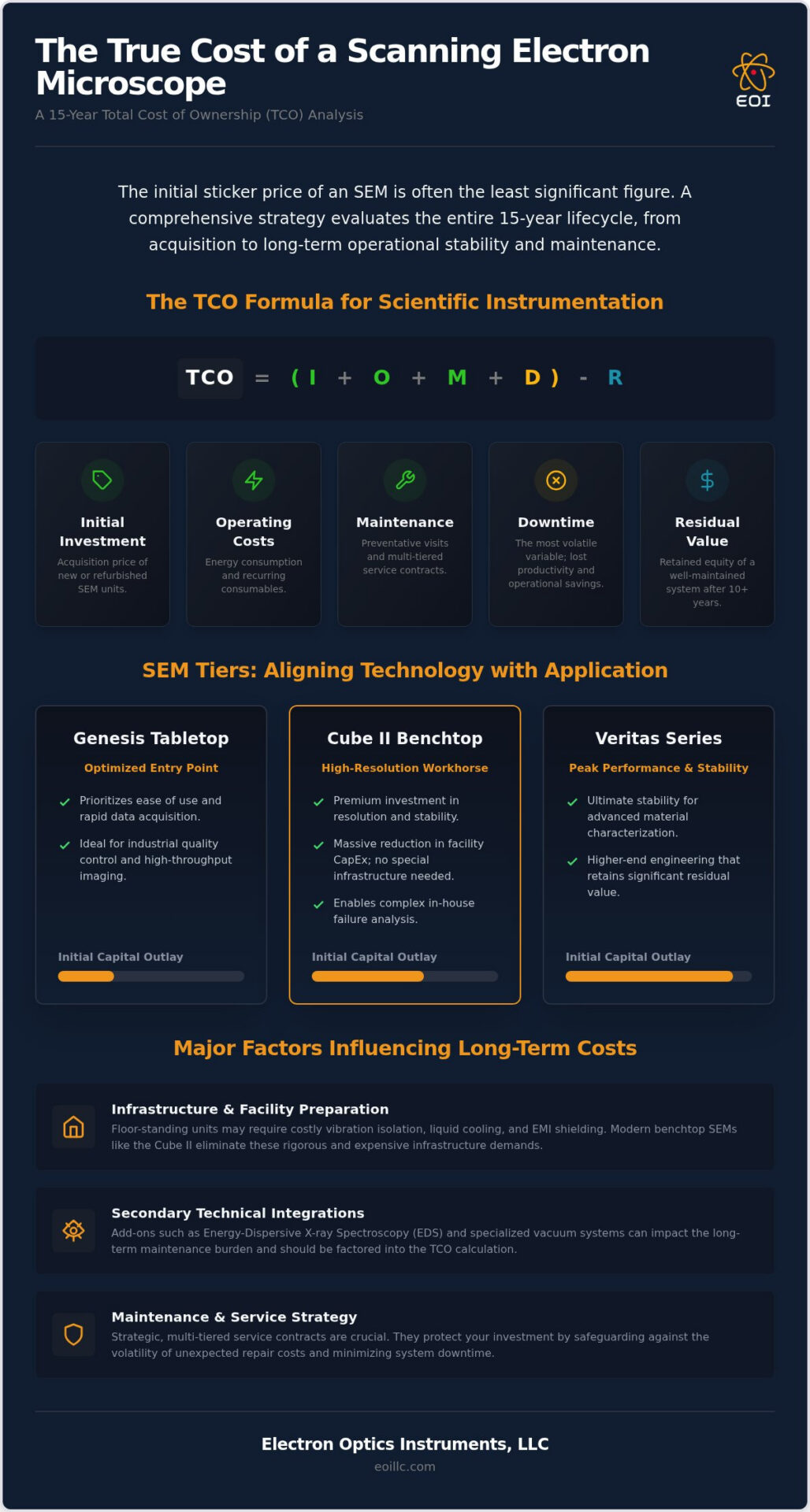
The traditional paradigm of electron microscopy often required extensive facility modifications that could significantly inflate the total investment. Floor-standing units typically necessitate active vibration isolation systems and specialized liquid cooling architectures, adding layers of complexity to the laboratory footprint. Conversely, the transition toward desktop SEM technology, exemplified by the Cube II benchtop SEM, represents a massive reduction in facility CapEx by eliminating these rigorous infrastructure demands. Modern laboratory design also prioritizes electromagnetic interference (EMI) shielding, a critical variable for floor-standing units that benchtop models mitigate through integrated shielding and compact geometries. By reducing the need for dedicated power conditioning and environmental stabilization, these units allow organizations to allocate capital toward analytical capabilities rather than facility overhead.
The TCO Formula for Scientific Instrumentation
To establish a defensible financial framework, stakeholders should utilize a structured TCO formula: Initial Investment (I) + Operating Costs (O) + Maintenance (M) + Downtime (D) minus Residual Value (R). Operating costs encompass energy consumption and consumables, while maintenance includes multi-tiered service contracts and preventative visits. Downtime represents the most volatile variable, where a single day of system failure can negate months of operational savings. Analytical precision acts as the fundamental driver of long-term ROI, ensuring that data integrity remains uncompromised throughout the instrument’s service life. Evaluating the residual value of a well-maintained Veritas Series SEM after ten years reveals that high-end engineering retains significant equity, providing a strategic exit or upgrade path that further optimizes the SEM total cost of ownership. This longitudinal perspective ensures that the selection of a microscope, whether it’s a new Veritas Pro or a refurbished unit, remains a sound strategic investment.
Tiered Acquisition Models: New vs. Refurbished SEM Units
The selection of an electron microscope requires a meticulous evaluation of how initial capital allocation influences the long-term SEM total cost of ownership. Organizations must navigate a complex landscape of instrumentation tiers, choosing between rapid-throughput tabletop systems, high-resolution benchtop units, or the strategic acquisition of refurbished hardware. According to recent electron microscopy market analysis, the divergence in pricing tiers reflects distinct engineering priorities that dictate a facility’s operational trajectory for a decade or more. This acquisition choice fundamentally dictates the subsequent ten years of operational expense, as higher-end systems often demand more sophisticated maintenance protocols while providing superior data density.
The Genesis Tabletop SEM serves as an optimized entry point for high-throughput imaging, prioritizing ease of use and rapid data acquisition for industrial quality control. In contrast, the Cube II and Veritas Series represent a premium investment in benchtop resolution, offering the stability required for advanced material characterization. While the initial capital outlay for these systems is higher, the investment is justified by the reduction in analytical bottlenecks and the ability to perform complex failure analysis in-house.
Capital Savings with Certified Refurbished Microscopes
Refurbished SEM Units provide a strategic pathway for startups and research facilities to access high-end features on a restricted budget. The price-to-performance ratio of these units often exceeds that of new entry-level models, provided the refurbishment meets rigorous OEM standards. This meticulous restoration is critical for mitigating the hidden repair costs that frequently plague non-certified secondary market hardware. While a new Veritas FE-SEM offers the pinnacle of modern performance, a certified refurbished floor model may serve as a viable alternative for laboratories requiring specific chamber volumes or legacy detector compatibility without the premium of a brand-new system.
Justifying the Premium for Field Emission (FE) Technology
The physics of the electron source remains a primary driver of the SEM total cost of ownership. Field Emission technology, integrated into the Veritas FE and Veritas HR models, carries a higher initial cost due to the complexity of the source and the ultra-high vacuum requirements. However, the ROI becomes evident in semiconductor QC and nanotechnology applications where resolution benchmarks of 1nm are mandatory. By achieving sub-5nm clarity, these models minimize sample re-run costs and prevent the analytical bottlenecks associated with lower-resolution tungsten sources. For institutions seeking to optimize their technological footprint, exploring the Veritas Series configurations ensures that the selected instrument aligns with both technical requirements and fiscal constraints.
Technical Variables That Influence Operational Costs
The operational efficiency of an electron microscope is fundamentally tied to the modular subsystems selected during the configuration phase. While the electron source defines the resolution ceiling, the choice of detectors, vacuum architecture, and analytical software dictates the daily fiscal performance of the laboratory. When analyzing the SEM total cost of ownership, stakeholders must look past the primary column to evaluate how these technical variables influence sample throughput and labor requirements. Integrating automation tools and high-efficiency detectors can significantly reduce the cost-per-sample, transforming the instrument from a capital-intensive asset into a streamlined analytical engine.
The ROI of Integrated EDS Systems
The addition of elemental analysis capabilities is a primary factor that influences the electron microscope cost, yet its impact on long-term ROI is often underestimated. Single-vendor EDS Systems, such as those integrated within the Veritas Series, offer a unified service path that eliminates the administrative complexity of multi-vendor hardware configurations. This technical synergy ensures that software updates and hardware calibrations remain synchronized, reducing the likelihood of system conflicts that lead to expensive downtime. Rapid elemental identification provides a definitive ROI in failure analysis environments by accelerating root-cause determination and preventing the escalation of production-line defects.
Vacuum Maintenance and Sample Throughput
Vacuum system architecture represents a critical, often overlooked component of the SEM total cost of ownership. While oil-based rotary vane pumps offer a lower entry price, dry scroll pump systems provide superior vacuum stability and eliminate the risk of hydrocarbon contamination over a five-year horizon. This stability is essential for maintaining the longevity of the electron column, as it minimizes the accumulation of contaminants on sensitive apertures and lenses. Choosing a dry system often results in fewer Preventative Maintenance Visits and a lower overall consumable burden.
The inclusion of Variable Pressure (VP) or “low-vac” modes significantly alters the labor economics of the laboratory. By allowing for the imaging of non-conductive samples without the need for gold or carbon coating, VP modes reduce sample preparation time and the associated costs of coating materials. This throughput optimization is further enhanced by modern automation and AI software, which can perform autonomous particle analysis and feature classification. These systems drastically reduce the man-hours required for data processing, allowing senior researchers to focus on high-level interpretation rather than repetitive manual measurement. Whether optimizing a Cube II benchtop SEM or a full-scale Veritas FE model, these technical choices define the boundary between a high-maintenance tool and a high-efficiency solution.
Protecting the Investment: Maintenance and Service Strategy
A robust maintenance strategy serves as the primary defense against the volatility of the “D” variable in the SEM total cost of ownership formula. While the initial investment is a fixed capital event, the ongoing costs associated with maintenance (M) and downtime (D) are dynamic factors that require meticulous longitudinal planning. Proactive consumables management is central to this effort; budgeting for regular filament, aperture, and scintillator replacements ensures that the electron column maintains peak performance without the risk of sudden resolution degradation. By treating these components as planned operational expenses rather than emergency repairs, laboratories can stabilize their annual budgets and ensure the technical reliability of their Veritas Series or Cube II systems over a fifteen-year horizon.
The Value of Tiered Service Agreements
Effective SEM maintenance protocols can extend the operational lifespan of a microscope significantly, enhancing the residual value of the asset. Choosing between a basic inspection plan and a full-coverage agreement requires a strategic assessment of the cost of one week of system downtime versus the predictable expense of a priority service contract. Electron Optics Instruments provides national service coverage for all major SEM manufacturers, offering a technical synergy that ensures consistent performance regardless of the original equipment manufacturer. This multi-tiered approach allows organizations to customize their coverage levels based on the criticality of the instrument to their unique production or research workflows.
On-Site Training and Installation Logistics
The human element remains a significant variable in equipment longevity and operational precision. Professional sem operation training acts as a critical safeguard against user-induced equipment failure, which frequently accounts for a substantial portion of non-routine service visits. Beyond initial calibration and installation, which ensure performance standards are met from day one, ongoing training ensures that operators can identify early indicators of vacuum instability or filament wear. Additionally, the TCO impact of relocation services should not be overlooked; moving sensitive electron optics between facilities requires specialized logistical excellence to prevent the misalignment of internal components. Meticulous attention to these logistical details ensures that the SEM total cost of ownership remains within projected bounds while maintaining the highest analytical standards.
Strategic Procurement: The EOI Advantage in 2026
Selecting a high-precision instrument is a commitment to a decade of operational synergy, where the technical capabilities of the hardware must align with the fiscal objectives of the organization. Electron Optics Instruments, LLC leverages over thirty years of specialized expertise to bridge this gap, offering a consultative procurement process that prioritizes long-term stability over short-term savings. As the sole US distributor for EmCraft Scanning Electron Microscopes, we ensure that technical support and parts availability remain streamlined, directly mitigating the risks of extended downtime. This established logistical excellence allows our partners to integrate advanced SEM techniques into their workflows while maintaining a clear view of the SEM total cost of ownership.
Our approach centers on technical authority and meticulousness, ensuring that every Veritas Series configuration or benchtop installation is optimized for its specific industrial application. By analyzing the intersection of innovation and reliability, we help stakeholders navigate the complexities of procurement with a visionary outlook that accounts for the grounded realities of international production standards.
Evaluating the Cube II for High-Throughput QC
The Cube II Benchtop SEM distinguishes itself as the industry leader in performance-to-price ratio, particularly for facilities requiring 24/7 reliability in high-throughput manufacturing environments. Its robust engineering minimizes the frequency of recalibration, making it the preferred choice for industrial failure analysis where data integrity is paramount. While the Genesis Tabletop SEM serves as an excellent entry-point for basic analytical needs, the Cube II offers the enhanced resolution and stability required for more demanding quality control protocols. Case studies from 2026 manufacturing sectors highlight its ability to maintain peak performance under constant use, proving that a compact footprint doesn’t necessitate a compromise in analytical precision.
Navigating the Quote Process with EOI
Requesting a quote through EOI is a collaborative exercise in defining your laboratory’s analytical trajectory. We provide detailed assessments that account for your specific vacuum requirements, detector configurations, and elemental analysis needs. Because EOI serves as a national service partner for all major SEM brands, our perspective is rooted in a comprehensive understanding of the entire microscopy landscape. This broad technical capability ensures that your procurement decision is backed by a support network that understands the nuances of various architectures. When finalizing your SEM procurement, consider this essential checklist to ensure a low SEM total cost of ownership and high ROI:
- Verification of infrastructure compatibility to avoid hidden facility CapEx.
- Alignment of detector arrays with specific sample characterization goals.
- Inclusion of multi-tiered service contracts to stabilize maintenance budgets.
- Establishment of a consumables replenishment schedule for filaments and apertures.
- Assessment of operator training requirements to prevent user-induced system failure.
Optimizing Your Analytical Infrastructure for 2026 and Beyond
Mastering the SEM total cost of ownership requires a shift from viewing microscopy as a one-time purchase to treating it as a dynamic, fifteen-year investment. By calculating the synergy between initial capital outlay, preventative maintenance, and residual value, your organization can eliminate the volatility of unexpected downtime. Whether you deploy the high-throughput Cube II benchtop SEM or a customized Veritas FE model, the success of your laboratory depends on aligning technical precision with fiscal meticulousness.
As the sole US distributor for EmCraft with over thirty years of SEM industry expertise, Electron Optics Instruments provides the stability and technical authority required to navigate this procurement landscape. We offer comprehensive service support for all major brands, ensuring that your analytical capabilities remain uninterrupted. It’s time to transition your laboratory toward a more reliable and cost-effective future.
Request a Personalized Quote for the Cube II Benchtop SEM to secure an instrument that matches your technical requirements and your budget. We look forward to helping you achieve unparalleled precision in your industrial applications.
Frequently Asked Questions
What is the average starting price for a benchtop SEM in 2026?
Entry-level benchtop systems generally occupy the most accessible price tier in the electron microscopy market. Factors such as detector configuration and vacuum capabilities influence the final quote for these instruments. While specific pricing varies by manufacturer and technical specifications, these units provide a lower entry point than floor-standing research models. They eliminate the need for significant laboratory renovations, which further reduces the initial capital requirement for organizations focused on high-throughput quality control.
How much do refurbished scanning electron microscopes cost compared to new models?
Refurbished scanning electron microscopes typically represent a significant reduction in capital expenditure, often costing a fraction of a new equivalent system. This pathway allows laboratories to access advanced features or larger chamber volumes that might otherwise exceed their budgetary constraints. When sourcing through an authorized distributor like Electron Optics Instruments, these units undergo rigorous calibration to meet original performance standards, ensuring that the analytical precision remains comparable to newer instrumentation.
Are there hidden costs in SEM installation and relocation?
Installation and relocation involve several indirect expenses that can inflate the SEM total cost of ownership. Facility modifications, including vibration isolation platforms, dedicated power conditioning, and specialized cooling systems, are common requirements for larger units. Relocation adds further complexity, as sensitive electron optics require professional decommissioning and climate-controlled transport. Post-move recalibration is essential to ensure the instrument meets its original resolution benchmarks after the mechanical stresses of transit.
How much should I budget for annual SEM maintenance and service contracts?
Annual budgets for maintenance and service contracts are typically calculated as a percentage of the initial system value. These agreements are vital for stabilizing operational costs and preventing the financial impact of unplanned downtime. Choosing a multi-tiered service contract provides priority access to field engineers and covers the cost of major components. This proactive approach ensures that the instrument remains within its performance specifications while extending its total service life beyond a decade.
Does the resolution of a benchtop SEM significantly impact its total cost of ownership?
The resolution of a microscope is a primary driver of its total lifecycle cost due to the complexity of the underlying electron source. High-resolution Field Emission (FE) systems require ultra-high vacuum environments and more sophisticated electronics, which necessitates higher-tier service contracts. While the initial investment is greater, superior clarity reduces the frequency of sample re-runs and analytical errors. This trade-off between higher CapEx and increased analytical efficiency is a core component of a strategic investment framework.
Can I lease a benchtop SEM to manage the initial capital expenditure?
Organizations frequently explore leasing or financing arrangements to manage the significant capital expenditure associated with electron microscopy. While Electron Optics Instruments focuses on direct sales of new and refurbished units, many institutions utilize third-party financial partners to distribute the cost over several years. This strategy allows for the immediate deployment of advanced hardware like the Cube II without depleting liquid capital. It’s advisable to consult with your internal financial department to determine if a lease-to-own model fits your fiscal profile.
What is the typical cost of adding an EDS system to an existing SEM?
Adding an Energy Dispersive Spectroscopy (EDS) system represents a substantial technical upgrade that influences the SEM total cost of ownership. The investment depends on the detector’s active area and the level of software integration required for automated elemental mapping. Integrated systems, such as those available for the Veritas Series, offer a unified service path that simplifies long-term maintenance. This investment is often justified by the ability to perform comprehensive material characterization and failure analysis in-house.
How often do SEM filaments need replacement, and what is the typical cost?
Filament replacement frequency depends heavily on the electron source type and the intensity of usage. Standard tungsten filaments typically require replacement after approximately one hundred hours of active beam time, representing a recurring but predictable consumable expense. In contrast, Field Emission sources last significantly longer but involve a much higher replacement cost when they eventually reach their end-of-life. Budgeting for these consumables ensures that your laboratory maintains consistent imaging performance without unexpected interruptions in workflow.