

The most sophisticated electron optics system remains only as precise as the least disciplined operator behind the console. You’ve likely experienced the frustration of inconsistent imaging results across different shifts or the acute anxiety that accompanies a novice user handling a high-value instrument like the Veritas Ultra or Cube II. These operational variances don’t just compromise data integrity; they pose a tangible threat to the longevity of your sensitive hardware. Understanding how to write an sop for sem operation is no longer a clerical task. It is a critical risk-mitigation strategy that bridges the gap between hardware capability and human performance. By establishing a professional framework, you can ensure your laboratory maintains the rigorous 0.5 mrem/hr radiation safety standards while significantly reducing training overhead. This article provides an expert-driven roadmap for 2026, detailing the technical requirements, software integration for modern Windows 11 platforms, and the structural protocols necessary for achieving international excellence in analytical precision. We’ll explore the synergy between meticulous documentation and superior industrial performance to stabilize your laboratory’s output and protect your investment.
Key Takeaways
- Establish a rigorous administrative framework utilizing specific document identifiers and versioning protocols to ensure that all operators adhere to uniform analytical standards.
- Master the technical nuances of how to write an sop for sem operation by standardizing vacuum parameters and high-voltage selection, thereby safeguarding sensitive electron optics against operational error.
- Implement methodical pre-operational checklists that verify system status and gas supplies to mitigate the risk of instrument downtime and ensure vacuum integrity.
- Bridge the structural gap between documentation and practical execution by integrating specialized on-site technical training as the definitive stage of SOP implementation.
- Facilitate streamlined preventative maintenance visits and rigorous audit compliance through the maintenance of structured operational records and periodic user competency audits.
The Strategic Importance of Standard Operating Procedures in Electron Microscopy
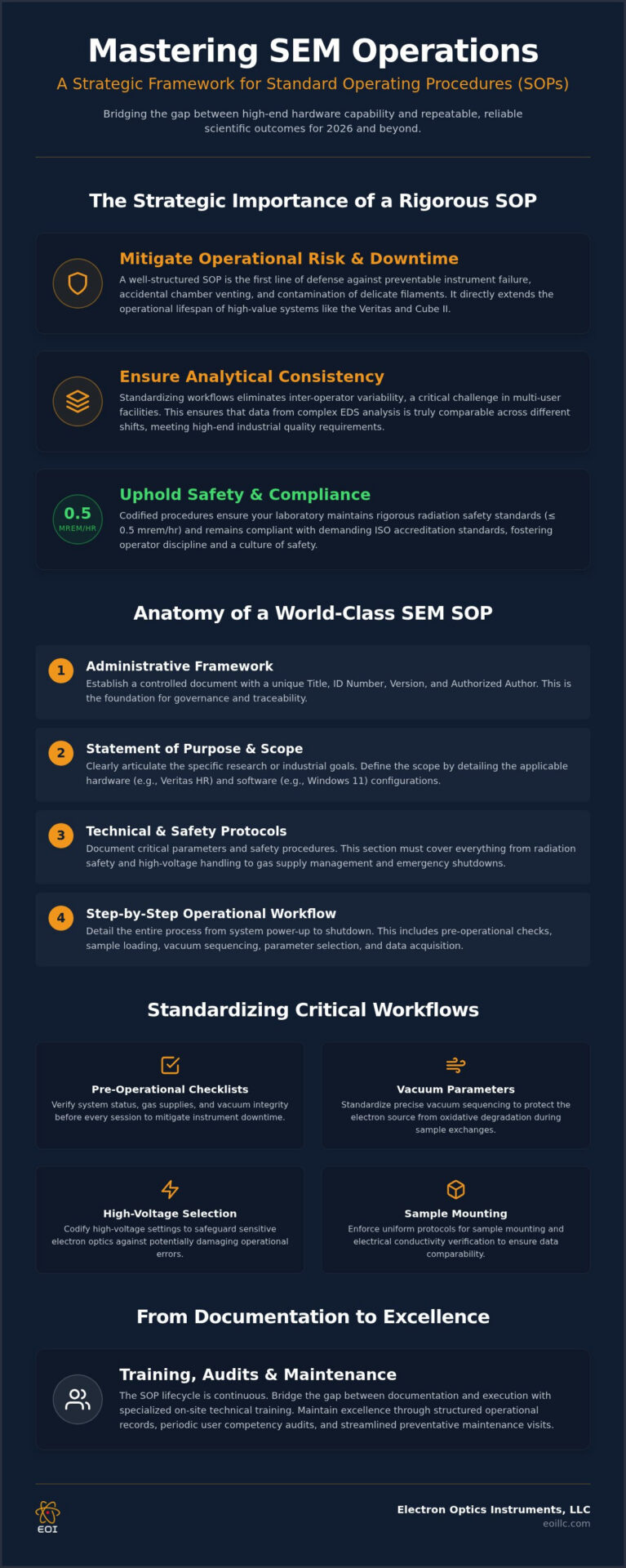
In the context of modern industrial characterization, a Standard Operating Procedure (SOP) serves as much more than a simple instruction manual; it’s a controlled document that dictates the technical integration and analytical accuracy of the entire laboratory. As research standards evolve in 2026, the necessity for a rigorous framework becomes paramount for maintaining the precision expected by international B2B partners. Meticulous documentation regarding how to write an sop for sem operation ensures that every imaging session adheres to a visionary standard of reliability, effectively bridging the gap between high-end hardware capability and repeatable scientific outcomes. This technical integration is essential for laboratories seeking to align with the 2026 trajectory of the global microscopy market, which is increasingly defined by AI-driven automation and remote accessibility of the Scanning Electron Microscope (SEM).
Mitigating Operational Risk and Instrument Downtime
High-throughput environments can’t afford the logistical paralysis caused by preventable instrument failure. In laboratories utilizing advanced systems like the Veritas FE or Cube II, the cost of downtime often extends beyond immediate repair fees to include delayed production cycles and missed corporate milestones. A well-structured SOP acts as the first line of defense for vacuum system integrity, preventing the accidental venting of the chamber or the contamination of delicate filaments. Specifically, systems like the Veritas Plus or Genesis Tabletop SEM require precise vacuum sequencing to protect the electron source from oxidative degradation during sample exchanges. Operator discipline, fostered through these standardized workflows, directly correlates with the long-term health of the electron optics. By codifying the correct power-up sequences and pressure thresholds, facilities can extend the operational lifespan of their systems while ensuring they remain compliant with rigorous ISO accreditation standards.
Ensuring Analytical Consistency Across Multi-User Facilities
Inter-operator variability is a persistent challenge in multi-user facilities where different levels of expertise can lead to divergent data sets. Standardizing the operational workflow reduces these discrepancies, particularly during complex EDS (Energy Dispersive Spectroscopy) analysis where parameter selection is critical. When every user follows the same protocols for sample mounting and electrical conductivity verification, the resulting data becomes truly comparable across different shifts. This level of meticulousness is essential for meeting the high-end quality requirements of specialized industrial sectors. The gold standard for SEM data integrity is defined as the achievement of absolute technical reproducibility where analytical results remain independent of the individual operator’s subjective methodology. Establishing this consistency is a prerequisite for any facility aiming to project an image of technical prowess and logistical excellence in 2026.
Essential Structural Framework for a Comprehensive SEM SOP
A robust Standard Operating Procedure (SOP) is more than a sequence of technical instructions; it’s a governance document that ensures the integrity of high-value assets. Creating a professional framework requires a clear hierarchy of information that starts with administrative metadata. This includes the document title, a unique identification number, the current version, and the authorized author. These elements aren’t mere formalities. They represent the first step in establishing a controlled environment where technical integration is prioritized over ad-hoc methodologies.
Mastering how to write an sop for sem operation demands that authors define the statement of purpose with analytical precision. This section should articulate the specific research or industrial goals the instrument is intended to achieve, whether it’s high-resolution imaging on a Veritas HR SEM or rapid screening via a Cube II Benchtop SEM. By clearly defining the scope, you ensure that the protocols are tailored to the specific hardware and software configurations in use, such as the latest Windows 11-based SEMView8000 platforms that are becoming standard in 2026. This specificity prevents the application of generic procedures to specialized hardware, which is a common cause of suboptimal data quality.
Administrative Metadata and Document Control
A professional SOP is a living document that requires a formal review cycle to maintain its technical authority. As hardware undergoes upgrades or as preventative maintenance visits reveal new operational efficiencies, the documentation must reflect these changes to remain relevant. Version control is critical; it prevents the use of obsolete methods that could lead to instrument damage or non-compliance during audits. Accessibility is equally vital. The document should be readily available at the workstation to ensure that operators have immediate access to critical safety and operational data during active sessions.
Defining Scope and Personnel Responsibilities
Clarity in personnel qualifications is essential for mitigating liability and ensuring lab safety across multi-user environments. The SOP should explicitly define the training required for different levels of access, linking these permissions to verified competency milestones. By establishing a clear chain of responsibility, the facility ensures that only qualified personnel handle sensitive electron optics, maintaining the superior standards required for international production excellence. Key roles often include:
- Basic Operator: Personnel permitted to perform standard imaging and sample loading after completing initial on-site training.
- Power User: Experienced individuals authorized to adjust advanced alignment parameters and perform EDS system calibrations.
- Instrument Custodian: The primary individual responsible for SOP enforcement, system health monitoring, and coordinating with service engineers.
Documenting Technical Specifications and Critical Safety Protocols
The technical integrity of an electron microscopy facility rests upon the precision of its documented safety and operational limits. When addressing how to write an sop for sem operation, the primary focus must shift from general usage to the rigorous standardization of hardware parameters. This meticulousness ensures that every operator, regardless of their individual experience level, maintains the instrument within its designed performance envelope. By codifying these technical specifications, laboratories protect their investment in advanced systems like the Veritas Series or Cube II while simultaneously ensuring the safety of the personnel interacting with high-voltage electronics. These protocols serve as the foundational architecture for a reliable, high-throughput analytical environment.
Standardizing Vacuum and Electron Optics Parameters
Vacuum stability is the fundamental prerequisite for any electron optics session. The SOP must define the precise thresholds for acceptable vacuum levels before the high-voltage beam is energized to prevent premature filament contamination. Establishing “Safe Zones” for beam current and spot size is essential; these limits prevent the overloading of the aperture and reduce the frequency of required preventative maintenance visits. For instance, the procedure should dictate the specific sequencing for venting and pumping the specimen chamber, ensuring that the transition between atmospheric pressure and high vacuum occurs without introducing particulate matter into the column. Consistency in these vacuum protocols is what separates a high-performing industrial lab from one plagued by frequent downtime.
Environmental and High-Voltage Safety Standards
High-voltage safety represents a critical component of laboratory risk management. The SOP needs to provide clear guidelines for acceleration voltage (kV) selection, balancing the requirement for high-resolution imaging with the need to prevent sample charging or radiation hazards. During Energy Dispersive Spectroscopy (EDS) analysis, X-ray safety becomes a primary concern. Operators must be trained to verify that the instrument shielding maintains an exposure rate of less than 0.5 mrem/hr at 5 cm from any surface, as required by 2026 safety standards. Proper handling of SEM consumables, such as filaments and apertures, is also necessary to prevent metallic contamination or electrical issues. The introduction of volatile materials into a high-vacuum environment can lead to rapid outgassing, which risks catastrophic contamination of the electron source and the degradation of column pressure integrity. Meticulous sample preparation for non-conductive materials is not just a data quality issue; it’s a safety protocol that prevents electrical discharge within the chamber.
Developing the Step-by-Step Operational Workflow
The operational workflow represents the practical execution of the technical standards established in the administrative and safety frameworks. When considering how to write an sop for sem operation, the sequence must begin with rigorous pre-operational checks that confirm the instrument’s readiness for high-voltage activity. This includes verifying the status of the vacuum system and ensuring that nitrogen or other process gas supplies are at sufficient pressure levels for the intended session. These preliminary steps prevent the initiation of imaging sequences under suboptimal conditions, which is a common precursor to user error and hardware stress.
Sample Preparation and Loading Procedures
Mechanical stability and electrical conductivity are the twin pillars of successful SEM sample preparation. The SOP should detail specific mounting techniques for diverse sample geometries, ranging from flat metallurgical mounts to complex three-dimensional industrial components. For non-conductive materials, the procedure must mandate sputter coating to mitigate surface charging; this phenomenon otherwise distorts the electron path and degrades image clarity. Once prepared, loading into the specimen chamber must follow the precise vacuum sequencing outlined in the safety protocols to maintain column integrity and prevent filament oxidation.
Imaging Optimization and Data Acquisition
The imaging sequence is where technical precision meets analytical output. A professional SOP provides a methodical approach for alignment and stigmation correction, which is vital for achieving high-resolution results at the limits of the instrument’s capability. Operators should follow a structured path to ensure data quality:
- Perform initial beam alignment and aperture centering at lower magnifications to stabilize the electron path.
- Execute methodical stigmation correction to eliminate image blurring caused by beam asymmetry, particularly at magnifications exceeding 10,000x.
- Optimize the working distance (WD) based on the specific analytical requirement, balancing the need for depth of field against the requirement for peak resolution.
- Standardize image resolution and dwell times to produce publication-quality results while minimizing beam-induced damage to sensitive samples.
Standardizing the final stages of the session is just as critical as the initial setup. Data management protocols should dictate file naming conventions and metadata storage to ensure long-term traceability in large-scale industrial facilities. Finally, the shutdown procedure must return the SEM to a safe standby state, ensuring the electron source is properly ramped down and the chamber is left under vacuum. For organizations seeking to validate these internal processes, scheduling preventative maintenance visits offers an opportunity to audit operational workflows against verified hardware performance metrics.
Implementation, Training, and Maintenance Integration
The completion of a rigorous technical framework is merely the first step in establishing a culture of analytical excellence. While the initial phases of determining how to write an sop for sem operation focus on technical constraints, the final stage must address human implementation. A document, no matter how detailed, can’t replace the nuanced understanding gained through practical application. Transitioning from a written protocol to a living laboratory standard requires a methodical approach to training and a clear alignment with professional maintenance schedules. This integration ensures that the standards of meticulousness established in the documentation are reflected in the daily operation of the facility.
Bridging the Gap with Professional Technical Training
Professional competency validation is the only way to ensure that the theoretical standards in your SOP are actually being met on the lab floor. Investing in on-site training fees allows facilities to customize education for specific industrial applications, whether that involves high-resolution imaging or complex EDS mapping. This specialized instruction bridges the gap between basic operation and expert-level characterization. It also acts as a primary cost-saving measure. By ensuring operators understand the subtle indicators of system stress, labs can reduce long-term repair costs and minimize the risk of catastrophic instrument failure. Professional training transforms the SOP from a static file into a dynamic tool for industrial performance.
SOPs as a Foundation for Preventative Maintenance
A professional SOP should clearly delineate the boundary between daily operator tasks and complex field service requirements. Daily maintenance, such as checking cooling water levels or verifying gas pressures, keeps the system within its operational safe zone. These routine actions prepare the instrument for successful annual service contract visits, allowing field engineers to focus on high-level calibrations rather than basic cleanup. A well-executed user SOP creates a synergistic relationship with professional service contracts by stabilizing the instrument’s baseline performance between expert interventions. This stability is essential for maintaining the analytical precision required for international production standards.
Refining the process of how to write an sop for sem operation should include a plan for periodic audits to ensure the document remains a reflection of current laboratory realities. These audits provide a feedback loop, allowing the instrument custodian to update the documentation as software versions evolve or new research standards emerge. When troubleshooting, the SOP should provide a clear escalation path. Operators should handle basic vacuum resets or software reboots, but any fluctuation in column pressure or beam stability requires immediate contact with field service. This structured approach ensures that your Veritas or Cube II system remains a reliable cornerstone of your characterization capabilities for years to come.
Securing Technical Excellence in the 2026 Microscopy Landscape
Establishing a rigorous operational framework is the definitive method for transforming individual user competence into institutional reliability. By mastering how to write an sop for sem operation, you create a controlled environment where technical integration and analytical precision are no longer variable, but foundational. This strategic meticulousness safeguards your sensitive electron optics while ensuring that every imaging session meets the high-end standards of international industrial production. A well-structured document effectively bridges the gap between sophisticated hardware capability and the practical realities of high-throughput characterization.
With over 30 years of industry experience, Electron Optics Instruments, LLC provides the expert narrative and technical capability required to stabilize your laboratory’s output. Our team offers comprehensive service contracts across all major manufacturers and delivers the expert on-site technical training necessary to validate your internal protocols against real-world hardware performance. Maximize your laboratory efficiency with professional SEM training and service to ensure your facility remains at the forefront of specialized characterization. Your commitment to structured excellence today ensures the continued longevity and accuracy of your analytical systems for years to come.
Frequently Asked Questions
Why is an SOP necessary for a benchtop SEM like the Cube II?
An SOP is necessary for the Cube II to ensure that its streamlined form factor does not lead to operational complacency or technical errors. While benchtop models are designed for accessibility, they still contain sensitive electron optics and high-voltage components that require methodical handling to prevent filament contamination. Standardizing these procedures ensures that every user maintains the instrument’s analytical precision and long-term health, regardless of their experience level or the complexity of the industrial application.
How often should an SEM operating procedure be reviewed and updated?
Standard operating procedures should be reviewed annually or whenever a significant hardware or software transition occurs. For instance, updating to a Windows 11-based SEMView8000 platform or integrating a new EDS system requires a formal documentation audit to ensure technical accuracy. This cadence aligns with annual preventative maintenance visits, allowing lab managers to refine protocols based on the physical condition of the instrument and the latest characterization standards for 2026 research environments.
What are the most common safety hazards to include in an SEM SOP?
A comprehensive SOP must prioritize high-voltage electronics, radiation shielding, and vacuum system integrity. It is critical to document protocols that maintain an exposure rate of less than 0.5 mrem/hr at 5 cm from any surface of the machine. Additional hazards include the handling of volatile chemicals during sample preparation and the risk of implosion if the specimen chamber is mishandled. Addressing these risks directly ensures compliance with international laboratory safety standards and protects both personnel and equipment.
Should an SEM SOP include sample preparation instructions?
Yes, sample preparation is an integral component of the operational workflow and must be included to ensure data integrity. When determining how to write an sop for sem operation, you should specify mounting techniques and the necessity of sputter coating for non-conductive materials. Proper preparation prevents surface charging and outgassing, which can catastrophically contaminate the electron column. Standardizing these steps ensures that the imaging results remain consistent and reproducible across different operators and shifts.
How do I document troubleshooting steps for common imaging artifacts?
Troubleshooting should be documented as a clear, step-by-step escalation path that differentiates between user-correctable issues and field service requirements. For artifacts like stigmation blur or image drift, the SOP should provide specific corrective actions, such as adjusting the stigmation coils or checking the sample’s electrical grounding. If the artifact persists after these basic interventions, the protocol should mandate contacting a professional service engineer to prevent accidental damage during unauthorized repair attempts.
Can a generic SOP template be used for different SEM manufacturers?
While a generic template provides a structural starting point, it must be heavily customized to reflect the specific technical specifications of each manufacturer’s hardware. Different systems, such as the Veritas Series or the Cube II, utilize unique vacuum sequencing and software interfaces that require precise documentation. A generic approach often overlooks critical model-specific safety interlocks or alignment procedures, which can lead to operational errors and a decrease in the overall quality of the analytical data produced.
How does an SOP help with EDS analysis accuracy?
An SOP ensures EDS accuracy by standardizing the geometric and electronic parameters necessary for reliable X-ray collection. It dictates the specific working distance and acceleration voltage required to achieve the optimal take-off angle for the detector. By following these rigorous protocols, operators can minimize shadowing effects and ensure that the elemental quantification is technically sound. This level of meticulousness is essential for laboratories that must meet strict audit or compliance standards in 2026 industrial sectors.
What is the role of the lab manager in SOP enforcement?
The lab manager acts as the primary instrument custodian, responsible for both the technical accuracy of the documentation and its consistent application on the lab floor. Their role involves conducting periodic audits to identify user knowledge gaps and coordinating professional on-site training to bridge those deficiencies. By linking SOP adherence to lab access permissions, the manager ensures that only qualified personnel handle sensitive electron optics, thereby maintaining the facility’s superior standards of reliability and performance.