

In high-precision microscopy, the failure of a single tungsten filament or a contaminated aperture is not merely a logistical oversight; it’s a critical breach in research continuity that can cost a laboratory thousands in lost throughput. Effectively managing sem consumables inventory requires more than a reactive procurement mindset. It demands a strategic framework that aligns technical requirements with the rigorous 2026 regulatory shifts, including the FDA’s new Quality Management System Regulation (QMSR) and the revised ISO 10012 standards for measurement management systems.
You’re likely familiar with the operational paralysis that occurs when missing parts halt a multi-shift project, or the budget strain caused by emergency expedited shipping fees. This article provides the technical and logistical roadmap necessary to master your supply chain, ensuring a seamless flow of electron microscopy components. We’ll examine how to leverage predictive maintenance and advanced analytics to eliminate unplanned downtime, reduce operational costs through optimized procurement timing, and improve overall instrument uptime for superior research throughput.
Key Takeaways
- Establish a proactive operational model by managing sem consumables inventory through sophisticated data-driven tracking systems that mitigate the risk of unplanned instrument downtime.
- Develop mathematically sound reorder points and safety stock levels by meticulously analyzing instrument utilization rates to harmonize inventory expenditures with operational resilience.
- Implement rigorous environmental storage protocols, specifically targeting low-humidity and dust-free conditions, to preserve the technical integrity of sensitive components like filaments and apertures.
- Integrate consumable procurement into professional service agreements to ensure a consistent supply chain for advanced systems such as the Cube II and Veritas Series.
- Align inventory management frameworks with contemporary 2026 regulatory updates, including the FDA’s Quality Management System Regulation, to uphold research integrity and compliance.
The Critical Role of Consumables in SEM Operational Stability
In the high-precision environment of electron microscopy, the distinction between a functioning instrument and an idle asset often rests upon the availability of a single specialized component. Consumables are the technical lifeblood of high-resolution imaging. They directly influence the analytical accuracy and beam stability of advanced systems like the Cube II Benchtop SEM. While general industrial strategies often focus on reducing waste in broad categories, successfully managing sem consumables inventory requires a granular understanding of how specific component degradation affects electron optics and vacuum integrity. Without a rigorous framework, laboratories risk compromising the meticulousness required for nanometer-scale research.
Classifying SEM Consumables: From Filaments to Vacuum Fluids
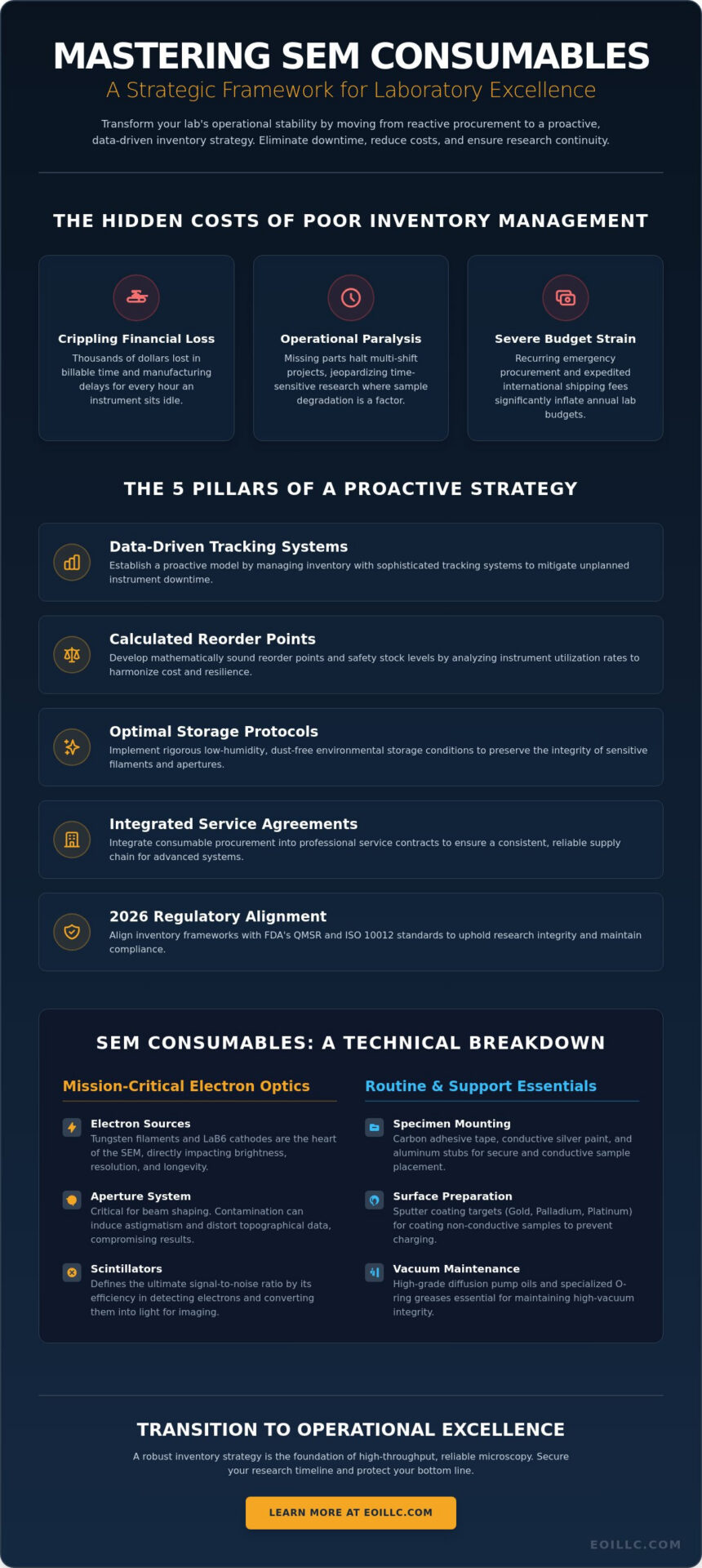
A sophisticated inventory model must distinguish between routine supplies and mission-critical electron optics components. Electron sources represent the most vital category; tungsten filaments are the standard for many applications, yet Lab6 cathodes offer superior brightness and longevity at the cost of stricter vacuum requirements. The health of the aperture system is equally paramount, as even minor carbon buildup can induce beam astigmatism and distort topographical data. Beyond the column, the scintillator’s efficiency in image detection defines the ultimate signal-to-noise ratio. Routine essentials that support these systems include:
- Specimen Mounting: Carbon adhesive tape, conductive silver paint, and aluminum stubs.
- Surface Preparation: Sputter coating targets composed of gold, palladium, or platinum.
- Vacuum Maintenance: High-grade diffusion pump oils and specialized greases for O-ring seals.
Effectively managing sem consumables inventory involves more than just keeping drawers full; it requires a predictive approach to component wear that anticipates the end-of-life for filaments before they fail mid-session.
The True Cost of Stockouts and Emergency Procurement
The financial implications of poor inventory foresight extend far beyond the purchase price of the parts themselves. When an instrument sits idle in an industrial failure analysis setting, the hourly cost can be staggering, often reaching thousands of dollars in lost billable time or manufacturing delays. Applying foundational inventory management principles to the microscopy suite helps mitigate these hidden expenses. Stockouts don’t just delay results; they can compromise the integrity of time-sensitive research projects where sample degradation is a factor.
Emergency procurement frequently necessitates expedited international shipping, which can inflate annual lab budgets by significant margins if it becomes a recurring necessity. Furthermore, the administrative burden of managing multiple emergency orders distracts technical staff from their primary research objectives. By transitioning to a structured procurement rhythm, labs ensure that systems like the Veritas Series remain operational, protecting both the research timeline and the bottom line.
Implementing Precision Tracking Systems for Microscopy Labs
The transition from reactive procurement to a proactive, data-centric model is a prerequisite for maintaining operational continuity in specialized industrial sectors. Relying on manual ledgers or decentralized spreadsheets often leads to catastrophic oversights, particularly in facilities housing multiple high-performance units such as the Veritas Series. Centralized tracking ensures that every filament, aperture, and stub is accounted for, creating a transparent audit trail that enhances institutional accountability. Successfully managing sem consumables inventory in 2026 requires this level of administrative rigor to meet the demands of high-throughput research environments. By establishing clear ownership of the inventory audit process, laboratories can eliminate the ambiguity that often leads to critical stockouts.
To achieve maximum precision, tracking systems must be synchronized with SEM operation logs. By correlating consumable depletion with actual beam hours, lab managers can refine their predictive models for filament longevity and vacuum pump maintenance. This integration allows for a sophisticated understanding of burn rates, transforming raw usage data into actionable procurement intelligence.
Digital Inventory Solutions vs. Manual Ledger Systems
Manual tracking systems are fundamentally ill-equipped for the complexities of modern industrial microscopy. They lack the real-time visibility required to manage fluctuating demand and are prone to human error during data entry. In contrast, adopting modern laboratory inventory management strategies through cloud-based platforms provides an instantaneous overview of stock levels across multiple locations. These digital solutions utilize standardized nomenclature to prevent the duplication of stock entries, ensuring that technical staff can identify the correct part for a Veritas Pro versus a Veritas Ultra without ambiguity. Automated alerts can be configured to trigger reorders before stock reaches critical thresholds, effectively insulating the lab from supply chain volatility.
Utilizing Barcoding and RFID for High-Value Components
The implementation of barcoding and RFID technology is essential for the management of high-value components, such as EDS detectors or specialized FEG emitters. Handheld scanning technology streamlines the check-out process, significantly reducing the labor hours dedicated to manual stock counts. This technological layer also facilitates a “First-In, First-Out” (FIFO) protocol, which is critical for maintaining the technical integrity of vacuum-sealed components and chemical reagents that may have finite shelf lives. For organizations looking to bridge the gap between inventory management and technical performance, integrating professional preventative maintenance visits provides a baseline for evaluating the accuracy of these tracking systems. This meticulousness ensures that every component used in the microscopy suite contributes to the highest standards of analytical accuracy.
Establishing Data-Driven Reorder Points and Safety Stock
Precision in managing sem consumables inventory requires a shift from intuitive replenishment to a rigorous mathematical framework. At the core of this strategy lies the optimization of reorder points, which must account for the delicate equilibrium between inventory carrying costs and the catastrophic financial impact of instrument downtime. A stagnant inventory of high-value apertures or field emission sources ties up capital that could be deployed elsewhere; however, the absence of these components during a critical research phase can result in institutional paralysis. By analyzing historical utilization data, lab managers can establish safety stock levels that act as a buffer against both internal demand spikes and external supply chain volatility.
Effective reorder points aren’t static. They require periodic calibration based on projected project volumes and seasonal shifts in laboratory throughput. For instance, a facility anticipating a surge in failure analysis contracts must adjust its procurement triggers semi-annually to ensure that consumable availability scales alongside operational demand. This data-driven approach ensures that the supply chain remains resilient without overextending the annual procurement budget.
Calculating Lead Times for Specialized Electron Optics Parts
Accurately predicting lead times is essential when dealing with specialized electron optics that often face manufacturer backlogs or require stringent vacuum-sealed shipping protocols. These components are not off-the-shelf commodities; they frequently involve complex international logistics and customs clearances that can extend delivery windows by several weeks. In the United States, the presence of a sole distributor for EmCraft systems plays a vital role in stabilizing these lead times, providing a more predictable procurement window for North American laboratories. Safety stock in the context of electron microscopy represents the minimum buffer of critical filaments maintained to insulate the laboratory against supply chain volatility and ensure 99% instrument uptime. Identifying these “long-lead” items early allows for a more strategic, semi-annual planning cycle that prevents emergency procurement crises.
The Impact of Instrument Utilization Rates on Consumable Burn
The rate at which a laboratory depletes its inventory is directly proportional to specific instrument parameters and sample preparation intensity. High-voltage settings and extended imaging sessions at high magnifications significantly accelerate filament degradation, necessitating more frequent replacements than standard low-vacuum operations. Laboratories must also correlate the frequency of sample preparation with the consumption of mounting media, such as aluminum stubs and carbon adhesives. By leveraging historical usage data, managers can accurately predict the future needs of systems like the Genesis Tabletop SEM, ensuring that reorder points reflect real-world burn rates rather than theoretical averages. This level of meticulousness transforms managing sem consumables inventory from a clerical task into a strategic pillar of laboratory performance.
Storage Best Practices for Sensitive SEM Components
The technical integrity of electron microscopy components is a fragile variable that extends far beyond the point of manufacture. Storing these parts requires more than organized shelving; it necessitates a controlled environment that isolates sensitive materials from atmospheric contaminants. Particulate ingress, moisture, and hydrocarbon outgassing are constant threats that can degrade a filament or contaminate an aperture before it ever enters the vacuum column. Successfully managing sem consumables inventory in 2026 demands a rigorous approach to environmental preservation that mirrors the meticulousness of the imaging process itself. By maintaining a dust-free and low-humidity storage architecture, laboratories protect their investment and ensure that every replacement part performs to its original engineering specifications.
Security protocols are equally vital, particularly for facilities utilizing high-value precious metal sputter targets. Gold, palladium, and platinum discs represent significant capital assets and must be stored in secure, climate-controlled environments to prevent both physical loss and surface oxidation. Transitioning these parts from storage to installation requires a clean-room mindset to avoid the transfer of skin oils or ambient dust, which could otherwise lead to catastrophic vacuum failures or image artifacts.
Mitigating Contamination and Degradation
Long-term storage of filaments and apertures should be restricted to desiccators or specialized vacuum cabinets. These units act as a primary defense against humidity, which can lead to the oxidation of tungsten or the degradation of hygroscopic sample mounting media. Vacuum pump oils require similar attention; improper storage in unsealed containers can lead to hydrocarbon contamination, which eventually migrates into the SEM column and reduces the signal-to-noise ratio. To maintain the highest standards of analytical accuracy, conductive coatings and adhesives must be kept in their original, airtight packaging until the moment of application. If you need to restock your supply of high-purity components, you can browse our full catalog of SEM filaments and consumables to ensure your lab remains operational.
Organizing the Lab for Workflow Efficiency and Traceability
A well-organized consumables station should be designed to mirror the actual SEM maintenance workflow. This spatial alignment reduces the time technicians spend searching for parts and minimizes the duration the vacuum chamber remains open to atmosphere. Labeling protocols must clearly distinguish between open and sealed containers to prevent cross-contamination between different material grades. Many high-throughput labs now utilize “Ready-to-Use” kits for common preventative maintenance tasks, containing a pre-measured set of filaments, apertures, and O-rings. This modular approach to managing sem consumables inventory improves traceability and ensures that every maintenance event is performed with fresh, verified components, thereby maximizing instrument longevity and research throughput.
Integrating Inventory Management with Professional Service Contracts
The implementation of internal frameworks, such as the digital tracking and environmental storage protocols discussed in previous sections, provides a robust foundation for operational stability. However, the ultimate optimization of managing sem consumables inventory is achieved through the formal integration of professional service contracts. These agreements transcend traditional procurement models, creating a streamlined channel that aligns with the specific technical requirements of high-performance systems like the Cube II and Veritas units. By leveraging over 30 years of specialized industry experience, laboratories can offload the administrative complexities of supply chain management to experts who possess a visionary understanding of the intersection between hardware performance and component longevity.
This integrated approach minimizes the logistical friction that often complicates high-throughput research environments. It ensures that the procurement process is not an isolated administrative task but a technical function synchronized with the instrument’s lifecycle. By delegating these responsibilities to a reliable partner, lab managers can focus on primary research objectives while maintaining the highest standards of meticulousness in their hardware support systems.
The Synergy Between Preventive Maintenance and Consumable Supply
A primary advantage of these structured service agreements is the synchronization of part replacement with scheduled maintenance visits. This strategic alignment significantly reduces total downtime by ensuring that critical components, such as filaments or apertures, are replaced before they reach a point of failure. Field service engineers play a vital role in this ecosystem; they conduct meticulous on-site audits of consumable stock during every visit to verify that safety stock levels remain sufficient for projected workloads. These contracts also offer priority access to rare or high-demand components, providing a critical layer of protection against global supply chain volatility that could otherwise stall research throughput.
Leveraging Expert Partnerships for Optimized Lab Performance
Transitioning from a standard vendor-client relationship to a strategic technical partnership allows laboratories to utilize on-site technical training as a catalyst for operational growth. When laboratory personnel are educated on the nuances of efficient consumable usage, the overall burn rate of filaments and mounting media is optimized, leading to a more sustainable and cost-effective inventory model. This expert-led approach ensures that the supply chain serves as a proactive contributor to instrument health rather than a mere reactive function. For facilities dedicated to maintaining the highest standards of research integrity and analytical accuracy, the final recommendation is to align your inventory strategy with long-term instrument health through professional SEM service contracts. This holistic integration ensures that technical requirements are met with global capability and rigorous precision.
Advancing Laboratory Resilience Through Strategic Procurement
The advancement of industrial microscopy necessitates a transition from reactive logistics to a sophisticated framework that prioritizes precision and predictive analysis. By implementing data-driven reorder points and rigorous environmental storage protocols, laboratories can effectively insulate their operations from the volatility of global supply chains. Successfully managing sem consumables inventory is a technical necessity that ensures the analytical accuracy of every imaging session while eliminating the hidden costs of unplanned downtime. It’s a foundational requirement for any facility committed to maintaining the highest standards of research integrity.
Optimizing laboratory performance requires aligning these internal processes with a strategic technical partner. Leveraging over 30 years of electron microscopy expertise and our position as the sole US distributor for EmCraft SEMs, we offer comprehensive service for all major SEM manufacturers. Our expert-led maintenance programs ensure that your supply chain remains as resilient as your hardware, allowing your team to focus on technical breakthroughs rather than administrative hurdles.
Explore Professional SEM Service and Consumable Support to secure the long-term stability and research throughput of your microscopy suite. Establishing a seamless, expert-managed supply chain is a vital step in mastering the operational realities of modern industrial research.
Frequently Asked Questions
How often should I audit my SEM consumables inventory?
Laboratories operating high-throughput industrial schedules should conduct physical audits on a monthly basis to reconcile digital logs with actual stock. For facilities with lower utilization rates, a quarterly audit cycle is typically sufficient to identify discrepancies before they escalate into procurement crises. Regular reconciliation ensures that your tracking systems remain accurate and prevents the administrative oversights that lead to emergency shipping requirements.
What are the most common SEM consumables that cause unplanned downtime?
Tungsten filaments and final apertures are the most frequent causes of unexpected instrument idling due to their finite operational lifespans and sensitivity to contamination. While filaments eventually reach a burn-out point, apertures can accumulate carbon buildup that induces beam astigmatism. Maintaining a precise buffer of these specific electron optics components is essential for sustaining the analytical accuracy of your research workflows.
Can I use third-party filaments in my Cube II or Veritas SEM?
While third-party filaments are often physically compatible, utilizing OEM-certified filaments is the only way to guarantee the beam stability and centering precision required for high-resolution imaging. Third-party components may exhibit variations in wire gauge or mounting alignment, which can compromise the resolution of the Veritas Series. Sticking to verified parts ensures that your system operates within its original engineering specifications.
How do I calculate the ideal safety stock level for SEM apertures?
You can determine the ideal safety stock level by multiplying your average monthly consumption rate by the maximum lead time in months, then adding a 20% buffer for surge projects. This data-driven method for managing sem consumables inventory provides a mathematical safeguard against supply chain volatility. It’s a proactive strategy that balances the cost of carrying inventory against the risk of catastrophic instrument downtime.
What are the environmental storage requirements for tungsten filaments?
Tungsten filaments must be stored in a desiccated, dust-free environment to prevent surface oxidation and the accumulation of atmospheric particulates. Utilizing vacuum cabinets or sealed desiccators with active moisture indicators is the standard for preserving the technical integrity of these sensitive components. Proper storage ensures that the filament performs reliably from the moment of installation, protecting the signal-to-noise ratio of your imaging.
Does an SEM service contract typically include consumables?
Standard service contracts generally cover labor and mechanical components but exclude routine consumables such as filaments, stubs, and adhesives. However, many laboratories opt for premium, comprehensive agreements that integrate consumable supply into the service schedule to simplify procurement. These tailored partnerships can reduce the administrative burden of managing sem consumables inventory by delegating replenishment to your service provider.
How can I track consumable usage across multiple lab shifts effectively?
The most effective method for tracking usage across multiple shifts is the implementation of a centralized digital checkout system that requires unique user IDs. This creates a transparent audit trail that correlates consumable depletion with specific research projects and beam hours. Standardizing the nomenclature for all parts within this system eliminates the risk of technical staff selecting incorrect components during late-night or weekend operations.
What is the shelf life of SEM vacuum pump oil?
Unopened vacuum pump oil maintains its technical integrity for approximately two to three years when stored in a cool, climate-controlled environment. Once a container is opened, the oil becomes susceptible to moisture absorption and hydrocarbon degradation, which can compromise vacuum performance. It’s advisable to use opened oil within six to twelve months to ensure that your vacuum system remains free from contaminants that could affect imaging quality.