

Relying on optical microscopy for modern industrial quality control is no longer a sustainable strategy when sub-micron defects remain invisible to traditional lenses. You’re likely aware that the high costs and logistical delays inherent in outsourced failure analysis create significant friction in your production lifecycle. It’s clear that the complexity of legacy floor-standing systems often demands specialized operators and infrastructure that don’t align with the need for agile, in-house solutions. Precision is no longer optional. This professional guide provides the technical framework to evaluate and integrate a tabletop sem for quality control to achieve unprecedented precision in your industrial workflows.
You’ll discover how the latest 2026 innovations, including the Cube II Benchtop SEM and integrated EDS systems, allow for rapid root cause analysis and elemental characterization without the burden of a massive laboratory footprint. We’ll examine the evolutionary shift from simple observation to automated microstructural analysis, ensuring your quality standards meet the rigorous demands of global manufacturing excellence. By analyzing current market trends, including the $0.22 billion global market valuation and the projected 6.3% CAGR through 2035, we’ll outline how to secure a system that provides a definitive return on investment while maintaining the technical authority your sector demands.
Key Takeaways
- Understand why modern industrial standards necessitate a shift from optical limitations to the high-precision capabilities of a tabletop sem for quality control.
- Learn to prioritize effective resolution and optimized accelerating voltage over raw magnification to ensure sub-micron defects don’t compromise your production integrity.
- Evaluate the strategic balance between capital expenditure and operational ease to determine if a compact benchtop system or a traditional floor-standing unit fits your laboratory’s specific throughput requirements.
- Identify the essential components of a successful SEM integration, from establishing standardized operating procedures to securing specialized on-site training for your technical staff.
- Explore how purpose-built solutions like the Cube II and Genesis models offer the technical authority required to maintain a competitive advantage in global manufacturing.
The Evolutionary Shift: Why Quality Control is Moving to Tabletop SEM
The transition toward compact, high-precision instrumentation represents a critical advancement in global manufacturing standards. As industrial tolerances tighten, the adoption of a tabletop sem for quality control has become an operational necessity rather than a luxury. Traditional floor-standing units, while powerful, often impose prohibitive infrastructure requirements and high total cost of ownership. By contrast, modern benchtop solutions provide an evolutionary leap in accessibility, allowing engineers in the semiconductor, polymer, and metallurgy sectors to conduct sophisticated failure analysis directly on the production floor. This synergy of compact design and high-resolution imaging accelerates the production cycle, ensuring that quality benchmarks are met with rigorous accuracy. It’s a move toward decentralized expertise where precision is integrated into every stage of the supply chain.
Beyond the Optical Limit
The fundamental limitation of light-based inspection lies in the physics of the visible spectrum. Optical systems are constrained by the Abbe diffraction limit, which prevents the resolution of features smaller than approximately 200 nanometers. In the current manufacturing landscape, where sub-micron defects can lead to catastrophic system failures, this threshold is insufficient. A Scanning Electron Microscope (SEM) bypasses these constraints by utilizing electron beams with wavelengths significantly shorter than visible light. This allows for a depth of field and a level of detail that optical alternatives cannot replicate. Understanding the fundamental principles of scanning electron microscopy is essential for technical teams transitioning from traditional microscopy to electron-based inspection. By 2026, sub-micron defect detection has emerged as the global baseline, making the precision of electron optics a cornerstone of industrial excellence.
Operational Efficiency and Lab Footprint
One of the most significant advantages of modern tabletop systems is their streamlined operational profile. Unlike legacy systems that require dedicated facilities with specialized vibration isolation floors and liquid nitrogen cooling, tabletop units utilize integrated “plug-and-play” vacuum systems. This architectural efficiency reduces the laboratory footprint by up to 80% compared to floor-standing models. The reduction in sample preparation time is equally impactful. Automated stages and intuitive software interfaces allow QC technicians to perform rapid-fire inspections, moving from sample loading to high-resolution imaging in under three minutes. This technical agility eliminates the bottleneck of outsourced lab work, empowering facilities to maintain a steady, deliberate flow of verified components. By integrating these systems, companies achieve a sustainable balance between high-end quality and practical manufacturing realities. It’s about maintaining a high degree of technical authority while optimizing the physical space of the manufacturing environment.
Critical Specifications for Quality Control Benchmarking
Evaluating a tabletop sem for quality control requires a shift in focus from vanity metrics like maximum magnification to functional parameters that dictate real-world performance. While many manufacturers highlight magnification levels exceeding 100,000x, it’s the effective resolution that determines whether a technician can distinguish a sub-micron fracture from a surface artifact. In 2026, high-performance benchtop units typically achieve a resolution of 5nm to 10nm, providing the clarity necessary for rigorous failure analysis. Accelerating voltage, ranging from 1kV to 30kV, also plays a decisive role in imaging success. Lower voltages are essential for observing delicate surface topographies without damaging heat-sensitive samples, while higher voltages provide the electron penetration required for deep-tissue analysis and elemental detection.
The choice between Secondary Electron (SE) and Backscattered Electron (BSE) detectors depends entirely on your specific inspection goals. SE detectors excel at revealing topographical detail, making them ideal for examining surface roughness or mechanical wear. Conversely, BSE detectors provide compositional contrast based on atomic number, allowing operators to instantly identify heavy metal inclusions or material inconsistencies within a polymer matrix. To meet high-throughput demands, modern systems now incorporate automated batch inspection software. These tools allow for the pre-programming of coordinate-based routines, ensuring that repetitive quality checks remain consistent across multiple shifts. Facilities looking to optimize their analytical throughput often find that integrated EDS solutions provide the necessary data density without the complexity of separate workstations.
Integrating EDS for Elemental Analysis
Energy Dispersive Spectroscopy (EDS) has transitioned from a specialized research tool to a non-negotiable component of industrial quality control. It’s no longer enough to see a contaminant; you must identify its chemical signature to isolate the root cause of a production failure. Integrated EDS systems are generally preferred over third-party add-ons for tabletop platforms because they offer a unified software environment, reducing the training burden on QC staff. EDS integration transforms the SEM from a visual inspection tool into a comprehensive analytical platform by enabling real-time purity verification and phase identification within established QC workflows. This capability ensures that material certifications are backed by empirical, elemental data.
Vacuum Modes and Sample Compatibility
The versatility of a tabletop SEM is often defined by its vacuum management system. High-vacuum modes are the standard for conductive samples, providing the cleanest imaging environment for metallurgy and semiconductor inspection. However, many modern materials, such as polymers or biological components, tend to outgas or accumulate charge under a standard electron beam. Variable pressure or low-vacuum modes mitigate these issues by introducing a controlled amount of gas into the chamber, which neutralizes charge buildup and allows for the inspection of non-conductive samples without the need for gold or carbon coating. This flexibility ensures that the electron optics system remains stable and precise across a diverse range of industrial materials, maintaining the integrity of your quality data regardless of the sample’s electrical properties.
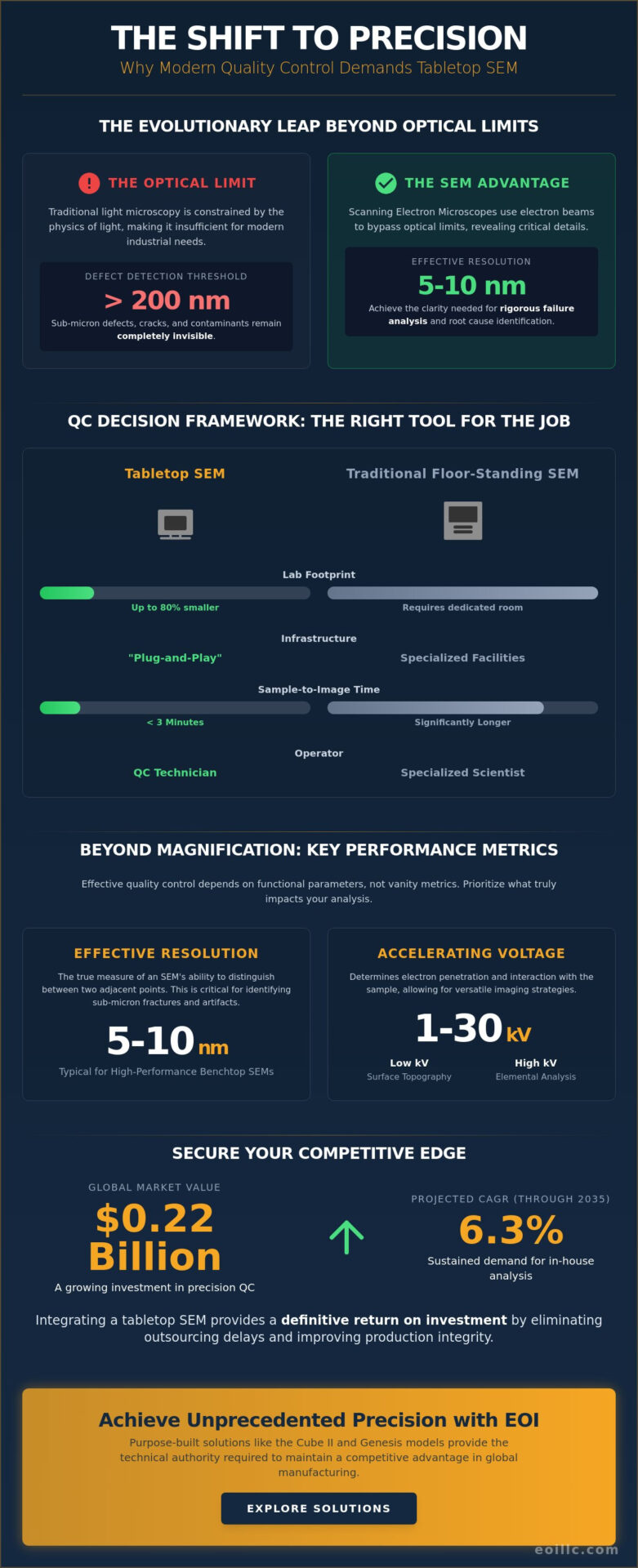
Tabletop vs. Floor-Standing SEM: A QC Decision Framework
Deciding on the appropriate SEM architecture necessitates a methodical evaluation of organizational goals and technical requirements. While floor-standing models offer unparalleled imaging power, the high capital expenditure and specialized infrastructure they demand often create barriers to rapid industrial integration. In contrast, the tabletop sem for quality control provides a more agile alternative, delivering the precision required for the vast majority of routine industrial inspections at a fraction of the total investment. This framework focuses on the synergy between technical capability and fiscal responsibility, ensuring that your laboratory’s evolution aligns with global manufacturing standards without sacrificing imaging excellence.
Ease of use remains a primary differentiator in the modern QC environment. Traditional systems frequently require dedicated PhD-level operators to manage complex alignment and vacuum sequences, which can bottleneck production. Tabletop units, however, are engineered with intuitive software interfaces that empower technicians to perform high-throughput batch inspections with minimal supervision. Maintenance costs also diverge significantly; benchtop systems typically utilize pre-aligned filaments and simplified aperture assemblies, reducing the frequency and complexity of service interventions. This reliability is vital for maintaining consistent production cycles without the delays inherent in outsourced failure analysis, which often takes weeks to return actionable data.
Calculating the Total Cost of Ownership (TCO)
A comprehensive analysis must extend beyond the initial purchase price to include installation, staff training, and recurring preventative maintenance visits. When you compare the cost of internalizing these capabilities against the escalating fees and slow turnaround times of third-party laboratories, the return on investment becomes clear. It’s essential to factor in the long-term savings associated with faster root cause analysis and reduced waste. For a detailed breakdown of these variables, consult the 2026 electron microscope price guide to ensure your budget accounts for both CAPEX and the operational expenses required for sustained precision.
Performance Thresholds for Industrial QC
Identifying the performance “sweet spot” is critical for technical future-proofing. For most polymer, metallurgy, and semiconductor applications, resolution requirements between 5nm and 15nm are perfectly served by tabletop platforms. It’s only when your research demands sub-2nm resolution or extreme low-voltage imaging of beam-sensitive materials that a floor-standing Field Emission SEM (FE-SEM) becomes mandatory. Many facilities choose to augment their tabletop systems with modular upgrades, such as 3D visualization software or integrated EDS detectors, to extend the analytical reach of their equipment as their quality standards evolve. This modular approach ensures that your laboratory remains at the intersection of innovation and reliability.
Strategic Implementation: Integrating SEM into Quality Workflows
The successful deployment of a tabletop sem for quality control necessitates a transition from procurement to a structured framework of operational integration. Designing a robust Standard Operating Procedure (SOP) ensures that imaging results remain consistent across various shifts and diverse operator skill levels. These protocols must define precise sample preparation steps, vacuum stabilization durations, and specific detector configurations for different material classes to maintain data integrity. Professional on-site training acts as the catalyst for this consistency, transforming a sophisticated instrument into a reliable industrial asset. Beyond daily use, organizations must account for the entire equipment lifecycle, including the complex requirements of decommissioning or relocation. Because electron optics are exceptionally sensitive to magnetic fields and mechanical vibrations, professional handling is mandatory to prevent misalignment or permanent damage during facility changes.
Achieving 99% uptime in a high-throughput production environment requires more than just high-quality hardware; it demands a proactive maintenance strategy. Regular preventative maintenance visits are essential to verify column alignment, clean apertures, and replace filaments before they reach their failure threshold. This methodical approach to equipment health minimizes the risk of catastrophic downtime that could stall a global manufacturing line. By prioritizing these strategic elements, businesses ensure that their investment in precision technology translates into sustained industrial excellence and reliable failure analysis.
Training and Skills Development
Advancing from basic instrument operation to expert-level failure analysis requires a structured curriculum that evolves with your technical needs. While automated software interfaces in 2026 significantly reduce operator error by handling complex vacuum and focus sequences, human expertise remains vital for interpreting subtle microstructural anomalies. Investing in professional SEM operation training ensures that your technical staff can leverage advanced imaging techniques for rapid root cause analysis. This proficiency is the baseline for long-term accuracy and ensures that your tabletop sem for quality control provides the highest possible return on investment through superior data density.
The Role of Service Contracts
For high-volume quality control laboratories, annual service agreements are a strategic necessity to mitigate operational risk. A comprehensive contract should prioritize rapid response times and immediate parts availability to ensure that production schedules remain uninterrupted. It’s vital to partner with a provider that possesses the technical depth to manage multi-vendor environments. EOI LLC maintains a unique position in the market by offering the expertise to service and calibrate scanning electron microscopes from all major manufacturers. This global capability provides a single point of accountability for your entire analytical suite, reinforcing the synergy between industrial performance and technical reliability.
The EOI LLC Advantage: Precision Solutions for Industrial Excellence
EOI LLC maintains a position of leadership in the optical and automotive technology sectors, a status solidified by a 30-year legacy as the exclusive US distributor for EmCraft. This enduring partnership allows us to offer a level of technical depth and supply chain excellence that generic manufacturers cannot replicate. Selecting a tabletop sem for quality control from our curated selection means integrating a system backed by decades of engineering expertise and a visionary approach to industrial innovation. We provide a comprehensive support structure that encompasses everything from initial capital sales to specialized hourly field service and complex optical repairs. This holistic commitment ensures that your facility achieves a sustainable balance between high-performance imaging and operational reliability. Our internal processes are as rigorous as the technologies we distribute, ensuring that every integration meets the highest global standards.
Cube II: Optimized for Throughput
The Cube II Benchtop SEM represents the premier choice for organizations requiring rapid-fire quality checks without sacrificing imaging precision. Its architecture is defined by exceptionally fast vacuum cycles and an intuitive software interface that streamlines the transition from sample loading to data acquisition. These features are particularly vital in semiconductor failure analysis and metallurgical purity testing, where production timelines demand immediate, actionable insights. The system eliminates the bottlenecks common in traditional microscopy, allowing for high-resolution verification in a fraction of the time. To understand the technical specifications that drive this performance, consult the Cube II features and specifications guide for a detailed analysis of its evolutionary capabilities. It’s a tool designed for the precision-minded professional who values efficiency and accuracy.
Genesis: Versatile Analytical Power
The Genesis Tabletop SEM serves as a versatile workhorse for multi-user facilities that require high-resolution imaging within a compact frame. Its design prioritizes flexibility, allowing for the seamless integration of advanced EDS detectors to facilitate real-time elemental characterization. This synergy between hardware and analytical software ensures that your quality control workflows remain rigorous and data-dense. Whether your team is investigating polymer inconsistencies or complex alloy microstructures, the Genesis series provides the technical stability necessary for sustained industrial excellence. It maintains a respectful distance from consumer-grade alternatives by offering a conventional SEM experience in a significantly reduced footprint. Consult with an EOI LLC specialist today to determine the ideal SEM for your QC lab and ensure your quality standards meet the demands of 2026 and beyond. Our experts are prepared to assist in selecting the configuration that best aligns with your specific manufacturing realities.
Advancing Industrial Standards through Electron Optics
Integrating a tabletop sem for quality control represents a decisive shift toward decentralized precision in global manufacturing. By transitioning from the resolution limits of light-based systems to the sub-nanometer accuracy of electron microscopy, your facility gains the ability to identify critical failure points in real-time. This guide has detailed the technical specifications and operational frameworks required to maintain high uptime through professional training and preventative maintenance protocols. Success in 2026 demands a methodical approach to both imaging and elemental analysis that aligns with your specific production realities.
As the sole US distributor for EmCraft Scanning Electron Microscopes, EOI LLC brings over 30 years of electron microscopy expertise to your laboratory. Our technical authority extends beyond equipment sales, encompassing comprehensive service and repair capabilities for all major SEM manufacturers to ensure your analytical suite remains operational. This synergy between innovative hardware and reliable field support provides the stability necessary for sustained industrial excellence. It’s a commitment to precision that we’ve maintained for three decades.
Request a Technical Consultation or Virtual Demo of our Tabletop SEM Solutions to secure your competitive advantage. We look forward to supporting your commitment to excellence.
Frequently Asked Questions
What is the difference between a benchtop and a tabletop SEM?
These terms are largely synonymous in modern industrial nomenclature, referring to compact scanning electron microscopes designed for installation on standard laboratory work surfaces. Both categories, including systems like the Cube II, provide conventional SEM capabilities within a footprint that is approximately 70% smaller than legacy floor-standing units. This evolutionary design allows for high-precision imaging to be integrated directly into production environments rather than being confined to dedicated microscopy suites.
Can a tabletop SEM perform EDS elemental analysis for quality control?
Yes, modern tabletop systems are frequently equipped with integrated Energy Dispersive Spectroscopy (EDS) detectors to facilitate rapid chemical characterization. This capability allows a tabletop sem for quality control to identify contaminants or verify alloy compositions by detecting characteristic X-rays emitted from the sample. In 2026, EDS integration has become a standard requirement for 85% of industrial failure analysis workflows, ensuring that material certifications are backed by empirical data.
How much space is required to install a tabletop SEM in a QC lab?
A typical installation requires approximately 1.5 to 2 square meters of stable bench space to accommodate the microscope, computer workstation, and vacuum pump. Unlike floor-standing models that require dedicated rooms with specialized cooling and vibration isolation, these units operate on standard 110V or 220V power outlets. The compact architecture ensures that high-precision imaging can be integrated into existing production environments without the need for costly facility modifications.
Is sample preparation more difficult for tabletop SEMs compared to optical microscopes?
Sample preparation for SEM is more involved than optical microscopy but has been significantly streamlined by 2026 technology. Conductive samples require minimal preparation, while non-conductive materials may need a thin carbon or gold coating to prevent charging, a process that typically takes less than 5 minutes using modern sputter coaters. Variable pressure modes in systems like the Genesis series further reduce this burden by allowing the inspection of uncoated samples in their natural state.
What is the typical lifespan of a tabletop SEM filament in a high-volume QC environment?
A standard tungsten filament typically provides between 100 and 200 hours of active beam time before requiring replacement. In a high-volume quality control setting operating 40 hours per week, this usually translates to a replacement interval of every 3 to 5 weeks. Modern pre-aligned filament cartridges allow technicians to complete this exchange in under 15 minutes, ensuring that the production cycle remains steady and deliberate without significant downtime.
Do I need a cleanroom to operate a tabletop scanning electron microscope?
A dedicated cleanroom is not a prerequisite for operating a tabletop SEM, although a clean, low-dust laboratory environment is highly recommended for optimal performance. The internal vacuum system protects the electron optics from atmospheric contaminants during operation. Maintaining a controlled environment with stable temperatures helps ensure that the 5nm to 10nm resolution remains consistent throughout high-precision industrial inspections, reflecting the brand’s commitment to reliability and excellence.
Can tabletop SEMs be used for automated particle counting and sizing?
Sophisticated software modules enable the tabletop sem for quality control to perform automated particle analysis, including counting, sizing, and morphological characterization. These automated routines can analyze thousands of particles in a single batch, providing statistically significant data for cleanliness verification in the automotive and aerospace sectors. This automation reduces human error and ensures that QC reports meet the rigorous ISO 16232 standards required for global manufacturing excellence.
What are the typical maintenance requirements for a tabletop SEM?
Maintenance involves a combination of routine operator tasks and professional preventative maintenance visits. Operators must regularly clean the sample chamber and replace filaments or apertures as they degrade through normal use. Professional service, conducted at least once every 12 months, is essential to calibrate the electron column and verify vacuum integrity. These rigorous processes ensure that the system maintains its technical authority and imaging precision over a typical 10-year operational lifespan.