
What if the primary constraint on your laboratory’s analytical throughput in 2026 isn’t the inherent limitations of your hardware, but the subtle, cumulative degradation of vacuum integrity and electron optics? For laboratory managers overseeing sophisticated systems such as the Veritas Series or Cube II benchtop SEM, the reality of costly downtime during critical research phases is a persistent concern that threatens both project timelines and fundamental data integrity. You recognize that maintaining sub-nanometer resolution requires more than periodic calibration; it demands a rigorous adherence to a technical framework that treats the instrument as a single, integrated ecosystem. This guide introduces a definitive sem maintenance checklist, providing the structured protocols necessary to mitigate image artifacts caused by contamination and prevent the high repair costs associated with neglected care.
By implementing this multi-tiered strategy for daily and monthly instrument care, your facility can achieve a measurable extension in the operational lifespan of filaments and vacuum pumps. We’ll explore the intersection of precision engineering and proactive maintenance, detailing specific procedures for cleaning apertures and monitoring column pressure to ensure peak analytical accuracy. This methodology serves as a roadmap for transforming reactive repair cycles into a predictive model that secures the long-term reliability of your advanced imaging systems.
Key Takeaways
- Understand how a systematic approach to cleaning and calibrating electron optics prevents catastrophic hardware failure and maintains sub-nanometer resolution.
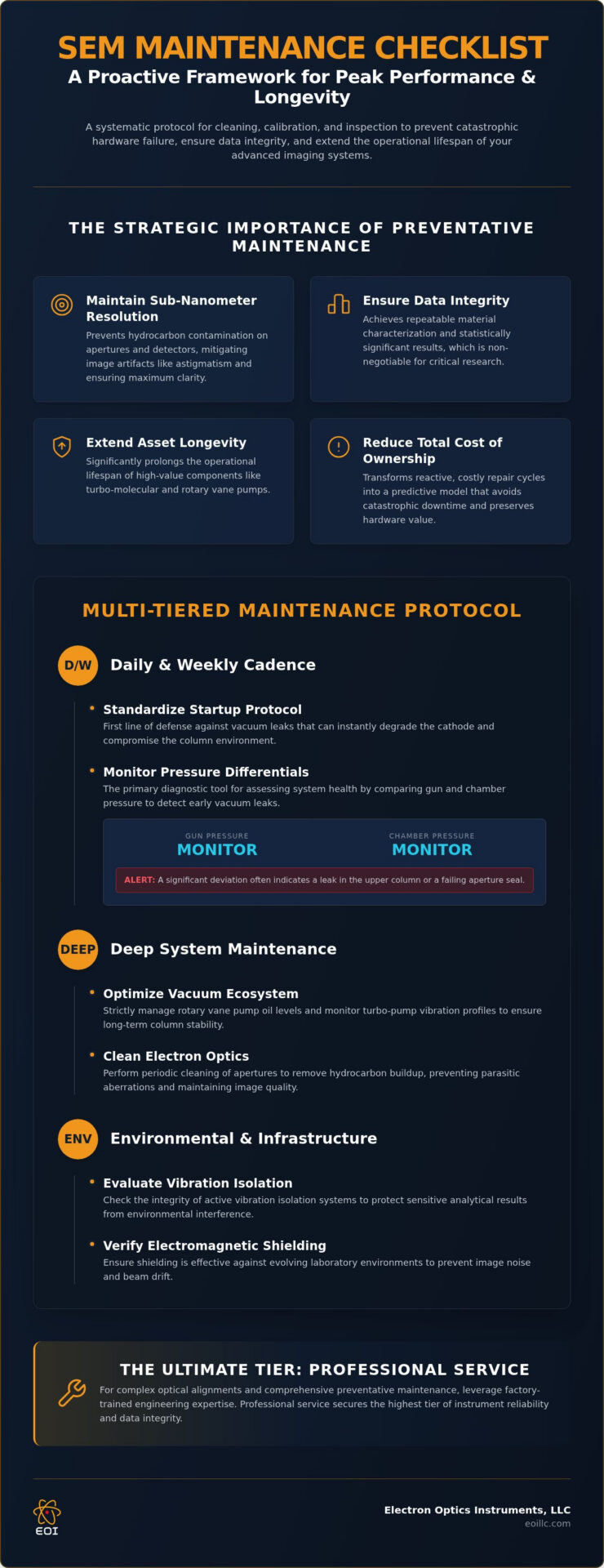
- Implement a standardized sem maintenance checklist that focuses on daily startup protocols and the critical monitoring of gun versus chamber pressure differentials to detect early vacuum leaks.
- Optimize the vacuum ecosystem by strictly managing rotary vane pump oil levels and monitoring turbo-pump vibration profiles to ensure the long-term stability of the column.
- Evaluate the integrity of active vibration isolation systems and electromagnetic shielding to protect sensitive analytical results from evolving laboratory environmental interference.
- Leverage factory-trained engineering expertise for complex optical alignments and preventative maintenance visits to secure the highest tier of instrument reliability and data integrity.
The Strategic Importance of SEM Preventative Maintenance
Preventative maintenance (PM) represents a rigorous, systematic protocol for the cleaning, calibration, and inspection of electron optics to prevent catastrophic hardware failure. Within the technical architecture of a Scanning Electron Microscope (SEM), these procedures ensure that the delicate balance between the electron source and the detection system remains optimized. Neglecting a routine sem maintenance checklist often leads to the accumulation of hydrocarbon contamination on apertures and detectors. This buildup introduces parasitic aberrations, specifically astigmatism and chromatic aberration, which degrade the clarity of high-magnification topography and limit the instrument’s ultimate resolution capabilities.
For laboratory managers, data integrity acts as the primary anchor for all research and development activities. A well-maintained instrument is non-negotiable for achieving repeatable material characterization and statistically significant analytical results across multiple sample sets. From an economic perspective, the rationale for proactive care is definitive. While a routine preventative maintenance visit requires a scheduled window of downtime, it’s negligible when compared to the catastrophic loss of a week’s production or the invalidation of a critical research phase due to instrument instability. Consistent technical oversight transforms the SEM from a potential point of failure into a reliable asset for high-precision metrology.
Image Quality as a Metric for Instrument Health
Early warning signs of electronic or vacuum instability often manifest as increased image noise or beam drift. These artifacts suggest that the internal environment of the column is no longer pristine, often due to outgassing from contaminated samples or degraded vacuum seals. High-resolution imaging, particularly at low accelerating voltages (kV), relies heavily on the synergy between column cleanliness and precise alignment. In this context, the signal-to-noise ratio in SEM maintenance is defined as the magnitude of the desired electronic signal relative to the background electronic interference that obscures image detail. Monitoring these metrics allows operators to identify vacuum leaks or electronic fluctuations before they compromise the integrity of the data.
Asset Longevity and Total Cost of Ownership
Consistent adherence to a technical service schedule significantly extends the operational lifespan of high-vacuum components, including turbo-molecular pumps and rotary vane systems. Adopting a comprehensive sem maintenance checklist ensures that these high-value components operate within their designed tolerances, preventing the premature wear of bearings and seals. Meticulous care also preserves the long-term value of the hardware, which is particularly relevant when considering the resale potential of refurbished SEM units in a competitive secondary market. Understanding these factors is essential for Calculating the Total Cost of Ownership for an SEM over its entire lifecycle, ensuring that the investment remains productive well into the future.
Routine SEM Maintenance Checklist: Daily and Weekly Cadence
Precision imaging in 2026 requires more than advanced hardware; it demands a consistent operational rhythm. Standardizing the startup protocol is the first line of defense against vacuum leaks that can instantly degrade a cathode. By integrating a detailed sem maintenance checklist into daily laboratory operations, technicians can identify subtle pressure fluctuations before they lead to catastrophic filament oxidation. This proactive approach ensures that the instrument remains in a state of constant readiness for high-resolution analysis.
Monitoring the delta between “gun pressure” and “chamber pressure” serves as a primary diagnostic tool for assessing system health. In high-performance systems like the Veritas Series, a deviation in gun pressure often indicates a leak in the upper column or an aging aperture seal, while chamber pressure issues usually stem from sample outgassing or door seal contamination. Maintaining a log of these values allows for the identification of trends that precede hardware failure. For laboratories requiring high-volume throughput, securing a steady supply of SEM filaments and consumables ensures that routine replacements don’t become logistical bottlenecks during critical research phases.
Implementing a “Golden Sample” test—using a known reference standard—allows for the daily verification of resolution, contrast, and stigmator efficiency. This benchmark provides an objective measure of instrument performance, independent of varying sample characteristics. Simultaneously, documenting filament hours is essential for predictive maintenance. This data enables managers to schedule replacements during planned downtime, rather than reacting to a sudden burnout that could compromise an active experiment or production run.
Daily Operator Checklist for Peak Performance
The daily workflow should begin with verifying vacuum levels and monitoring pump-down times. For the Cube II Benchtop SEM, any extension beyond the established baseline suggests a compromised seal or a saturated pre-pump. Operators must also inspect the final aperture for visible contamination or scorching, as these defects are the primary cause of beam instability and image artifacts. Finally, confirming the stability of the electron beam at various accelerating voltages ensures that the high-voltage power supply and alignment coils are functioning within their specified tolerances.
Weekly System Inspections and Housekeeping
Weekly tasks focus on the peripheral systems that support the electron column and ensure long-term stability. Technicians should check cooling system fluid levels and clean airflow filters, which is especially vital for compact units where thermal management directly impacts electronic drift. Reviewing digital logs for recurring error codes or unexpected software resets can reveal underlying power supply fluctuations or communication errors. Finally, a thorough cleaning of the sample exchange chamber prevents cross-contamination, protecting the sensitive detectors and the integrity of delicate specimens from hydrocarbon buildup.
Deep System Maintenance: Vacuum and Electron Optics
Deep system maintenance represents the transition from operational oversight to technical preservation. While daily checks ensure immediate readiness, the long-term reliability of a Scanning Electron Microscope depends on the integrity of its vacuum ecosystem and electron-optical column. This tier of care focuses on the mechanical and physical variables that, if left unaddressed, lead to subtle performance decay and eventual hardware failure. For a comprehensive understanding of these technical requirements, consult The Definitive Guide to SEM Maintenance.
The vacuum ecosystem requires periodic assessment of rotary vane pumps, specifically regarding oil contamination levels and the vibration profiles of turbo-molecular pumps. If a turbo-pump exhibits unusual acoustic signatures or increased vibration, it often signals bearing wear that can introduce mechanical noise into high-magnification images. Simultaneously, column maintenance involves the delicate process of cleaning or replacing final apertures to eliminate hydrocarbon buildup. This is a critical step in any robust sem maintenance checklist, as even microscopic debris can cause beam deflection and severe astigmatism. Integrating these deep-system checks into your laboratory protocol ensures that the instrument’s resolution remains within factory specifications.
Filament management is equally vital, requiring distinct protocols for Tungsten and CeB6 (Cerium Hexaboride) cathodes. Tungsten filaments demand careful monitoring of saturation points to prevent premature thinning, while CeB6 sources require precise temperature control to maximize their superior brightness and extended operational life. Meticulous cathode care directly impacts the signal-to-noise ratio and the overall stability of the analytical environment.
Vacuum Integrity and Leak Detection
Identifying O-ring degradation in the specimen chamber is essential, as hardened or cracked seals are frequent sources of atmospheric leaks. These leaks are often exacerbated by “outgassing” samples, which are materials that release volatile compounds under vacuum; this process can saturate the pump system and contaminate the sensitive electron-optical column. In a benchtop SEM, the turbo-molecular pump functions as a high-speed kinetic vacuum pump that utilizes rapidly rotating blades to exhaust gas molecules from the chamber, achieving the high-vacuum environment required for electron beam propagation.
Optimizing Electron Gun Performance
Proper alignment of the electron gun is necessary to maximize beam brightness and minimize spherical aberrations that blur image detail. Technicians should look for signs of filament aging, such as unstable emission current or significantly increased saturation times, which indicate the cathode is nearing the end of its functional life. For high-resolution systems like the Veritas HR SEM, maintaining the integrity of field emission sources is paramount, as these systems are particularly sensitive to vacuum fluctuations and require specialized alignment procedures to sustain their sub-nanometer imaging capabilities.
Environmental and Infrastructure Maintenance Factors
The operational stability of a Scanning Electron Microscope is inextricably linked to its physical environment. A comprehensive sem maintenance checklist must extend beyond the vacuum column to include the infrastructure that supports it. Vibration isolation is paramount; laboratory managers should regularly verify the integrity of active and passive dampening systems to ensure they remain capable of neutralizing low-frequency seismic noise. Similarly, Electromagnetic Interference (EMI) presents a significant risk to image clarity. As laboratories evolve with new electronic equipment, ensuring that original shielding remains intact is vital for preventing beam deflection and periodic noise artifacts that can obscure fine topographical details.
Power stability and thermal management represent the final pillars of infrastructure care. Utilizing a high-grade Uninterruptible Power Supply (UPS) is essential for protecting sensitive SEM electronics from voltage spikes and ensuring a controlled shutdown during power failures. This protection prevents the sudden loss of vacuum that can lead to filament oxidation or detector damage. Additionally, maintaining a consistent ambient temperature is non-negotiable for high-resolution imaging. Thermal fluctuations induce mechanical expansion and contraction within the stage and column, leading to unacceptable levels of image drift that compromise analytical accuracy during long-duration mapping or EDS acquisition.
Lab Environment Monitoring
Assessing changes in floor vibration is a critical maintenance step, especially when neighboring facilities install heavy industrial machinery or move high-traffic equipment. Monitoring humidity levels is equally important to prevent electrostatic discharge (ESD) during sample handling, which can damage sensitive secondary electron detectors. Additionally, implementing strict dust control measures in the SEM room protects the vacuum system’s intake and cooling fans from premature saturation. These environmental variables are often the root cause of “unexplained” resolution loss that internal calibrations cannot resolve.
Training and User Management
Technical maintenance is only as effective as the personnel operating the hardware. Implementing a detailed User Log allows managers to track instrument utilization and identify if specific sample types are contributing to accelerated column contamination. Accessing professional SEM training is a necessary investment to prevent human-error-induced damage, such as aperture scorching or stage collisions. Establishing Super User protocols ensures that advanced calibration tasks are performed only by those with the highest level of technical proficiency. To secure your facility’s operational excellence, consider scheduling a preventative maintenance visit from factory-trained engineers with decades of specialized experience.
Professional Service Contracts: The Ultimate Maintenance Tier
Professional service contracts represent the highest tier of instrument stewardship, moving beyond the daily sem maintenance checklist to address deep-seated mechanical and electronic variables that require specialized diagnostic equipment. A professional preventative maintenance visit from EOI engineers involves a comprehensive audit of the electron-optical column, including the ultrasonic cleaning of sensitive apertures and the precise recalibration of stigmator coils. These factory-trained experts, who possess an average of 20 years of industry experience, utilize advanced tools to perform high-vacuum leak detection and verify the linearity of secondary electron detectors. This level of meticulousness ensures that the instrument’s performance remains consistent with its original factory specifications.
Securing a formal service agreement provides laboratories with priority support, which is a critical factor in reducing the Mean Time to Repair (MTTR) during hardware failures. This rapid response capability is essential for industrial environments where even a single day of downtime translates into significant production loss. Additionally, documented professional service is a mandatory requirement for laboratories seeking to maintain ISO compliance or other industry-specific certifications. It provides a verifiable record of instrument health and calibration accuracy that’s essential for high-stakes analytical work.
Tiered Service Agreements: Finding the Right Fit
Service structures are typically categorized into “PM-only” contracts, which focus on scheduled inspections, and “Full-Service” agreements that include the cost of all replacement parts and labor. High-throughput industrial labs often require the added security of 24/7 technical support to manage around-the-clock operations. Because EOI engineers provide on-site service for electron microscopes from all major manufacturers, facilities can consolidate their maintenance protocols under a single, authoritative partner, ensuring cross-platform reliability and a unified sem maintenance checklist across the entire laboratory.
The ROI of Professional SEM Oversight
The economic rationale for professional oversight is rooted in the substantial reduction of emergency repair expenses and the preservation of research integrity. By identifying wear in components like rotary vane pumps or filaments before they fail, proactive care prevents the cascading damage that often follows a catastrophic vacuum loss. This ensures that advanced hardware, such as the Veritas series or the Cube II benchtop SEM, continues to deliver sub-nanometer resolution for its entire operational life. To secure your laboratory’s technical future, Contact Electron Optics Instruments for a custom maintenance quote.
Securing the Future of Analytical Precision
Achieving sub-nanometer resolution in 2026 requires a definitive shift from reactive repairs to a culture of technical meticulousness. By integrating a multi-tiered sem maintenance checklist into your laboratory’s daily operations, you ensure that vacuum integrity and electron-optical alignment remain within factory tolerances. This proactive framework doesn’t just prevent catastrophic hardware failure; it safeguards the fundamental integrity of your research data and extends the operational lifespan of your high-value assets. Each protocol, from monitoring gun pressure to assessing environmental EMI, contributes to a stable and predictable analytical environment.
While internal protocols are vital, the highest level of instrument reliability is achieved through the synergy of operator care and professional engineering expertise. Electron Optics Instruments brings 30+ years of SEM expertise to every preventative maintenance visit. Our factory-trained engineers, who possess decades of field experience, provide on-site service for all major SEM brands, ensuring that your equipment operates at peak efficiency regardless of the manufacturer. This comprehensive approach to stewardship is what allows modern facilities to push the boundaries of materials science.
Secure Your Lab’s Productivity with an EOI Service Contract.
Investing in professional stewardship is the most effective way to eliminate the risks of unexpected downtime and secure the analytical future of your facility.
Frequently Asked Questions
How often should an SEM undergo professional preventative maintenance?
A Scanning Electron Microscope should undergo professional preventative maintenance at least once per year to ensure operational stability. For high-throughput industrial facilities or those operating in 24/7 research environments, bi-annual visits are often necessary to mitigate the wear on vacuum components and electron optics. These scheduled inspections by factory-trained engineers prevent the subtle performance decay that leads to catastrophic hardware failure and ensures your sem maintenance checklist remains effective for long-term reliability.
What are the first signs that an SEM vacuum system is failing?
The primary indicators of a failing vacuum system include significantly extended pump-down times and erratic fluctuations in gun or chamber pressure readings. You might also observe increased image noise or “drift” as atmospheric molecules interfere with the electron beam path. If the system fails to reach its base vacuum level within the established timeframe, it often suggests a compromised O-ring seal or a saturated pre-pump that requires immediate technical intervention to protect the cathode.
Can I replace the SEM filament myself, or does it require a technician?
Most laboratory operators can replace standard Tungsten filaments after receiving proper technical training, provided they adhere to strict cleanliness protocols to prevent column contamination. However, high-resolution sources like those in the Veritas FE series require more complex alignment procedures that often necessitate professional oversight. Regardless of the filament type, ensuring the vacuum is fully vented and using lint-free gloves is essential to maintain the integrity of the electron-optical environment.
How does sample preparation affect the frequency of SEM maintenance?
Sample preparation directly impacts maintenance frequency because volatile or improperly desiccated specimens introduce hydrocarbons into the high-vacuum chamber. This “outgassing” leads to rapid contamination of the final aperture and detection systems, necessitating more frequent cleaning cycles. Utilizing a rigorous sample preparation protocol, including effective coating and drying, preserves the cleanliness of the column and reduces the cumulative burden on your vacuum pumps and sensitive electron optics.
What is the difference between preventative and predictive maintenance for SEMs?
Preventative maintenance involves scheduled cleaning and calibration tasks performed at set intervals to prevent failure, such as the items found on a standard sem maintenance checklist. Predictive maintenance utilizes real-time data, such as filament hours and vacuum pump vibration profiles, to anticipate exactly when a component will fail. While preventative care provides a reliable baseline for instrument health, predictive strategies allow for more precise scheduling of downtime based on the actual condition of the hardware.
Why is my SEM image suddenly blurry or drifting?
Sudden image blurring or drift usually stems from hydrocarbon contamination on the apertures or sample charging due to poor conductivity. If the blur persists after aperture cleaning, it may indicate electronic instability in the high-voltage power supply or a failure in the vibration isolation system. External factors, such as new heavy machinery installed nearby or changes in the laboratory’s electromagnetic environment, can also introduce interference that manifests as periodic noise or beam deflection.
Are benchtop SEMs like the Cube II easier to maintain than floor models?
Benchtop SEMs like the Cube II are designed with modularity and smaller vacuum volumes, making them generally more accessible for routine operator care than complex floor-model systems. Their compact architecture often simplifies the process of aperture replacement and vacuum seal inspection. Despite this increased accessibility, they still require a disciplined maintenance cadence to protect their high-resolution capabilities and ensure the long-term reliability of their integrated turbo-molecular pumping systems.
What consumables should I always keep in stock for my SEM?
To maintain operational continuity, you should always stock essential SEM filaments and consumables. Key items include:
- Spare Tungsten or CeB6 filaments to address sudden burnouts.
- Final apertures of varying sizes for resolution optimization.
- High-vacuum grease and replacement O-rings for chamber seals.
- Rotary pump oil and lint-free cleaning supplies for routine housekeeping.
Having these components on hand prevents extended downtime when a filament reaches its saturation limit or when a contaminated aperture needs immediate replacement during a critical project.