
An SEM service contract is fundamentally a strategic volatility hedge rather than a mere maintenance expense. In the current 2026 landscape, the cost of sem service contract agreements is dictated by the specific threshold of laboratory downtime an organization is prepared to absorb. You understand that the financial impact of extended downtime for high-end optics often exceeds the price of the repair itself; this creates significant friction when justifying maintenance line items to corporate stakeholders. It’s a common frustration to balance the requirement for meticulous instrument calibration with the pressure of rigid fiscal cycles.
This guide analyzes the critical variables, tiered coverage models, and operational ROI of scanning electron microscope agreements to help you optimize your laboratory budget. We’ll provide a clear framework for evaluating service tiers, ranging from basic preventative maintenance for a Cube II benchtop system to comprehensive support for Veritas FE SEM installations. You’ll gain the technical insight necessary to identify the hidden costs of pay-as-you-go maintenance. This knowledge provides the confidence to select a long-term partner that prioritizes both innovation and infrastructure reliability. Our analysis ensures your facility maintains the superior standards required for global industrial leadership.
Key Takeaways
- Define service agreements as strategic risk-mitigation instruments designed to insulate laboratory budgets from the volatility of unplanned hardware failures.
- Evaluate the primary technical variables, including specialized labor and vacuum system components, that dictate the annual cost of sem service contract agreements.
- Contrast the long-term financial risks of reactive “pay-as-you-go” maintenance against the operational stability provided by scheduled preventative maintenance visits.
- Understand how meticulous service protocols preserve the precision of high-end optics and maximize the eventual resale value of the instrument.
- Identify the logistical advantages of partnering with a provider that offers technical expertise across a broad range of benchtop and floor-model SEM systems.
The Strategic Role of Service Contracts in Scanning Electron Microscopy
In the specialized sector of electron optics, an SEM service contract serves as a comprehensive risk management instrument. It provides a structured framework for maintaining the intricate hardware of a Scanning Electron Microscope (SEM). As we progress through 2026, high-throughput laboratories increasingly view these agreements as essential for operational continuity. Standard facility insurance policies typically exclude technical failures of specialized components such as high-vacuum pumps, sophisticated electronics, or tungsten filaments; this leaves the laboratory vulnerable to significant financial exposure. The correlation between instrument age and the necessity of a formal agreement is undeniable. As hardware matures, the statistical probability of component fatigue necessitates a more proactive maintenance strategy. Investing in a structured agreement ensures that the cost of sem service contract is viewed as a capital protection strategy rather than a simple operational expense. The evolution of laboratory environments in 2026 emphasizes a synergy between industrial performance and rigorous oversight, requiring microscopes to operate at peak efficiency with minimal interruption.
The High Cost of Unplanned Laboratory Downtime
Unplanned interruptions in laboratory operations create a cascade of logistical failures. When a floor model like the Veritas Ultra SEM experiences a critical failure, the ripple effect extends through production timelines and jeopardizes research grant milestones. Contractual priority response times act as a vital safeguard against these disruptions, ensuring that technical expertise is deployed with precision. Beyond the technical benefits, principal investigators find a distinct psychological advantage in predictable annual budgeting. Establishing the cost of sem service contract early in the fiscal year eliminates the anxiety associated with sudden, unbudgeted repair expenses that can derail a project’s financial stability. These agreements transform unpredictable repair events into manageable, fixed-cost line items, allowing leaders to focus on innovation rather than crisis management.
Service Contracts as a Foundation for Data Integrity
Professional maintenance is the cornerstone of reliable data. Scheduled Preventative Maintenance Visits ensure that calibration accuracy remains within strict tolerances. This meticulousness is critical for laboratories striving to meet ISO 9001 or industry-specific compliance standards that demand verifiable instrument performance. Regular service frequency directly influences the resolution performance of both benchtop units, such as the Cube II, and high-performance floor models. Without consistent professional intervention, subtle drifts in electron beam alignment can compromise the integrity of EDS (Energy Dispersive Spectroscopy) results and structural analysis. Consistent maintenance ensures that every image captured meets the high-end quality standards required for international production and peer-reviewed research, cementing the laboratory’s reputation for accuracy.
Deconstructing the Cost Components of SEM Service Agreements
Calculating the total cost of sem service contract agreements requires a granular understanding of the technical variables involved in electron optics maintenance. While the initial capital expenditure for an instrument is a significant milestone, the 10-year lifecycle cost is largely defined by the operational expenses associated with specialized service. These costs aren’t uniform; they fluctuate based on the complexity of the hardware and the specific requirements of the laboratory’s production environment. For instance, a sole-source contract for service and maintenance often reflects the necessity of proprietary expertise and specialized components that third-party generalists cannot provide. It’s vital to recognize that the price of a contract is a reflection of the risk the service provider assumes on your behalf.
Labor and Technical Expertise Variables
The primary driver of any service agreement is the Field Service Engineer’s labor rate. There’s a profound difference between general laboratory equipment repair and the meticulous calibration of a Veritas Pro SEM. Specialized expertise in electron optics ensures that the instrument’s resolution and beam stability are restored to original factory specifications. When a provider brings over 30 years of industry experience to the table, the efficiency of each visit increases. This depth of knowledge reduces the time spent on diagnostics and prevents the “trial and error” approach that often characterizes less experienced technicians. Modern 2026 contracts frequently include remote diagnostic capabilities, allowing engineers to identify vacuum leaks or electronic failures before they set foot in your facility.
Consumables and High-Value Component Coverage
A comprehensive agreement must address the lifecycle of critical hardware. Standard consumables, such as SEM Filaments and Consumables, are often bundled into basic plans to ensure the microscope remains operational for daily tasks. However, high-value components like turbo-molecular pumps and scintillator crystals represent a different tier of financial risk. Excluding these from a contract can lead to sudden, five-figure repair bills that disrupt annual budgets. Integrated systems, particularly EDS (Energy Dispersive Spectroscopy) hardware, require additional calibration and software synchronization. A “full-coverage” premium acts as an insurance policy against the failure of these expensive subsystems, providing a level of fiscal certainty that “parts-only” plans lack.
- Vacuum Systems: Coverage for mechanical and turbo pumps is essential for long-term stability in high-vacuum environments.
- Electronics: Protection for high-voltage power supplies, main control boards, and specialized imaging electronics.
- Integrated Technology: Maintenance and calibration of EDS detectors and associated data acquisition hardware.
Travel and logistical expenses also play a pivotal role in the final fee structure. Laboratories located in remote industrial hubs may face higher service fees due to the transit time and logistical coordination required for an on-site visit. By integrating these variables into a single, structured agreement, laboratories can better manage the total cost of ownership over the instrument’s productive life. This methodical approach to budgeting ensures that the intersection of innovation and reliability remains uninterrupted by unforeseen technical failures.
Comparative Analysis: Service Contract Tiers vs. Billable Hourly Rates
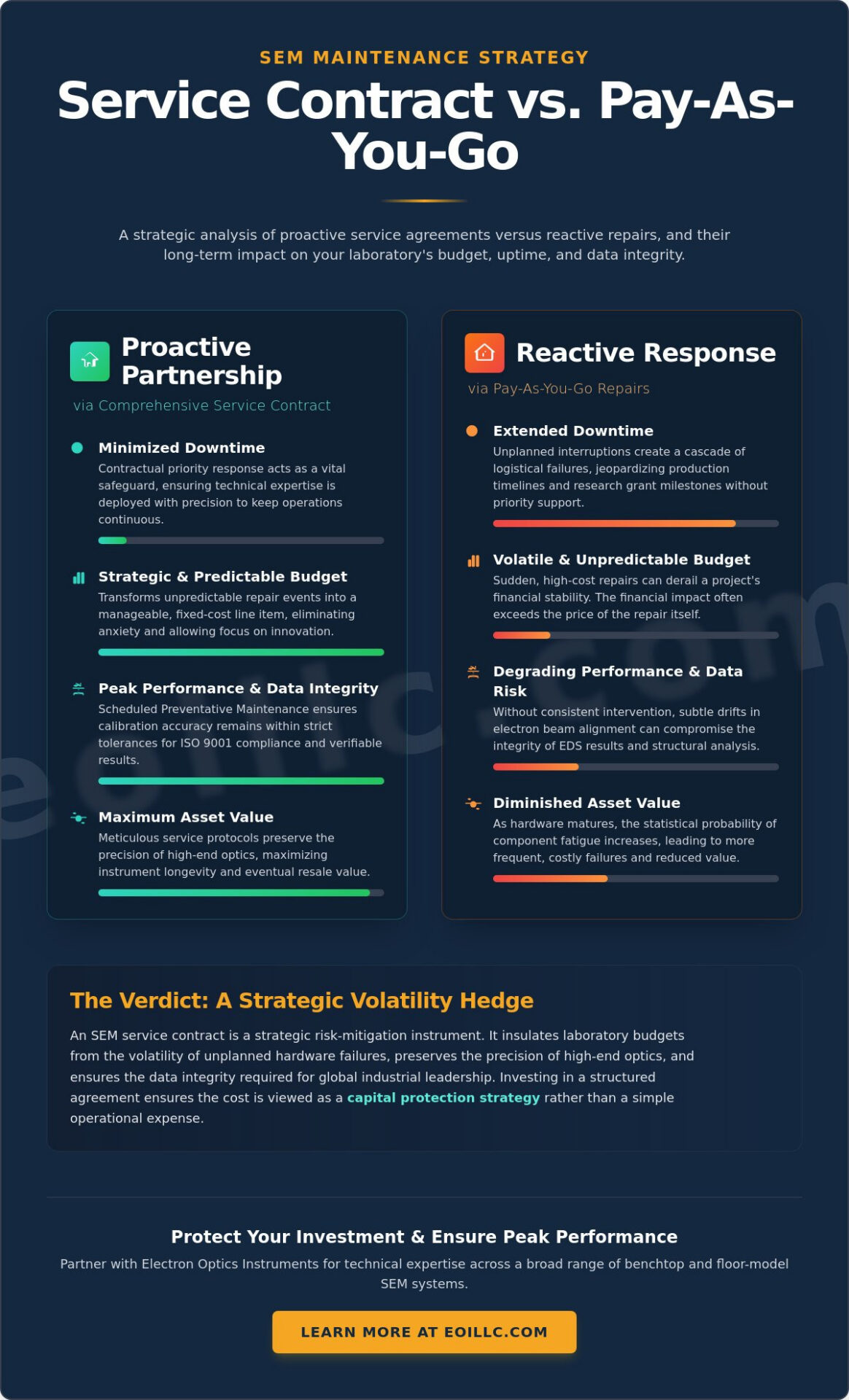
The transition from capital acquisition to operational maintenance requires a critical evaluation of how a laboratory manages technical risk. Choosing between billable hourly rates and a formal agreement is essentially a choice between fiscal volatility and structured stability. While some facilities opt for a “Pay-as-You-Go” approach, the actual cost of sem service contract agreements often proves more economical when factoring in the “emergency premium” associated with reactive repairs. This comparative analysis delineates the boundaries between basic maintenance and full-spectrum coverage, providing a roadmap for fiscal predictability in high-utilization 2026 environments. Understanding these distinctions is vital for maintaining the meticulous standards required in advanced industrial research.
The Financial Risk of Hourly Field Service
Hourly service visits for complex hardware like the Veritas Ultra SEM are inherently unpredictable and carry significant hidden costs. Without a contract, a laboratory faces the highest possible labor rates and is often relegated to the bottom of the service queue behind contract-holding partners. Emergency surcharges can inflate a single repair visit by 50% or more, creating immediate friction with financial stakeholders. Non-contract customers also lack the benefit of fixed parts pricing. This makes them susceptible to market-driven markups on critical components like high-vacuum pumps or imaging electronics. The “Pay-as-You-Go” model might seem attractive for a new Genesis Tabletop SEM under initial warranty, but it quickly becomes a liability once the instrument enters its primary operational lifecycle.
Tiered Coverage Frameworks
Laboratories generally select from three primary tiers to balance their operational needs with budget constraints. Each level offers a different equilibrium between upfront cost and coverage depth. Establishing a baseline of SEM maintenance is the first step in ensuring long-term hardware health.
- Silver/Basic Tiers: This baseline focuses on scheduled Preventative Maintenance Visits. It ensures that instruments like the Cube II receive professional inspections and vacuum system cleaning; however, it typically excludes the cost of replacement parts or emergency labor.
- Gold/Standard Tiers: These agreements introduce priority response times and coverage for essential SEM Filaments and Consumables. They provide a middle ground for facilities that require faster turnaround but can manage some level of parts-related financial risk.
- Platinum/Comprehensive Tiers: This is the “Platinum” standard for high-throughput facilities. It covers all labor, travel, and parts, including high-value items like turbo pumps and EDS detectors. It eliminates the uncertainty of the cost of sem service contract by aligning the laboratory’s technical health with its long-term financial objectives.
Selecting the appropriate tier requires an honest assessment of instrument utilization. For a laboratory where a 48-hour delay in data acquisition results in five-figure production losses, the comprehensive tier isn’t an indulgence; it’s a fundamental logistical safeguard. Conversely, for secondary research units with flexible timelines, a Silver tier focusing on preventative care might provide the necessary baseline for operational stability.
Quantifying ROI: How Maintenance Agreements Mitigate Total Cost of Ownership
Measuring the return on investment for laboratory infrastructure requires a shift from viewing maintenance as a sunk cost to recognizing it as a strategic asset preservation tool. The financial logic underpinning the cost of sem service contract agreements is rooted in the mitigation of long-term capital depreciation. By committing to a structured oversight program, organizations ensure that the intricate electron optics of a Veritas Pro SEM or a Cube II benchtop unit operate within peak performance parameters for their entire operational life. This meticulousness prevents the phenomenon of cascading failures, where a single neglected component, such as a degraded vacuum seal or a contaminated aperture, triggers a sequence of events that eventually compromises the entire vacuum column or damages expensive turbo-molecular pumps. Protecting the internal environment of the microscope is essential for maintaining the high-end quality standards required in 2026 industrial sectors.
The Lifecycle Extension Factor
Regular cleaning and precise alignment protocols are fundamental to preventing permanent damage to the electron source and sensitive detectors. Statistical observations within the industry suggest a stark contrast in instrument longevity based on maintenance history. A professionally maintained unit can realistically provide a 15-year lifespan of high-precision service, whereas a neglected instrument often faces decommissioning or expensive overhauls after only 7 years. Beyond physical hardware, modern service agreements facilitate the integration of firmware and software updates that keep older units competitive with 2026 data standards. This proactive approach to SEM maintenance also significantly enhances the resale value of the equipment. When the time comes to transition to a newer model like the Veritas FE SEM, a documented history of professional service acts as a primary value anchor in the secondary market.
Operational Efficiency and User Training
The return on investment extends into the daily efficiency of the laboratory staff. High-tier service agreements often include dedicated sessions for on-site technical training, which are vital for reducing the frequency of service calls induced by user error. There is a clear synergy between SEM operation best practices and the overall performance of the service contract. Educated operators can identify subtle performance drifts early, allowing for remote diagnostics rather than emergency on-site repairs. This educational component transforms the service provider from a mere repair vendor into a collaborative partner in the laboratory’s success. It’s an investment in human capital that ensures the sophisticated hardware is utilized to its full technical potential. To ensure your facility maintains this level of operational excellence, you should evaluate your current instrument’s maintenance trajectory to identify potential areas for optimization.
Selecting a Service Provider: The Electron Optics Instruments Advantage
The final phase in optimizing laboratory infrastructure involves selecting a technical partner capable of translating complex maintenance requirements into sustained operational stability. While the individual cost of sem service contract agreements remains a primary fiscal metric, the true value is found in a provider’s ability to offer a unified maintenance strategy for diverse instrumentation. Modern laboratories in 2026 frequently manage mixed-manufacturer environments where different generations of electron optics coexist within a single facility. Consolidating these instruments under the Electron Optics Instruments, LLC umbrella eliminates the logistical friction inherent in managing multiple vendor relationships and disjointed billing cycles. Leveraging over 30 years of specialized expertise across both benchtop and floor model systems, we provide the meticulous oversight necessary to maintain international production standards while optimizing the cost of sem service contract management across a comprehensive fleet.
Universal Service for All Major SEM Manufacturers
Technical integration is the cornerstone of a sophisticated service strategy, particularly when procurement must be streamlined across different brands. The Electron Optics Instruments, LLC approach consolidates service for various architectures under one authoritative agreement, which is highly beneficial for organizations utilizing high-performance floor models alongside specialized units like the Genesis Tabletop SEM or the Cube II Benchtop SEM. Our engineers possess a deep understanding of the nuances in multiple electron optics designs, from traditional thermal emission to advanced field emission sources. This breadth of knowledge is supported by an extensive inventory of critical components, ensuring that both the latest Veritas Series SEM models and legacy hardware remain fully operational. Accessing a reliable supply of filaments and vacuum components for varied architectures ensures that your investment yields consistent, high-end results across the entire facility.
Tailored Agreements for Specialized Applications
Industrial failure analysis and academic research environments demand distinctly different maintenance cadences to remain effective. High-contaminant industrial sectors require more frequent Preventative Maintenance Visits to mitigate debris accumulation within the vacuum column and protect sensitive EDS (Energy Dispersive Spectroscopy) systems. Conversely, academic institutions often require flexible contract structures that align with seasonal research cycles or variable fiscal windows. Developing customized schedules that reflect these specific operational realities is essential for achieving long-term hardware reliability. Whether you are managing a fleet of refurbished SEM units or a new Veritas FE SEM installation, our national service network provides localized expertise with the reach of a global innovator. Securing your laboratory’s future starts with a professional assessment of your current hardware and operational goals. Establishing a rigorous service framework today ensures that your facility maintains the precision and stability required for the grounded realities of international production and logistical excellence.
Securing Operational Stability through Strategic Maintenance
Professional oversight is the definitive hedge against technical volatility in the modern laboratory. By transitioning from reactive, billable repairs to structured agreements, organizations protect both their capital investments and their data integrity. The total cost of sem service contract agreements is fundamentally justified by the mitigation of cascading hardware failures and the long-term preservation of high-end optics resolution. This guide has demonstrated that tiered coverage offers a scalable framework for facilities to achieve fiscal certainty while maintaining rigorous industrial standards.
Partnering with a seasoned innovator ensures seamless technical integration across your entire fleet. Electron Optics Instruments, LLC provides over 30 years of industry experience and technical support for all major SEM manufacturers. As the sole US distributor for EmCraft SEMs, we specialize in the meticulousness required for international production excellence. Take the definitive step in optimizing your facility’s uptime and research output. Request a Customized SEM Service Contract Quote to align your maintenance strategy with your 2026 operational goals. Your commitment to instrument precision today ensures the groundbreaking discoveries of tomorrow.
Frequently Asked Questions
How much does a typical SEM service contract cost annually?
Annual fees for scanning electron microscope maintenance are influenced by instrument complexity and desired coverage depth. Industry data from 2025 and 2026 indicates that the cost of sem service contract agreements typically ranges from $5,000 to $20,000 per year. High-performance field emission systems or specialized government installations often command higher premiums; for example, some annual maintenance renewals for advanced units are valued at approximately $48,900. These figures illustrate the standard investment required for technological reliability.
Is it cheaper to pay for SEM repairs by the hour or through a contract?
A structured agreement is almost always more cost-effective than billable hourly rates when accounting for technical risk and downtime. Non-contract customers frequently face higher labor rates, emergency surcharges, and market-driven markups on critical components. While a single visit might seem less expensive initially, the cumulative cost of sem service contract protection is lower because it eliminates the financial volatility of catastrophic hardware failures. Consistent oversight prevents the expensive cascading failures common in neglected systems.
What is the difference between a preventative maintenance visit and a full service contract?
A preventative maintenance visit is a discrete service event focused on cleaning, calibration, and vacuum system optimization to ensure baseline performance. In contrast, a full service contract is a comprehensive risk management plan that includes these visits alongside priority response, labor, and often the cost of replacement parts. While a PM visit maintains accuracy, a full contract provides total budget predictability. This distinction is critical for principal investigators who must justify maintenance line items to financial stakeholders.
Does an SEM service contract cover the cost of filaments and apertures?
Coverage for SEM filaments and consumables depends on the specific tier of the agreement selected by the laboratory. Basic plans often exclude these items to reduce the annual fee, while standard and comprehensive tiers typically bundle them to simplify procurement. Including these high-wear components in your agreement ensures that the electron source remains optimized without requiring separate purchase orders for every replacement cycle. This integration supports the synergy between operational performance and budgetary precision.
Can I get a service contract for a refurbished scanning electron microscope?
Organizations can certainly secure service agreements for refurbished SEM units to ensure their continued operational reliability. These instruments often require more consistent oversight as they age, making a structured maintenance plan a vital component of their total cost of ownership. Professional providers offer tailored agreements that provide the same level of technical expertise and parts priority for refurbished hardware as they do for new installations. This ensures that even secondary-market equipment meets rigorous 2026 data standards.
Are travel expenses for the field service engineer included in the contract fee?
Travel and logistical expenses for a field service engineer are generally bundled into comprehensive and high-tier service agreements. This inclusion provides laboratories in remote or industrial hubs with a fixed cost, protecting them from the variable fees associated with engineer transit and accommodation. It’s important to verify this inclusion in lower-tier plans, as some baseline agreements may bill travel expenses as a separate line item. Fixed-price travel ensures that logistical realities don’t disrupt your annual maintenance budget.
How does a service contract affect the resale value of my SEM?
A documented history of professional service significantly enhances the resale value of a scanning electron microscope. Potential buyers in the 2026 secondary market prioritize instruments that have undergone consistent preventative maintenance and professional calibration. This verifiable record of meticulous care acts as a primary value anchor, ensuring the instrument commands a higher price during decommissioning or upgrade cycles. Regular service demonstrates that the hardware has been maintained at the high-end quality levels required for industrial performance.
Can one service contract cover microscopes from different manufacturers?
Consolidating maintenance for a mixed-manufacturer laboratory under a single service agreement is a strategic advantage for many facilities. This universal approach allows a laboratory to streamline its administrative processes and ensure consistent service quality across different brands. Technical experts with a deep understanding of varied electron optics architectures can maintain multiple systems, ranging from benchtop units to advanced floor models, under one cohesive contract. This consolidation eliminates the friction of managing multiple vendor relationships and disparate billing cycles.