

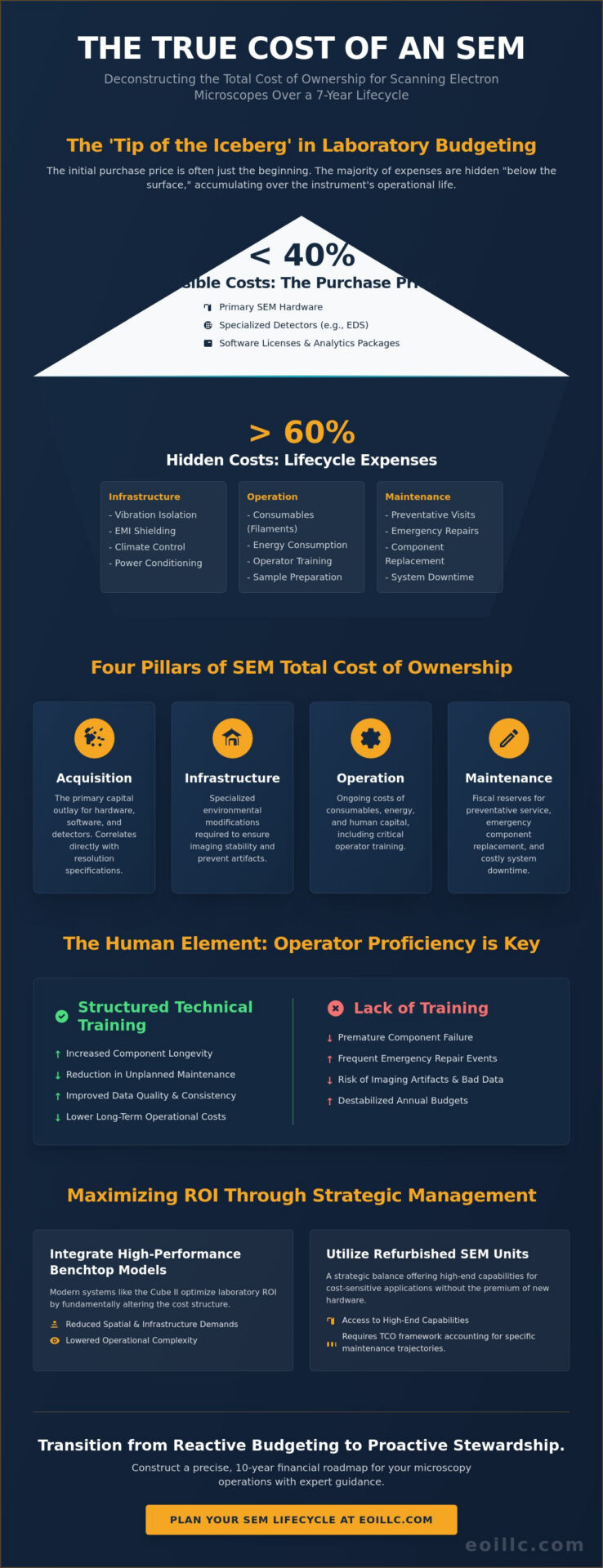
Did you know that the initial capital expenditure for a scanning electron microscope typically represents less than 40% of its total lifecycle cost over a seven-year operational period? For laboratory directors and procurement specialists, the acquisition phase is merely the threshold of a complex fiscal journey. Identifying the hidden costs of sem ownership is essential for maintaining the integrity of project timelines and ensuring that specialized repairs don’t destabilize annual budgets. You’ve likely recognized that unforeseen downtime is more than a technical inconvenience; it’s a significant drain on institutional resources and research momentum.
This comprehensive guide provides the analytical framework necessary to construct a precise, 10-year financial roadmap for your microscopy operations. Precision requires foresight. We’ll examine the data-driven realities of consumable lifecycles, from tungsten filament replacement to the logistical demands of preventative maintenance visits. By evaluating these variables, you can justify the acquisition of high-performance benchtop models like the Cube II and implement strategies to mitigate emergency repair expenses. We’ll transition from reactive budgeting to a proactive model of technical stewardship that prioritizes both innovation and fiscal reliability.
Key Takeaways
- Recognize that the initial procurement price typically accounts for less than 40% of the lifecycle expenditure, necessitating a comprehensive Total Cost of Ownership (TCO) framework for accurate long-term budgeting.
- Identify the rigorous environmental infrastructure requirements, including vibration isolation and electromagnetic shielding, that constitute the primary hidden costs of sem ownership.
- Evaluate the financial trade-offs between tungsten and field emission sources while establishing a disciplined schedule for Preventative Maintenance Visits to mitigate the risk of catastrophic hardware failure.
- Quantify the impact of the human element by correlating operator proficiency with component longevity, highlighting the necessity of structured technical training to reduce unplanned maintenance events.
- Discover how integrating high-performance benchtop models like the Cube II can fundamentally optimize laboratory ROI by reducing spatial infrastructure demands and operational complexity.
The Total Cost of Ownership (TCO) Framework for Electron Microscopy
The initial capital expenditure for a Scanning electron microscope (SEM) represents the inception of a complex fiscal commitment rather than its conclusion. For institutional leaders, defining Total Cost of Ownership (TCO) requires an analytical shift from simple procurement to lifecycle stewardship. Industry data indicates that the “sticker price” of high-precision scientific instrumentation often constitutes only 30% to 40% of the aggregate expenses incurred over a seven-year operational period. Recognizing the hidden costs of sem ownership is therefore a prerequisite for maintaining technical reliability and long-term financial predictability.
A robust TCO framework is constructed upon four distinct pillars of expenditure:
- Acquisition: The primary capital outlay for hardware, software, and specialized detection systems.
- Infrastructure: The specialized environmental modifications required to ensure imaging stability.
- Operation: The ongoing costs of consumables, energy, and human capital.
- Maintenance: The fiscal reserves necessary for preventative service and emergency component replacement.
Establishing this framework allows laboratories to transition from reactive budgeting to a proactive model of technical integration. It ensures that the pursuit of higher resolution doesn’t inadvertently lead to institutional insolvency through unmanaged secondary expenses.
Direct vs. Indirect Acquisition Costs
The complexity of acquisition extends beyond the base unit. Integrating specialized EDS (Energy Dispersive Spectroscopy) Systems often adds significant value but also increases the initial capital requirement. There is also a direct correlation between resolution specifications and long-term cost. An entry-level unit providing 15nm resolution carries far lower secondary costs than a sub-1nm high-end system, which requires more stringent vacuum conditions and proprietary imaging modules. Software licensing and annual updates for advanced analytical packages represent additional capital outlays that must be negotiated during the initial procurement phase to prevent future budget shortfalls.
The ‘Tip of the Iceberg’ Metaphor in Laboratory Budgeting
Visualizing SEM costs often mirrors the classic iceberg metaphor. The visible hardware represents the tip, while the submerged expenses, such as system downtime and periodic calibration, remain hidden from immediate view. High-performance models like the Cube II Benchtop SEM are engineered to minimize these submerged infrastructure costs by reducing the footprint and environmental requirements typically associated with floor-standing units. Alternatively, some facilities optimize their ROI by incorporating Refurbished SEM Units. These systems provide a strategic balance, offering high-end capabilities for cost-sensitive applications without the premium associated with new hardware, provided the TCO framework accounts for their specific maintenance trajectories.
Site Preparation and Environmental Infrastructure Requirements
The successful deployment of high-precision electron optics depends entirely upon the stability of the physical environment in which the system resides. While the initial investment for an SEM covers the primary hardware, the physical room itself often requires significant modification to meet rigorous operational standards. These site-specific upgrades represent a substantial portion of the hidden costs of sem ownership. For instance, high-resolution imaging is exceptionally sensitive to thermal drift and electromagnetic interference (EMI). A facility that hasn’t been properly shielded or climate-controlled will consistently produce imaging artifacts, effectively nullifying the technical advantages of a high-end Veritas Series SEM.
Beyond the room’s shell, the hidden expense of specialized laboratory furniture and vibration isolation tables must be accounted for in the early planning stages. Standard laboratory benches lack the structural rigidity required to support the weight of a vacuum chamber while simultaneously dampening ambient floor vibrations. Power quality is another critical variable. Electrical “noise” and subtle voltage fluctuations can destabilize the electron beam, leading to a loss of resolution that is often misdiagnosed as a hardware malfunction. Ensuring a clean, conditioned power supply is a technical necessity that demands meticulousness during the design phase.
Vibration Isolation and Acoustic Mitigation
Achieving nanometer-scale resolution requires a sophisticated approach to dampening. Active vibration isolation systems, which utilize sensors and actuators to cancel out incoming seismic noise, are significantly more effective than passive rubber mounts but require a higher initial outlay. Acoustic interference from HVAC systems or nearby high-traffic corridors can also vibrate the column enough to blur images. High-end SEM operation typically requires vibration levels below 0.5 micrometers per second and acoustic noise levels not exceeding 60 decibels to maintain sub-nanometer resolution integrity. Facilities that overlook these thresholds often find themselves retrofitting expensive acoustic dampening panels after the system is already installed.
Vacuum System Integrity and Power Conditioning
The vacuum system is the heart of the microscope, and its requirements extend into the building’s plumbing and venting infrastructure. Specialized vacuum pumps require dedicated exhaust lines to prevent the accumulation of heat and mechanical noise within the laboratory. Additionally, the sensitivity of electron guns, particularly in Field Emission (FE) systems, necessitates the use of high-capacity Uninterruptible Power Supplies (UPS). These systems protect the source from sudden power loss, which can cause catastrophic thermal shock to the filament. For facilities prioritizing rapid deployment with minimal environmental modification, evaluating a benchtop SEM solution like the Genesis Tabletop SEM can significantly streamline the integration process by reducing the overall HVAC and spatial infrastructure load.
Consumables, Preventative Maintenance, and Component Longevity
Operational excellence in electron microscopy is sustained through the meticulous management of recurring expenses that extend far beyond the initial infrastructure setup. In high-throughput environments, the “burn rate” of specific components represents a significant portion of the hidden costs of sem ownership. While the previous sections established the foundational capital and facility requirements, the ongoing financial health of a laboratory depends on accurately forecasting the lifecycle of its electron sources and vacuum components. Neglecting these variables often leads to a degradation in image quality and unbudgeted emergency service calls.
A primary consideration in this lifecycle analysis is the financial trade-off between different electron sources. Tungsten filaments, while economically accessible at the point of purchase, typically offer a limited operational life of 100 to 200 hours. In contrast, Field Emission (FE) sources, utilized in systems like the Veritas FE SEM, provide superior brightness and longevity spanning several years. However, they require a more stringent vacuum environment and a higher initial investment. Research from the National Institute of Standards and Technology (NIST) on long-term cost-of-ownership suggests that standardized maintenance schedules are the most effective way to ensure these high-performance components reach their full technical potential.
Filaments and Apertures: The Hidden Recurring Expenses
Maintaining beam stability requires more than just source replacement. Final apertures must be cleaned or replaced at regular intervals to prevent carbon contamination, which can cause beam drift and distorted imaging. Beyond the obvious hardware, laboratories must budget for specialized vacuum pump oils, gaskets, and cleaning solvents. These items may seem incidental, but their cumulative cost in a multi-unit facility can be substantial. For example, replacing a tungsten filament involves not just the part cost but also the billable labor and the subsequent system bake-out time, which temporarily halts production.
Annual Service Contracts vs. Reactive Repair Costs
The distinction between proactive and reactive management often determines the profitability of industrial failure analysis labs. Multi-tiered service agreements, ranging from priority support to parts-only coverage, provide a predictable financial ceiling for annual expenditures. Relying on reactive repairs introduces a “downtime penalty” that far exceeds the cost of a service contract. When an SEM remains idle, the hourly loss of throughput can destabilize project timelines and client commitments. Adhering to rigorous SEM maintenance protocols, including regular Preventative Maintenance Visits, extends the interval between major overhauls and ensures that the system operates within its original factory specifications for the duration of its service life.
The Human Element: Training, Operation, and Sample Preparation
The efficacy of a high-precision imaging system is inextricably linked to the proficiency of its operator. While previous sections detailed the physical and mechanical requirements of microscopy, the human element represents a variable that can either preserve or deplete institutional resources. Inadequate technical stewardship often manifests as accelerated hardware wear, particularly in the delicate electron optics and vacuum seals. These failures are frequently categorized as mechanical issues, yet they originate in operational oversight, forming a significant portion of the hidden costs of sem ownership that laboratories fail to anticipate. Precision hardware requires an equally precise level of human intervention to maintain its factory-specified resolution.
Budgeting for human capital requires a dual-track approach: initial onboarding and continuous professional development. When an experienced microscopist departs, the loss of institutional knowledge creates a competency vacuum that can lead to increased downtime and a higher frequency of unplanned maintenance events. High-throughput facilities must treat training as a capital investment rather than a one-time expense. This ensures that every user understands the nuances of beam alignment, vacuum management, and EDS calibration, thereby mitigating the risk of catastrophic source failure or column contamination.
Operator Competency and Technical Training Fees
Staff turnover poses a recurring financial risk to laboratory stability. Without a structured program for professional SEM operation, new users may inadvertently shorten the lifespan of expensive filaments or contaminate the chamber through improper sample loading. On-site training sessions provide the advantage of familiarizing staff with their specific environmental variables, whereas manufacturer-led workshops offer deep-dive expertise into advanced imaging modules. A balanced cost-benefit analysis usually favors a hybrid model to ensure long-term equipment health and consistent data integrity across project lifecycles.
Ancillary Equipment: Sputter Coaters and Sample Mounting
The transition from imaging conductive metals to non-conductive biological or polymer samples necessitates additional capital investment in sample preparation hardware. Sputter coaters are essential for depositing a nanometer-scale conductive layer, typically gold, palladium, or carbon, to prevent specimen charging. These systems introduce their own lifecycle costs, including the recurring procurement of high-purity targets and specialized mounting adhesives. Neglecting to budget for these consumables can stall research progress, especially when high-purity silver paint or specialized sample holders are required for complex geometries. Integrating these ancillary needs into the initial TCO framework prevents mid-cycle budget shortfalls.
To ensure your facility maintains peak operational standards while controlling long-term expenditures, explore our comprehensive range of Veritas Series SEM systems designed for intuitive operation and industrial-grade reliability.
Maximizing ROI Through Strategic SEM Lifecycle Management
The final phase of establishing a sustainable microscopy program involves a transition from basic administrative oversight to strategic lifecycle optimization. While earlier discussions focused on the immediate environmental and operational variables, long-term ROI is fundamentally determined by how a facility manages the latter stages of its equipment’s service life. The desktop SEM revolution has emerged as a critical catalyst in this transition, offering a high-performance alternative that bypasses the extensive cleanroom infrastructure and specialized HVAC requirements typical of larger systems. By integrating these compact solutions, laboratories can effectively neutralize many of the hidden costs of sem ownership that accumulate during the mid-to-late stages of a floor-model’s deployment.
Refurbished Units and Equipment Relocation Services
Strategic decommissioning and the realization of salvage value are essential components of a robust TCO equation. When analyzing the electron microscope cost, institutional leaders must weigh the advantages of new capital investments against the fiscal benefits of certified refurbished models. For industrial applications with specific throughput requirements, a refurbished unit provides a high-end entry point at a significantly reduced capital outlay. However, the logistical burden of equipment relocation presents a unique financial risk that must be managed. Uncertified relocation attempts frequently result in optical misalignment or vacuum system degradation, necessitating costly professional re-calibration. Professional installation ensures that performance standards are met post-move, acting as a vital financial safeguard for the instrument’s longevity.
The Long-Term Value of Partner-Led Service Agreements
Achieving sustained technical performance isn’t a matter of chance; it’s the result of disciplined, partner-led stewardship. Leveraging over 30 years of specialized industry experience, Electron Optics Instruments, LLC acts as a visionary partner in long-term cost containment. Our systems, including the Cube II Benchtop SEM and Genesis Tabletop SEM, are engineered to optimize throughput-to-cost ratios, ensuring that every imaging session contributes to research momentum rather than technical overhead. For lab managers, a comprehensive 5-year budget should prioritize the following pillars of fiscal stability:
- Preventative Maintenance Visits: Regular technical audits to sustain vacuum integrity and beam stability.
- Consumable Reserves: Dedicated funding for high-purity filaments, gaskets, and vacuum pump oils.
- Technical Training: Continuous staff development to mitigate the financial impact of operational error.
- Certified Relocation: Professional decommissioning and re-installation for facility upgrades or moves.
By internalizing these variables, laboratories can transform their microscopy suite into a reliable engine of industrial innovation. This proactive approach ensures that the hidden costs of sem ownership don’t compromise the institution’s primary research or production objectives.
Securing Analytical Integrity Through Financial Foresight
Navigating the complexities of high-precision imaging requires an analytical approach that transcends the initial procurement phase. By identifying the infrastructure demands, consumable lifecycles, and human capital requirements discussed throughout this guide, laboratory directors can transform potential liabilities into predictable assets. Addressing the hidden costs of sem ownership isn’t merely a budgetary necessity; it’s a strategic imperative that ensures the sustained accuracy and reliability of your technical output over a ten-year horizon. Precision in the laboratory must be matched by precision in the ledger.
With over 30 years of specialized industry experience, Electron Optics Instruments, LLC serves as a cornerstone for laboratories seeking long-term operational stability. As the sole US distributor for EmCraft Scanning Electron Microscopes and a provider of comprehensive service for all major SEM manufacturers, we possess the technical depth to guide your next equipment lifecycle. We invite you to request a customized TCO consultation for your next SEM acquisition to ensure your facility is engineered for both fiscal and technical excellence. Establishing a precise financial roadmap today secures the innovative breakthroughs of tomorrow.
Frequently Asked Questions
What is the most significant hidden cost in SEM ownership?
The most significant hidden costs of sem ownership typically reside in the specialized infrastructure and site preparation required to achieve imaging stability at the nanometer scale. Beyond the hardware, facilities must invest in electromagnetic shielding and precise climate control systems to prevent imaging artifacts. These environmental modifications often exceed the initial expectations of procurement teams who focus solely on the instrument’s base price.
How much should I budget annually for SEM maintenance and consumables?
Verified industry data suggests that ongoing expenses for maintenance and high-vacuum consumables add approximately 10% to 15% annually to the ownership costs of a high-resolution system. This allocation covers recurring items such as vacuum oils, gaskets, and apertures while also funding necessary technical support. For laboratories operating in high-throughput environments, these costs are a primary driver of long-term fiscal predictability.
Is a service contract actually worth the additional cost?
A structured service contract is a vital risk mitigation strategy that provides financial predictability by capping annual repair expenditures. While it represents an upfront investment, it protects against the “downtime penalty” associated with idle hardware in industrial failure analysis. These agreements often include priority support and Preventative Maintenance Visits, which are essential for extending the operational lifecycle of the electron optics.
How does a benchtop SEM compare to a floor model in terms of total cost of ownership?
Benchtop models like the Cube II fundamentally lower the TCO by eliminating the need for extensive cleanroom infrastructure and dedicated HVAC systems. Floor-standing units require significant spatial footprints and specialized plumbing for vacuum exhaust, whereas tabletop systems utilize standard electrical outlets and occupy minimal space. This drastically reduces the associated utility overhead and facility modification expenses.
What are the environmental requirements that might increase my installation costs?
Installation costs are frequently driven by the necessity for active vibration isolation tables and acoustic mitigation panels to protect image clarity. High-resolution imaging is exceptionally sensitive to seismic noise from nearby machinery and acoustic interference from building ventilation systems. Facilities may also need to install dedicated power conditioning systems and Uninterruptible Power Supplies (UPS) to protect sensitive electron guns from voltage fluctuations.
Can I save money by purchasing a refurbished scanning electron microscope?
Purchasing a refurbished scanning electron microscope can significantly reduce initial capital expenditure while maintaining high analytical standards for many industrial applications. These units offer an excellent ROI for laboratories with cost-sensitive projects that don’t require the absolute latest software-defined throughput modules. It’s essential to ensure the unit is certified and supported by a partner with the technical expertise to manage its specific maintenance trajectory.
How often do SEM filaments need to be replaced and what does it cost?
Replacement frequency depends on the electron source; tungsten filaments typically offer a lifetime of 100 to 200 hours, whereas CeB6 sources can exceed 1,000 hours of operation. The total cost involves both the physical component and the billable labor for installation and the subsequent system bake-out. Facilities must track operational hours meticulously to schedule these replacements before a filament failure causes unplanned downtime.
What ancillary equipment is absolutely necessary for basic SEM operation?
Basic SEM operation requires a sputter coater for preparing non-conductive samples and a vibration isolation system to ensure stable imaging. Additionally, an Energy Dispersive Spectroscopy (EDS) system is often considered essential for performing elemental analysis alongside imaging. Protecting the system with a high-capacity UPS is also a non-negotiable requirement to prevent catastrophic source damage during sudden power interruptions.