

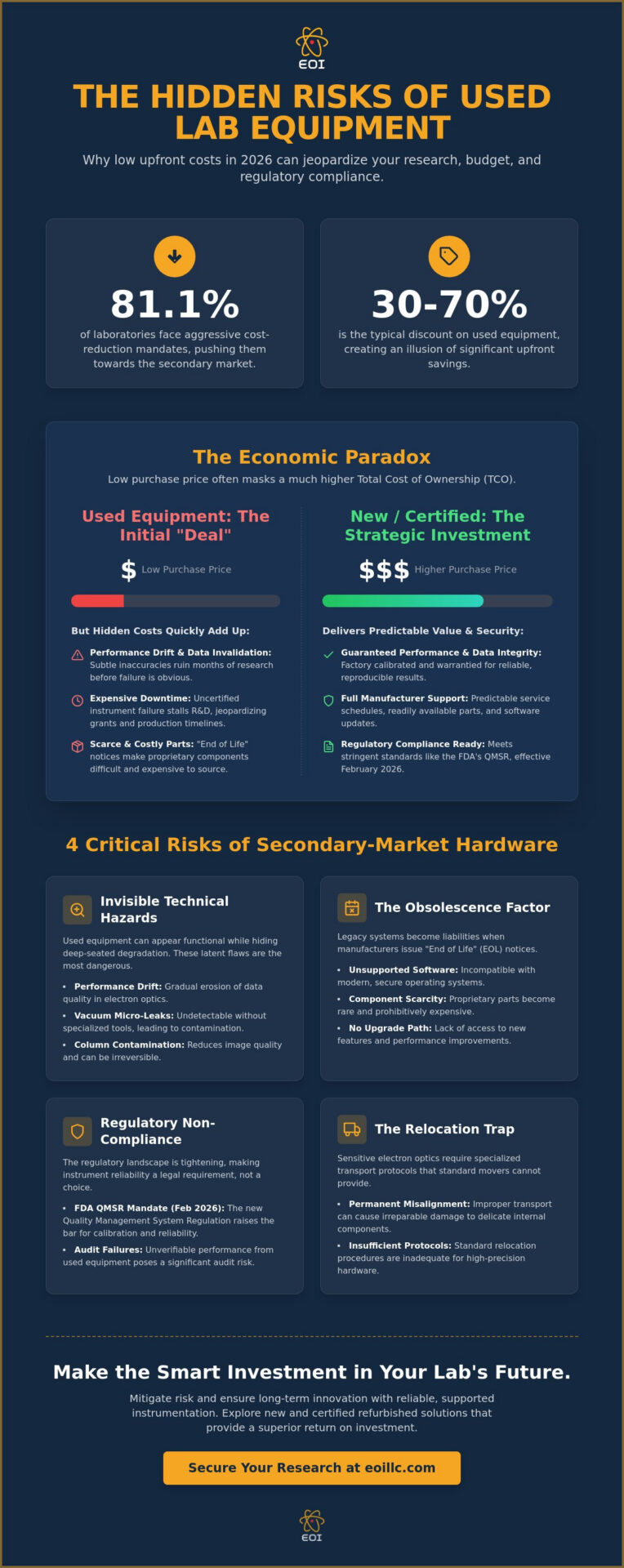
The 30% to 70% discount typically found on the secondary market might seem like a strategic solution for the 81.1% of laboratories currently facing cost-reduction mandates, yet this initial savings often masks a trajectory toward operational instability. The primary risks of buying used lab equipment in 2026 involve more than just the potential for a total mechanical failure; they represent a fundamental threat to data integrity through performance drift and the high cost of maintaining legacy systems that may soon lack manufacturer support. With the FDA’s Quality Management System Regulation (QMSR) now in full effect as of February 2026, the margin for error in instrument calibration and reliability has reached a critical threshold.
We recognize the tension between capital budget constraints and the absolute necessity for precision in high-complexity research. This technical assessment offers a rigorous analysis of the mechanical, financial, and operational hazards inherent in secondary-market instrumentation. You’ll gain a framework for evaluating the total cost of ownership, an understanding of specific failure points in complex optics, and the justification needed to secure reliable hardware that sustains long-term innovation. This guide ensures your infrastructure remains a catalyst for progress rather than a liability to your results.
Key Takeaways
- Analyze the economic paradox where low upfront procurement costs are frequently offset by high operational expenses and potential data invalidation.
- Identify technical vulnerabilities inherent in aged vacuum systems and the specific risks of buying used lab equipment without documented maintenance of electron optics.
- Assess the impact of “End of Life” (EOL) notices on software stability and the scarcity of proprietary components in legacy instrumentation.
- Evaluate why standardized relocation protocols are insufficient for sensitive hardware and how uncertified transport risks permanent mechanical misalignment.
- Establish a decision-making framework to determine when a new benchtop SEM or a certified refurbished unit provides a superior return on investment.
The Economic Paradox: Why Low Upfront Costs Often Mask High Operational Risks
The 2026 secondary market for scientific instrumentation operates within a complex regulatory framework, shaped largely by the mandatory enforcement of the FDA’s Quality Management System Regulation (QMSR). While 81.1% of laboratories are currently tasked with aggressive cost-reduction mandates, the procurement of secondary-market hardware frequently initiates a cycle of operational instability that belies the perceived fiscal prudence of the initial transaction. Procurement departments often succumb to the psychological allure of immediate capital savings, yet they fail to account for the performance drift that characterizes aged electron optics. This phenomenon represents one of the most significant risks of buying used lab equipment, as subtle inaccuracies in data can invalidate months of research before the hardware failure becomes apparent.
Distinguishing between superficial mechanical wear and systemic degradation is vital for maintaining laboratory standards. While a technician can easily replace a spent filament, identifying micro-leaks in a vacuum system or carbon contamination within a column requires specialized diagnostic tools that secondary-market vendors rarely possess. As-is auctions represent the apex of financial vulnerability in this sector. These transactions offer no recourse for the buyer when internal components, such as the delicate apertures or electromagnetic lenses, prove to be beyond the point of economical repair. The lack of a verified service history turns a “deal” into a high-stakes gamble with departmental funding.
The Illusion of Savings in Capital Procurement
The delta between the price of a used high-end SEM and a modern solution like the Cube II Benchtop SEM is often smaller than it appears once the costs of modernization are factored in. Initial budget wins are frequently erased by the impact of equipment downtime on industrial R&D cycles. When an uncertified instrument fails, the resulting delay in data acquisition can jeopardize grant deadlines and stall time-sensitive production milestones. In an era where 63.4% of labs report stable budgets but increased pressure for throughput, the reliability of a new system provides a level of operational security that secondary hardware cannot replicate.
Total Cost of Ownership (TCO) vs. Purchase Price
A comprehensive fiscal analysis must extend beyond the invoice to include the importance of equipment calibration, software licensing fees, and specialized installation protocols. Legacy systems often require proprietary software that is no longer supported by modern operating systems, necessitating additional investments in bridge hardware or unsecure legacy computers. These risks of buying used lab equipment escalate as manufacturers issue “End of Life” notices, making spare parts both scarce and prohibitively expensive.
In the specific context of analytical microscopy, Total Cost of Ownership constitutes the aggregate of all fiscal expenditures, including initial procurement, recurring maintenance, software updates, and the potential costs of data invalidation, measured over a five-year operational lifecycle.
Choosing to invest in a Genesis Tabletop SEM or a Veritas Series SEM ensures that the laboratory benefits from a predictable service schedule and a guaranteed supply chain for consumables. This proactive approach to hardware procurement mitigates the uncertainty inherent in the secondary market, allowing researchers to focus on innovation rather than troubleshooting aging infrastructure.
Invisible Technical Hazards in Precision Electron Optics
Precision in electron microscopy is a fragile equilibrium maintained by a synergy of high-vacuum physics and stable electromagnetic fields. When evaluating the risks of buying used lab equipment, the most catastrophic failures are often those that remain undetectable during a standard pre-purchase demonstration. A unit that appears operational may harbor deep-seated degradation in its vacuum architecture or signal processing chain, leading to a gradual erosion of data quality that bypasses immediate detection. This performance drift is particularly dangerous in 2026, where modern research standards require absolute reproducibility and adherence to strict digital data integrity protocols.
Electronic fatigue represents another silent hazard that secondary-market buyers frequently overlook. High-voltage power supplies and detector arrays utilize specialized components that degrade with every hour of operation. Scintillators in secondary electron detectors lose their peak sensitivity over time, while capacitors in high-voltage modules are prone to drying out, which leads to voltage instability and increased image noise. This hardware obsolescence is compounded by software isolation. Many used SEMs are tethered to orphaned operating systems that lack modern cybersecurity patches, creating a significant vulnerability in any networked laboratory environment. For those seeking to avoid these technical pitfalls, exploring advanced imaging solutions with modern software integration is a necessary step in securing long-term research viability.
Vacuum Integrity and Leak Path Risks
The integrity of an SEM depends on the resilience of its elastomeric seals and the operational health of its pumping stack. Over a ten-year lifecycle, O-rings lose their elasticity and develop micro-fissures that allow atmospheric ingress. These leaks force turbomolecular pumps to work at higher rotational frequencies to maintain operating pressure, which accelerates bearing wear and leads to sudden, expensive failures. Replacing a turbomolecular pump in a legacy model often requires sourcing parts that have been discontinued, significantly increasing the total cost of ownership. Furthermore, a history of poor vacuum management can lead to permanent filament and aperture damage due to oxidation and ion bombardment.
Performance Drift and Calibration Loss
Achieving sub-nanometer resolution requires more than just a functional electron source; it demands perfect alignment of the electromagnetic lenses and a pristine optical column. Column contamination, often caused by poor sample handling or a history of inadequate vacuum, results in carbon buildup that deflects the electron beam. This creates performance drift, where the instrument produces images that look acceptable to the untrained eye but contain geometric distortions that invalidate quantitative analysis. Rigorous sem maintenance is the only way to verify that an instrument still meets its original factory specifications for precision and accuracy. Identifying these deep-seated optical misalignments is one of the most critical risks of buying used lab equipment, as they can lead to the publication of scientifically invalid data.
The Obsolescence Factor: Software and Component Scarcity
The technological trajectory of high-end analytical instrumentation is dictated by the lifecycle of its proprietary digital architecture. One of the most persistent risks of buying used lab equipment is the sudden issuance of an End of Life (EOL) notice from the original equipment manufacturer. These notices signal the cessation of technical support, spare parts production, and software patches, effectively turning a sophisticated instrument into a “black box” with no clear path for repair. In the context of 2026, where hardware-software synergy is paramount, the reliance on proprietary components means that a single failed circuit board can render an entire electron microscope unserviceable. Unlike general laboratory hardware, the specialized signal processing boards and scan generators found in advanced SEMs aren’t commodities available through standard industrial supply chains.
Cybersecurity standards have evolved rapidly, and legacy systems often fail to meet the rigorous data integrity requirements of modern industrial networks. Running instrumentation on unsupported operating systems creates a significant security vulnerability that IT departments are increasingly unwilling to tolerate. The difficulty of integrating legacy EDS systems with contemporary data networks further complicates the issue, as antiquated communication protocols often struggle with the high-speed data transfer required for real-time analysis. These risks of buying used lab equipment extend beyond mechanical failure, impacting the laboratory’s ability to maintain a secure and interoperable digital ecosystem.
The Software Compatibility Wall
Procuring a used SEM frequently forces a laboratory into a “frozen” IT environment. To maintain functionality, the instrument must remain tethered to an obsolete workstation, which prevents the implementation of modern security updates and limits the use of AI-driven analysis tools. The cost of mandatory software upgrades to bridge this gap can exceed the initial acquisition value of the hardware itself. Conversely, investing in current Veritas or Genesis models ensures long-term digital longevity, as these systems are designed with contemporary software architectures that support seamless integration with modern research workflows and evolving regulatory standards.
Supply Chain Hazards for Legacy Parts
The reality of the secondary market involves navigating a landscape of extreme lead times and uncertain availability. Discontinued SEM filaments and specialized vacuum controllers often carry lead times exceeding 12 weeks, a delay that can bring critical research projects to a standstill. Secondary market sellers rarely provide long-term parts guarantees, leaving the buyer responsible for sourcing components from a dwindling global inventory. There’s a distinct strategic advantage in opting for new desktop SEM models. These modern systems benefit from standardized support structures and a robust supply chain, providing the reliability necessary for high-throughput industrial and academic environments where downtime isn’t an option.
The Decommissioning and Relocation Trap
The physical transition of high-precision instrumentation from one facility to another represents a critical vulnerability in the procurement chain. One of the most underestimated risks of buying used lab equipment is the structural damage incurred during uncertified transport. Sensitive electron optics aren’t standard lab furniture; they’re delicate assemblies of electromagnetic lenses and vacuum components that require specialized handling. When a general liquidator manages the logistics, the risk of internal mechanical shifts increases exponentially. These shifts often manifest as an irreversible loss of resolution that only becomes apparent after the unit is powered on at the new site.
Neglecting the environmental requirements of the new installation site is a common pitfall. Electron microscopes are susceptible to vibration, electromagnetic interference (EMI), and acoustic noise. A site that’s suitable for a centrifuge or an incubator may be entirely incompatible with a Veritas Pro SEM or a Genesis Tabletop SEM. Ensuring the infrastructure can support the specific tolerances of the hardware is essential for maintaining data integrity. To guarantee your facility is prepared for advanced instrumentation, you should consult with our technical integration experts before finalizing any hardware acquisition.
Professional Decommissioning Protocols
Professional decommissioning involves more than simply disconnecting a power source. Technicians must mechanically lock the sample stage and secure the internal components of the optical column to prevent kinetic damage. General liquidators frequently offer “curbside delivery,” which is a significant red flag for SEMs because it suggests a lack of specialized crating or shock-absorption protocols. Vibration isolation is critical during the relocation of a benchtop SEM because even minor kinetic shocks can permanently misalign the electromagnetic lenses or compromise the integrity of the vacuum seals.
The Hidden Costs of Re-Installation
Site surveys are mandatory to ensure the new lab environment meets the strict sem operation specifications required for high-resolution imaging. These surveys account for floor stability, ambient EMI from elevators or power lines, and the stability of the local power grid. Budgeting for specialized rigging and professional recalibration post-installation is a necessity, not an option. Professional SEM installation services provided by EOI include comprehensive testing to verify that the instrument performs to factory standards in its new location, mitigating the uncertainty that usually follows a secondary-market purchase.
The average laboratory move can exceed $100,000 in total costs, and a significant portion of that budget is often dedicated to the recalibration of sensitive instruments. If the used equipment arrives with undocumented internal damage, the cost of repair can quickly surpass the initial savings. Relying on certified transport and installation protocols is the only way to protect your investment from the logistical hazards inherent in the used market.
Mitigating Risk: New Benchtop SEMs vs. Certified Refurbishment
Navigating the complex landscape of instrument procurement requires a strategic balance between capital expenditure and long-term operational reliability. While the financial allure of the secondary market is significant, the most effective strategy for mitigating the risks of buying used lab equipment involves a shift toward professional refurbishment or modern benchtop solutions. Professional refurbishment, when executed by certified technicians, provides a “Safe Third Way” that bridges the gap between high-risk as-is auctions and the higher capital requirements of new floor-standing units. By opting for Refurbished SEM Units that carry OEM-level warranties, laboratories can secure documented service histories and verified performance metrics that are absent in the general used market.
The integration of annual service contracts and Preventative Maintenance Visits further de-risks these investments by ensuring that performance drift is identified and corrected before it compromises research data. Comparing the electron microscope cost of new benchtop units against the total cost of ownership for high-risk used floor models often reveals that modern tabletop systems provide a superior return on investment. These systems eliminate the technical debt associated with legacy hardware while providing the precision necessary for 2026 research standards.
The Cube II and Genesis Advantage
Modern tabletop models like the Genesis Tabletop SEM and the Cube II Benchtop SEM represent a paradigm shift in laboratory infrastructure. These systems reduce the mechanical risks of buying used lab equipment by utilizing integrated, simplified vacuum paths and robust electronic architectures that are easier to maintain than legacy floor models. EOI ensures operational stability through comprehensive on-site technical training for all new instrumentation, empowering your staff to maximize the utility of the hardware from day one. This proactive approach, combined with regular preventative maintenance, creates a trajectory of sustained accuracy and industrial performance that secondary-market gear cannot match.
Final Procurement Checklist for 2026
Before finalizing any acquisition of secondary-market instrumentation, procurement officers should utilize the following technical framework to evaluate the viability of the hardware:
- Does the seller provide a comprehensive vacuum log and a documented history of column cleanings?
- Is the current operating system compatible with your facility’s 2026 cybersecurity and data integrity protocols?
- Are proprietary components, such as scan boards and specialized apertures, still in active production by the manufacturer?
- Can the seller produce a recent calibration certificate that verifies the instrument meets its original resolution specifications?
- What is the lead time for critical consumables, and is there a local supply chain for filaments and apertures?
Securing the future of your laboratory’s analytical capabilities requires meticulousness and a commitment to hardware reliability. To ensure your procurement strategy aligns with the rigorous demands of modern research, consult with an EOI specialist to evaluate your lab’s SEM requirements and discover how our integrated solutions can support your pursuit of technical excellence.
Securing the Future of Analytical Precision through Strategic Procurement
The transition toward high-complexity research in 2026 demands a meticulous evaluation of long-term operational stability versus immediate capital savings. By identifying the economic paradox of hidden total cost of ownership and the invisible hazards inherent in aged electron optics, laboratories can move beyond the inherent risks of buying used lab equipment. Prioritizing certified refurbishment or modern benchtop solutions ensures that research data remains valid and that facilities comply with the rigorous regulatory standards now in effect across the industrial landscape.
It’s essential to partner with an innovator that understands the grounded realities of technical integration and logistical excellence. Electron Optics Instruments brings over 30 years of specialized expertise to every engagement, serving as the sole US distributor for EmCraft SEMs. We provide comprehensive service contracts covering all major manufacturers, ensuring that your hardware remains a reliable anchor for visionary research. Request a Quote for a New or Certified Refurbished SEM to ensure your laboratory infrastructure reflects the highest standards of accuracy and international capability. Investing in reliable hardware today builds the foundation for the breakthroughs of tomorrow.
Frequently Asked Questions
What is the number one risk when buying a used scanning electron microscope?
The primary hazard involves performance drift, where subtle misalignments in the optical column or degradation of the electromagnetic lenses lead to data inaccuracies that bypass initial detection. This subtle erosion of precision often invalidates quantitative analysis, transforming the instrument into a significant liability for high-stakes research and industrial quality control. Unlike a total mechanical failure, performance drift is difficult to diagnose without specialized calibration tools.
How can I verify the condition of a used SEM before purchase?
Verification requires a comprehensive review of historical vacuum logs and recent calibration certificates alongside a live demonstration at the instrument’s maximum rated resolution. A thorough technical inspection must also include a check for carbon contamination within the column and an assessment of the detector’s signal-to-noise ratio. Relying on superficial visual inspections is insufficient for identifying deep-seated electronic fatigue or vacuum system micro-leaks.
Is it better to buy a used floor-model SEM or a new benchtop SEM?
A new benchtop SEM like the Genesis Tabletop SEM typically offers superior reliability and lower operational costs compared to an aged floor model. While legacy floor models might offer higher theoretical resolution, the technical risks of buying used lab equipment often manifest as excessive downtime and unserviceable component failures. Modern tabletop systems provide the precision required for 2026 research standards without the technical debt of legacy hardware.
Does used lab equipment come with any warranty or service support?
Standard used gear acquired through liquidators or as-is auctions rarely includes a warranty or ongoing technical support. Conversely, Refurbished SEM Units from specialized providers like EOI are delivered with OEM-level warranties and documented service histories. These certified units undergo rigorous testing to ensure they meet original factory specifications, providing a level of operational security that is absent in standard secondary-market transactions.
What are the hidden costs associated with relocating a used electron microscope?
Hidden expenditures include professional decommissioning protocols, specialized shock-absorbent crating, and site surveys to verify the new facility’s electromagnetic and vibrational stability. Post-installation recalibration by certified technicians is also mandatory to ensure the hardware performs accurately in its new environment. Neglecting these logistical necessities can lead to permanent mechanical misalignment and the immediate invalidation of any remaining hardware integrity.
Can I still get parts for a 10-year-old electron microscope?
Sourcing components for decade-old systems is increasingly difficult as manufacturers issue End of Life notices that signal the end of spare parts production. Critical proprietary components, such as scan boards or specialized vacuum controllers, often carry lead times exceeding 12 weeks if they can be found at all. This scarcity can bring vital research projects to a prolonged standstill, significantly impacting institutional productivity.
Why is software compatibility such a significant risk for used lab gear?
Legacy systems often run on unsupported operating systems that lack modern cybersecurity patches, creating significant vulnerabilities for secure industrial and academic networks. This software isolation also prevents the integration of contemporary AI-driven analysis tools and high-speed data transfer protocols. Laboratories are then forced into “frozen” IT environments that cannot comply with evolving 2026 data integrity and security requirements.
How does the total cost of ownership (TCO) differ between new and used SEM units?
The TCO of used units is frequently higher over a five-year operational window due to escalating service costs and the financial impact of unplanned downtime. While the initial purchase price is lower, the aggregate expenses of maintenance, parts sourcing, and potential data invalidation often exceed the cost of new instrumentation. New units provide a predictable fiscal trajectory with guaranteed uptime and modern technical support structures.