

The traditional reliance on external microscopy labs has transitioned from a standard operational procedure to a significant strategic bottleneck for modern industrial innovators. You likely recognize the operational friction of unpredictable R&D timelines caused by external backlogs, as well as the inherent risks to intellectual property when shipping sensitive samples off-site. Developing a robust business case for in-house sem analysis requires a shift in perspective; it’s about viewing microscopy as a core driver of technical velocity rather than just a capital expenditure. This article provides a comprehensive framework for evaluating the transition from outsourced services to in-house benchtop SEM capabilities to accelerate your development cycles. We’ll demonstrate how integrating systems like the Cube II or Veritas series can secure a faster time-to-market and reduce cost-per-analysis over a three to five year horizon. We’ll preview the path toward achieving operational excellence by embedding EDS and high-resolution imaging directly into your daily technical workflow.
Key Takeaways
- Develop a robust business case for in-house sem analysis by evaluating how modern benchtop advancements have eliminated the performance gap formerly associated with large-scale external facilities.
- Understand how internalizing scanning electron microscopy can accelerate R&D cycles by approximately 30 percent, enabling a more agile prototyping and iterative design methodology.
- Learn to quantify the economic transition from variable outsourcing expenditures to a stable investment model by calculating the specific volume threshold where ownership becomes profitable.
- Identify the simplified infrastructure and user-interface requirements that allow technical teams to operate benchtop SEMs without the necessity of a dedicated PhD specialist.
- Evaluate why the Cube II and Veritas Series represent scalable solutions that align with both entry-level imaging needs and high-resolution nanotechnology research.
Evaluating the Strategic Shift: The Modern Business Case for In-House SEM Analysis
In-house SEM analysis refers to the structural integration of a Scanning Electron Microscope directly into a company’s internal research and development or quality control infrastructure. Within the 2026 industrial landscape, significant advancements in benchtop electron optics have democratized high-resolution imaging, allowing organizations to bypass the traditional reliance on centralized core facilities. This shift is not merely a matter of convenience; it represents a fundamental move toward operational maturity. Building a robust business case for in-house sem analysis involves recognizing that technical velocity is now a primary competitive differentiator. When microscopic characterization is treated as a core internal competency, firms can align their analytical capabilities with the real-time data requirements of Industry 4.0, ensuring that material insights are generated at the same pace as production.
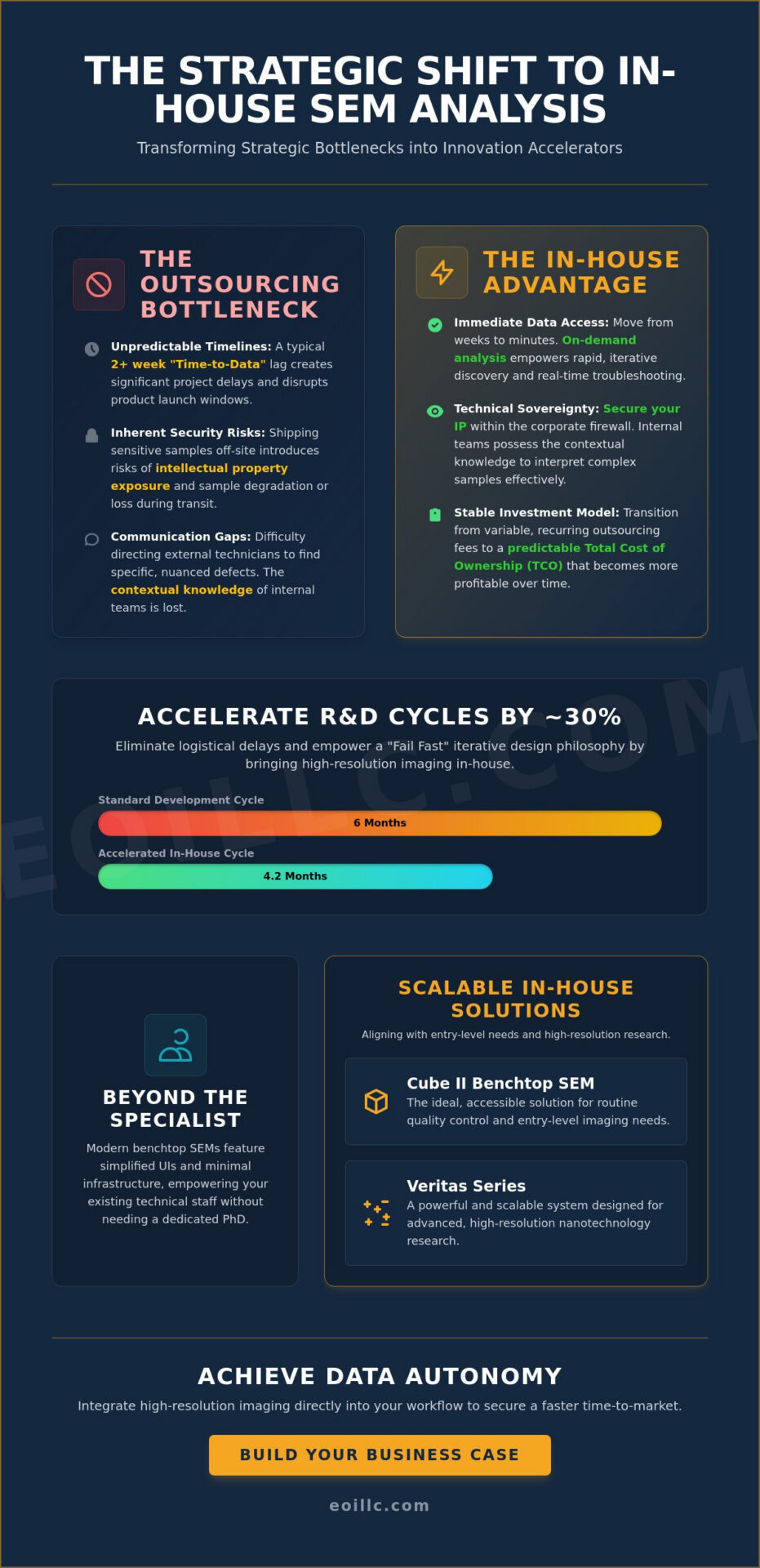
The reliance on external laboratories often creates a strategic bottleneck that hinders the steady flow of innovation. Organizations frequently find themselves trapped in an outsourcing cycle where the lack of immediate data access delays critical decision-making. By internalizing these capabilities through systems like the Veritas Series or the Cube II Benchtop SEM, enterprises transition from a state of service-dependence to one of technical sovereignty. This transition is essential for maintaining the meticulous standards required in specialized industrial sectors where precision and reliability are paramount.
The Hidden Friction of Outsourced Microscopy
Quantifying the “Time-to-Data” lag reveals the true cost of external analysis. A typical two-week delay from a contract facility can significantly disrupt product launch windows, especially in fast-moving sectors like semiconductor development or advanced metallurgy. Beyond scheduling, the logistical risks of sample degradation or loss during transport remain a constant concern for quality assurance teams. There is also a persistent communication gap; directing an external technician to locate specific, “needle in a haystack” defects is notoriously difficult. Internal teams possess the contextual knowledge required to interpret complex samples, a nuance that is often lost when samples are shipped off-site.
Transitioning from Service-Dependent to Data-Autonomous
Immediate access to imaging fundamentally alters the creative process in materials science. When microscopy becomes an on-demand tool, engineering teams experience a psychological shift, moving from a mindset of cautious experimentation to one of rapid, iterative discovery. This accessibility fosters an environment where “what-if” scenarios can be tested in minutes rather than weeks. Data-autonomy in laboratory instrumentation is the organizational capacity to generate, interpret, and apply technical insights without reliance on third-party analytical intermediaries. This autonomy ensures that intellectual property remains secure within the corporate firewall while accelerating the path toward large-scale production excellence.
Operational Efficiency and the Acceleration of R&D Cycles
Accelerating research and development cycles requires more than just skilled personnel; it necessitates immediate access to high-fidelity analytical instrumentation. The “Fail Fast” philosophy, which serves as a cornerstone for modern iterative design, relies heavily on the ability to inspect prototypes immediately following fabrication. By internalizing scanning electron microscopy, organizations can reduce a standard six-month development cycle by approximately 30 percent. This efficiency gain is primarily realized through the elimination of external logistical delays and the institutional capacity for immediate troubleshooting. Such technical agility is critical for maintaining a competitive edge in sectors where product life cycles are increasingly compressed.
Integrating EDS (Energy Dispersive Spectroscopy) Systems directly into the internal workflow allows for simultaneous topographical imaging and elemental mapping. This synergy is vital for identifying microscopic contaminants or verifying complex alloy compositions in real-time. Instead of waiting for a third-party laboratory to process batch samples, quality control teams can transition toward continuous verification. This shift ensures that production standards never deviate from specified tolerances, thereby maintaining the meticulous reliability expected in high-stakes industrial sectors. The transition from batch-based sampling to real-time verification represents a significant milestone in achieving operational excellence.
Real-Time Iteration and the Feedback Loop
The capacity for instant feedback transforms the laboratory into a dynamic environment where “adjust-and-retest” workflows occur within a single afternoon. Consider the technical challenge of troubleshooting a semiconductor coating defect. In an outsourced model, an engineer might wait days for an external report, only to find the provided data insufficient for root-cause analysis. With a Total Cost of Ownership (TCO) strategy that prioritizes internal assets like the Veritas FE SEM, that same engineer can identify the defect, adjust deposition parameters, and re-verify the results before the workday concludes. Modern automated imaging software further ensures that results remain consistent across various operators, maintaining technical accuracy without requiring extensive manual calibration.
Safeguarding Intellectual Property in High-Stakes Analysis
A significant component of the business case for in-house sem analysis involves the mitigation of risks related to intellectual property. Sending proprietary prototypes to shared-use core facilities introduces the danger of “IP Leakage,” where sensitive design details might be exposed to unauthorized personnel or competitors. For organizations operating in defense or aerospace, maintaining a closed-loop research environment is often a non-negotiable requirement. Internalizing the analysis ensures that the data chain-of-custody remains entirely within the corporate firewall, fulfilling stringent regulatory compliance standards and protecting the technical foundations of the brand’s competitive advantage.
The Economic Framework: ROI and Total Cost of Ownership (TCO) in 2026
The economic transition from operational expenditure (OPEX) to capital expenditure (CAPEX) constitutes the analytical core of any robust business case for in-house sem analysis. In the 2026 fiscal environment, decision-makers must weigh the cumulative burden of external laboratory fees against the long-term stability of an amortized asset. While outsourcing may appear cost-effective for sporadic testing, the financial narrative shifts rapidly as R&D volumes scale. Ownership of a Cube II Benchtop SEM allows an organization to replace variable, high-cost service invoices with a predictable depreciation schedule, directly improving the bottom line over a three to five year horizon. This strategic shift is further bolstered by U.S. tax provisions, such as Section 179 deductions, which allow firms to expense the full purchase price of qualifying equipment in the year of acquisition, significantly accelerating the return on investment.
A comprehensive assessment of the business case for in-house SEM must extend beyond the initial purchase price to include maintenance, SEM filaments, and power requirements. Modern benchtop systems are engineered for efficiency, consuming a fraction of the energy required by legacy floor models while utilizing simplified consumable paths. By internalizing these costs, enterprises gain immunity from the price volatility and scheduling premiums often associated with high-demand contract facilities.
Quantifying the Break-Even Point
Determining the precise moment of profitability requires a granular analysis of current outsourcing expenditures. Most contract facilities in 2026 command hourly rates ranging from $200 to $500, not including expedited processing fees or shipping costs. To calculate the break-even point, firms should aggregate these direct expenses alongside “soft costs,” such as the engineering downtime incurred while technical teams wait weeks for critical data. When a laboratory reaches a consistent volume threshold of approximately 10 to 15 samples per month, the amortized cost of an internal system typically becomes lower than the equivalent external spend. For organizations looking to refine these projections, consulting a detailed guide on how much does an electron microscope cost is a necessary step in the budget planning process.
Benchtop SEM vs. Traditional Floor Models
The “Desktop Revolution” has fundamentally altered the infrastructure requirements for high-resolution imaging. Unlike traditional floor-standing units that necessitate specialized vibration isolation, lead-shielded rooms, or high-voltage electrical modifications, a compact desktop SEM is designed for plug-and-play integration within existing laboratory footprints. This reduction in facility preparation costs represents a significant hidden saving in the TCO model. Furthermore, the maintenance simplicity of benchtop units, which often feature user-replaceable filaments and streamlined vacuum systems, reduces the frequency and cost of preventative maintenance visits compared to their complex floor-model counterparts. By optimizing the cost per square foot of laboratory space, companies can allocate more resources toward actual research rather than facility overhead.
Navigating Implementation: Infrastructure, Training, and Integration
The successful execution of a business case for in-house sem analysis depends on an organization’s ability to transition from conceptual approval to seamless operational integration. Historically, a significant specialist barrier acted as a deterrent, as legacy systems required a dedicated PhD-level operator to manage complex alignment and vacuum sequences. In the 2026 landscape, the integration of intelligent software and automated hardware has democratized this technology, allowing versatile engineering teams to achieve expert-level results. By developing rigorous internal Standard Operating Procedures (SOPs), technical departments ensure that imaging remains standardized across various projects. This institutionalization of technical knowledge is supported by a commitment to hardware reliability, where scheduled Preventative Maintenance Visits ensure that the instrumentation maintains 99% uptime, effectively serving as a continuous resource for the entire enterprise.
Mitigating the Learning Curve with Modern UI
The transition from manual tactile knobs to sophisticated touchscreen interfaces and AI-assisted focusing represents a paradigm shift within the Cube II and Veritas Series. These advancements allow researchers to concentrate on data interpretation and material characterization rather than the minutiae of instrument calibration. To ensure an immediate return on the investment, on-site training fees represent a strategic allocation that accelerates team competency and significantly reduces the time-to-first-result. Furthermore, automated sample navigation reduces operator error by providing a digital map of the specimen stage, which prevents accidental contact and preserves the integrity of sensitive SEM Filaments.
Facility Requirements and the Desktop Revolution
One of the most compelling technical arguments in the business case for in-house sem analysis is the minimal infrastructure required for contemporary benchtop units. Unlike traditional floor models that demand specialized high-voltage wiring and complex water-cooling loops, systems like the Genesis Tabletop SEM operate on standard 110V power. While sensitivity to vibration and electromagnetic interference (EMI) remains a factor, most 2026 benchtop electron optics are engineered with internal dampening that allows for deployment in standard office or laboratory environments. Finally, the ability to integrate raw imaging data and EDS results directly into existing Laboratory Information Management Systems (LIMS) ensures that microscopic insights are immediately accessible to stakeholders across the global organization. To begin optimizing your internal laboratory capabilities, explore our full range of Veritas Series SEM solutions today.
The Cube II and Veritas Advantage: Future-Proofing Your Laboratory
The selection of specific instrumentation represents the final, critical phase in solidifying the business case for in-house sem analysis. For organizations initiating their transition from external contract laboratories, the Cube II Benchtop SEM serves as an ideal entry point, providing a sophisticated balance of high-resolution imaging and operational simplicity. As research requirements mature, the Veritas Series offers a scalable trajectory toward advanced nanotechnology and sub-nanometer characterization. These systems, ranging from the Veritas Plus to the Veritas FE SEM, ensure that a laboratory’s analytical capacity can evolve in parallel with its technical ambitions. Choosing a platform that accommodates future growth is essential for maintaining long-term industrial relevance and maximizing the lifecycle value of the investment.
Technical sovereignty is achieved when the hardware choice aligns with both current budgetary realities and future developmental milestones. While previous sections of this analysis focused on the economic and operational shifts, the hardware selection defines the ultimate ceiling of your research capabilities. By selecting a partner with a deep catalog of specialized electron optics, firms ensure they aren’t locked into a static technology stack. Instead, they gain a flexible foundation that supports the meticulousness required for international production standards.
Scalable Solutions for Growing Research Demands
Strategic laboratory development often begins with the Genesis Tabletop SEM, a system designed for routine characterization and high-throughput screening. As resolution requirements intensify, organizations can migrate toward the Veritas Ultra or Veritas HR SEM without the friction of adopting an entirely new software ecosystem. This modularity extends to analytical capabilities; adding EDS (Energy Dispersive Spectroscopy) Systems allows for the integration of elemental mapping as project scopes expand. For budget-conscious startups or emerging research departments, Refurbished SEM Units provide a viable pathway to technical sovereignty without the initial capital intensity of new hardware. This tiered approach ensures that the business case remains sound throughout every stage of organizational growth.
Why Partnering with Electron Optics Instruments Ensures Long-Term Value
Technical hardware is only as effective as the support infrastructure that sustains it. Electron Optics Instruments (EOI) brings over 30 years of US-based distribution and technical expertise to every partnership, offering a level of stability that is rare in the specialized instrumentation sector. This longevity translates into a low-risk environment for the client, as EOI provides direct access to US-based field service engineers for rapid troubleshooting and technical consultation. A core component of this partnership is a “Service-First” philosophy, where comprehensive SEM maintenance is treated as a proactive strategy rather than a reactive necessity. By securing a steady supply of SEM Filaments and Consumables and scheduling regular Preventative Maintenance Visits, organizations protect their precision assets and ensure continuous operational excellence. Ownership of a Veritas or Cube II system is more than a simple acquisition; it’s a decisive competitive pivot that secures a company’s position at the forefront of industrial innovation.
Securing Technical Sovereignty: The Path Toward Analytical Excellence
Transitioning to an internal laboratory footprint represents more than a strategic financial adjustment; it is a commitment to industrial leadership and technical velocity. Developing a robust business case for in-house sem analysis empowers your organization to eliminate external dependencies while securing sensitive intellectual property within a controlled environment. By internalizing characterization through the Cube II or Veritas series, enterprises optimize their total cost of ownership and accelerate development cycles through immediate, high-fidelity data access. This shift ensures that your analytical capabilities remain as rigorous as your production standards.
Electron Optics Instruments supports this transition with over 30 years of industry experience as the sole US distributor for EmCraft SEMs. Our team provides the stability required for large-scale technical integration, offering comprehensive service contracts and professional on-site training to ensure peak operational performance from day one. Request a Custom ROI Analysis and Quote for the Cube II Benchtop SEM to quantify the specific impact this investment will have on your technical workflow. Establishing an internal microscopy suite is the definitive step toward achieving the meticulous precision and rapid innovation required for the next generation of industrial excellence.
Frequently Asked Questions
What is the typical break-even point for an in-house SEM compared to outsourcing?
The break-even point for an in-house SEM typically occurs when an organization reaches a consistent volume of 10 to 15 samples per month. At this threshold, the amortized cost of ownership falls below the cumulative expense of external laboratory fees and logistical overhead. This calculation is a fundamental component of the business case for in-house sem analysis, as it demonstrates the transition from variable service costs to a stable capital asset.
Do I need a PhD-level operator to run a benchtop SEM in 2026?
Modern benchtop systems don’t require a PhD-level operator because advancements in user interface design and AI-assisted focusing have automated complex alignment procedures. Technical teams can achieve high-fidelity results after completing professional on-site training provided by the distributor. This democratization of electron microscopy allows researchers to focus on data interpretation rather than the intricacies of instrument calibration.
What are the infrastructure requirements for installing a Cube II Benchtop SEM?
Installing a Cube II Benchtop SEM requires minimal infrastructure, utilizing standard 110V power without the need for specialized water cooling or high-voltage electrical modifications. While environmental stability is important, these compact units feature internal dampening that allows for deployment in standard laboratory or office settings. This capability significantly reduces the facility preparation costs associated with traditional electron optics.
How does in-house SEM analysis improve intellectual property security?
In-house analysis enhances intellectual property security by maintaining a closed-loop research environment where proprietary prototypes never leave the corporate firewall. This eliminates the risk of sensitive data exposure inherent in shared-use core facilities or third-party contract labs. Internalizing these capabilities ensures that the entire data chain-of-custody remains strictly within the organization’s control.
Can a benchtop SEM provide the same resolution as a traditional floor model?
Contemporary benchtop SEMs provide sufficient resolution for the vast majority of industrial R&D and quality control applications, effectively closing the gap with legacy floor models. While specialized floor systems like the Veritas FE SEM are necessary for sub-nanometer characterization, the Cube II series offers high-performance imaging for routine topographical and elemental analysis. Organizations should evaluate their specific resolution requirements to determine the most cost-effective platform.
What are the recurring costs associated with owning a scanning electron microscope?
Recurring costs for scanning electron microscope ownership primarily include SEM filaments, aperture consumables, and scheduled preventative maintenance visits. These operational expenses are predictable and can be integrated into the long-term business case for in-house sem analysis to ensure maximum instrument uptime. Maintaining a consistent supply of consumables prevents technical bottlenecks and preserves the precision of the electron optics.
How does Energy Dispersive Spectroscopy (EDS) integrate into the business case?
Energy Dispersive Spectroscopy (EDS) integrates into the business case by providing simultaneous topographical imaging and chemical characterization within a single workflow. This multi-modal analysis accelerates troubleshooting by allowing engineers to identify contaminants or verify alloy compositions in real-time. Integrating EDS systems reduces the need for secondary analytical steps, further streamlining the path toward product validation.
Is it better to buy a new benchtop SEM or a refurbished floor-standing model?
The choice between a new benchtop SEM and a refurbished floor-standing model depends on specific requirements for sample chamber size and ultimate resolution. Refurbished SEM units provide a high-value alternative for organizations requiring the large-chamber capacity of a floor model without the capital intensity of a new system. Conversely, a new Genesis or Cube II unit offers the latest advancements in automated software and a compact footprint for routine high-resolution imaging.