

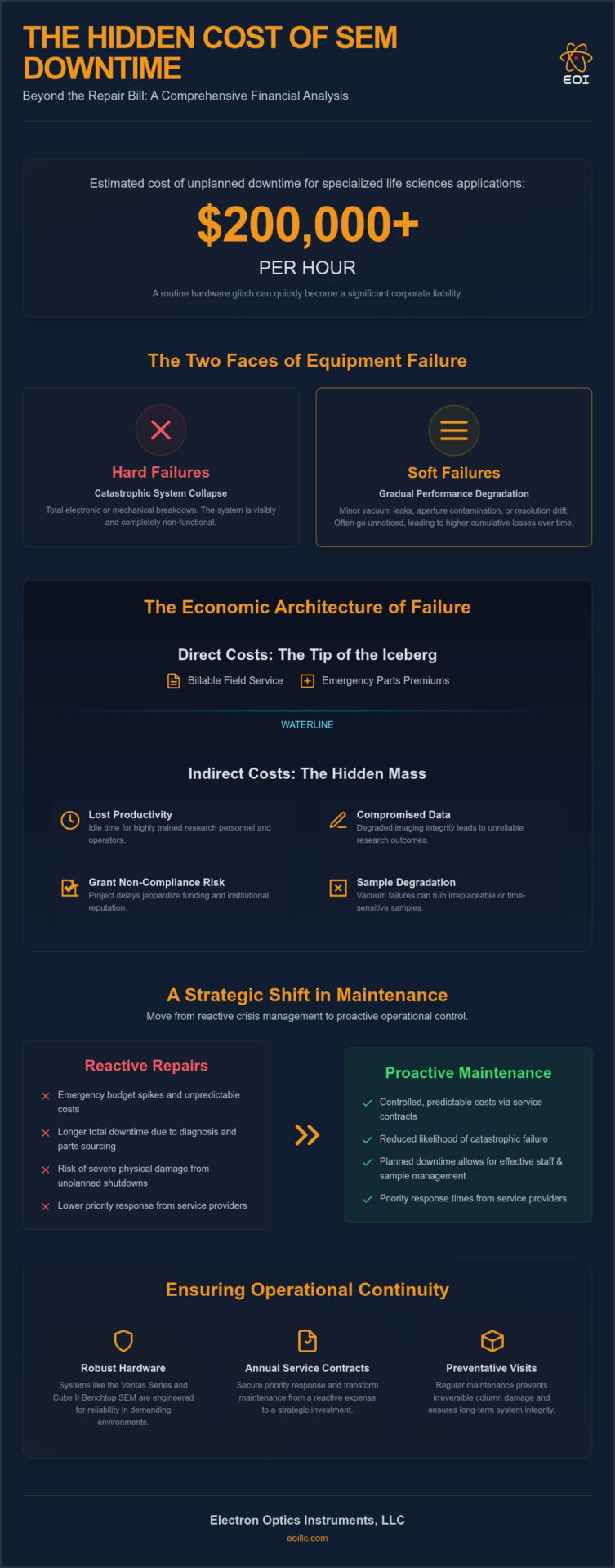
While a malfunctioning scanning electron microscope is often viewed through the narrow lens of a localized technical failure, the actual economic repercussions are far more expansive. For specialized life sciences applications in 2026, the estimated cost of unplanned downtime can exceed $200,000 per hour, a figure that transforms a routine hardware glitch into a significant corporate liability. You likely understand that equipment instability disrupts your daily workflow, yet the true cost of sem downtime frequently remains obscured by fragmented accounting and overlooked indirect expenses.
This analysis promises to quantify the multi-layered financial risks associated with microscope failure, ranging from the immediate loss of industrial productivity to the long-term danger of research grant non-compliance. We’ll explore a comprehensive framework for calculating Total Cost of Ownership (TCO) and demonstrate how strategic investments in systems like the Veritas Series or proactive maintenance visits can reduce operational volatility. By examining data-backed justifications for preventative care, this report provides the technical authority needed to transform maintenance from a reactive expense into a visionary strategy for institutional reliability and sustained logistical excellence.
Key Takeaways
- Define the scope of equipment failure beyond total system crashes to include soft failures that compromise analytical resolution and imaging precision.
- Learn to calculate the comprehensive cost of sem downtime by integrating direct repair expenses with the significant lost productivity of specialized research personnel.
- Establish a strategic framework for shifting from reactive repairs to proactive maintenance, significantly reducing the likelihood of emergency budgetary spikes.
- Recognize the financial return on investment provided by annual service contracts and regular preventative maintenance visits to prevent irreversible column damage.
- Discover how robust hardware solutions, such as the Veritas Series and Cube II Benchtop SEM, are engineered to maintain operational excellence in demanding laboratory environments.
Defining SEM Downtime in the Modern Research Environment
In high-precision laboratory environments, the definition of operational status must extend beyond a binary power state. A Scanning Electron Microscope (SEM) is considered non-functional whenever it fails to achieve its certified resolution or analytical accuracy. This nuanced perspective is essential for calculating the true cost of sem downtime, as it accounts for the subtle drift in performance that precedes a total system crash. When an instrument cannot provide the high-end quality required for specialized industrial sectors, it’s effectively offline, regardless of whether the software remains active.
Distinguishing between a hard failure, characterized by catastrophic electronic or mechanical collapse, and a soft failure is vital for accurate financial modeling. Soft failures, such as minor vacuum leaks or degraded imaging caused by aperture contamination, often result in higher cumulative losses. These issues frequently persist unnoticed, compromising the integrity of research data and causing backlogged failure analysis queues before a technician is eventually summoned. Achieving superior standards in microscopy requires a constant state of technical integration that soft failures quietly erode.
Calculating the total impact requires a comprehensive view of the recovery window. This period includes the time necessary for vacuum pump-down, filament conditioning, and the stabilization of the electron optics. Without accounting for these methodical procedures, the financial impact of an outage is consistently underestimated. The vacuum system remains the most critical component in maintaining long-term electron optics integrity, and its failure impacts every subsequent phase of the imaging workflow.
The Physical Risks of Unplanned System Shutdowns
Sudden vacuum loss presents severe risks to the internal architecture of high-end instruments. When power fails or a seal is compromised unexpectedly, oil back-streaming from mechanical pumps can contaminate the high-vacuum chamber and sensitive apertures. Power fluctuations also introduce thermal shock to sensitive components, specifically filaments and field emission sources, which can lead to immediate fracture or accelerated degradation. This improper cold shutdown triggers long-term technical degradation that persists long after the initial restart. The recovery period is the time from restoration of power to the completion of final beam alignment.
Planned vs. Unplanned Outages
Scheduled preventative maintenance represents a strategic advantage over reactive, emergency repairs. Planned downtime allows laboratory managers to implement sample queue management and reallocate highly trained technicians to alternative high-value tasks. These scheduled events also facilitate better coordination with service providers. Organizations that maintain active service contracts receive priority response times, which is a critical factor in mitigating the cost of sem downtime during unforeseen technical interruptions. Utilizing reliable systems like the Veritas Series or the Cube II Benchtop SEM ensures that when maintenance occurs, it’s a controlled component of a broader strategy for logistical excellence rather than an unpredictable budgetary spike.
The Economic Architecture of SEM Failure: Direct and Indirect Costs
Understanding the financial structure of equipment failure requires a shift from simple expense tracking to a comprehensive ROI analysis. U.S. manufacturers spend billions on machinery maintenance annually, yet the most significant losses often stem from the secondary ripples of an outage. The cost of sem downtime is built upon an architecture of both visible invoices and invisible productivity drains that can destabilize a laboratory’s fiscal health.
Visible costs include billable field service rates and the premium pricing associated with emergency replacement parts. In 2026, supply chain complexities often inflate these figures, especially when sourcing specialized components for legacy systems. These line items represent only the tip of the fiscal iceberg. Vacuum failures also introduce the risk of sample degradation. For sensitive biological or chemical specimens, a loss of pressure doesn’t just halt the imaging process; it can physically destroy unique samples that are impossible to replace, adding a layer of irrecoverable value loss to the total economic impact.
The “Idle Expert” problem remains a primary driver of indirect loss. When a high-resolution instrument goes offline, the loss isn’t merely the machine’s utility; it’s the stalled productivity of PhD-level researchers and senior technicians. Their burdened labor rates, which include salary, benefits, and overhead, continue to accumulate while critical failure analysis queues remain stagnant. This specialized labor is too expensive to remain unproductive.
Labor and Opportunity Costs
Laboratory managers must account for the ripple effect of missed project deadlines and grant reporting milestones. A single week of failure can jeopardize multi-year research funding or delay a product’s time-to-market. Additionally, the opportunity cost of diverted management attention is substantial. Instead of focusing on innovation, leadership is forced into crisis management, negotiating repair schedules and re-prioritizing backlogged samples. These distractions erode the visionary focus required for institutional growth.
Industrial Production and Quality Control Impact
In sectors like semiconductor manufacturing or aerospace engineering, the SEM is a critical gatekeeper. Stopping a production line because real-time failure analysis is unavailable can result in losses exceeding $50,000 per hour. Regulatory and compliance risks also escalate when quality assurance testing is delayed, potentially leading to non-conformance penalties. Implementing a Cube II Benchtop SEM as a redundant or primary analytical tool reduces these risks through a simplified operational architecture that’s easier to maintain than complex floor models. To ensure these economic variables don’t compromise your laboratory’s stability, consider the long-term security provided by our Annual Service Contracts.
Calculating Your Specific Cost of SEM Downtime
Quantifying the financial impact of equipment failure requires more than a cursory glance at repair invoices. A rigorous business impact analysis is necessary to identify the variables that dictate institutional stability. By utilizing a framework for Calculating Your Specific Cost, laboratory directors can move beyond guesswork and establish a multi-variable formula: (Labor + Parts + Opportunity Cost + Recovery Time). This systematic approach reveals that the cost of sem downtime is rarely linear. A 48-hour outage is often 10x more expensive than a 4-hour outage because it triggers a cascading failure in sample queues and forces the rescheduling of high-priority industrial contracts.
When evaluating the electron microscope cost, organizations must weigh the initial capital investment against the expected uptime percentage. High-resolution imaging systems are precision instruments that require a meticulously managed environment to function at peak efficiency. Historical service data serves as a visionary tool, allowing facilities to predict future fiscal volatility based on past component lifecycles. To maintain a steady narrative of reliability, the true cost of ownership must include a 5-10% annual contingency for unplanned maintenance, ensuring that emergency repairs don’t derail long-term corporate milestones.
The Downtime Cost Matrix
The following table illustrates how different failure modes impact laboratory resources and recovery timelines. These estimates highlight the necessity of technical integration and rapid response capabilities.
| Failure Mode | Direct Expense Level | Recovery Window | Operational Impact |
|---|---|---|---|
| Minor Alignment Issue | Low | 2-4 Hours | Minimal backlog; local calibration required. |
| Major Column Contamination | Moderate to High | 24-72 Hours | Significant sample queue disruption; requires expert cleaning. |
| Vacuum Pump Failure | High | 3-7 Days | Total system shutdown; risks of aperture damage and oil back-streaming. |
In addition to these variables, laboratories must factor in the escalating cost of emergency shipping for specialized SEM consumables and filaments, which can add significant premiums to an already inflated repair bill.
Intangible Costs: Reputation and Morale
The economic architecture of a laboratory is built on the foundation of trust and technical authority. Chronic equipment instability erodes this foundation, leading to a palpable decline in staff morale as PhD-level researchers face the psychological burden of unreliable instrumentation. When a commercial testing laboratory cannot meet its delivery promises, client trust evaporates, often resulting in the permanent loss of high-value industrial partnerships. These intangible costs are difficult to quantify on a balance sheet but represent a direct threat to the brand’s position as a leader in specialized research sectors.
Supporting the well-being of your research team during these periods of high stress is vital; to find resources on mental health and personal balance, visit Lumina.
Strategic Mitigation: Transitioning from Reactive to Proactive Maintenance
Transitioning from a reactive “break-fix” mentality to a proactive maintenance framework is the most effective method for controlling the cost of sem downtime. While modern incident management software might offer predictive alerts, physical components like apertures and filaments require manual inspection and timely replacement to ensure precision. A rigorous preventative maintenance (PM) schedule acts as a visionary insurance policy, identifying nascent vacuum leaks before they escalate into catastrophic column contamination or oil back-streaming events. Catching these issues early preserves the integrity of the electron optics and maintains the superior standards required for specialized industrial sectors.
The fiscal ROI of SEM maintenance service contracts becomes evident when comparing the stability of planned outages against the volatility of emergency repairs. By committing to a structured oversight program, laboratories can normalize their maintenance budgets and eliminate the unpredictable spikes associated with overnight shipping and high-priority technician dispatch. This methodical approach ensures that technical integration remains a core strength rather than an operational vulnerability.
The Value of Tiered Service Agreements
Relying on ad-hoc, on-call labor rates exposes an organization to significant financial risk during periods of high demand. Priority service contracts provide discounted labor rates and guaranteed response times within a formal Service Level Agreement (SLA), which directly mitigates the duration of an outage. Comprehensive parts coverage is particularly vital for aging scanning electron microscope models, where sourcing rare components can otherwise lead to weeks of inactivity. These agreements transform maintenance from a variable liability into a predictable operational anchor.
Operator Training as a First Line of Defense
Technical proficiency among staff is a critical component of institutional reliability. Professional on-site SEM training significantly reduces downtime attributed to human error, such as improper sample loading or filament over-saturation. Establishing best practices for daily SEM operation ensures that every user understands how to extend component lifespans through meticulous hardware management. Teaching staff to recognize early warning signs, such as subtle shifts in vacuum recovery times or minor image astigmatism, allows for intervention before a total system crash occurs.
Maintaining a strategic inventory of critical consumables, including filaments and apertures, further ensures that minor hardware failures don’t evolve into multi-day crises. To secure your laboratory’s operational continuity against the rising cost of sem downtime, we recommend exploring our Preventative Maintenance Visits to establish a foundation of technical excellence.
Ensuring Operational Continuity with Electron Optics Instruments, LLC
Mitigating the cost of sem downtime requires a partnership with a service provider that possesses a deep, multi-generational understanding of electron optics. With over 30 years of industry experience, Electron Optics Instruments, LLC provides the technical authority necessary to minimize laboratory volatility through meticulous hardware management and strategic oversight. We recognize that institutional reliability isn’t achieved through hardware alone; it’s the result of integrating high-performance systems with rigorous, expert-driven support frameworks that anticipate failure before it disrupts critical research cycles.
The Veritas Series and Cube II Benchtop SEM are specifically engineered to withstand the rigorous demands of high-throughput industrial and research environments. These systems prioritize maximum uptime by utilizing robust internal architectures that simplify routine maintenance and reduce the likelihood of the “soft failures” discussed in previous sections. For organizations managing diverse laboratory fleets, our manufacturer-agnostic service capability provides a significant logistical advantage. We possess the specialized expertise to service all major SEM manufacturers, ensuring that your entire analytical infrastructure remains operational under a single, unified technical standard.
Customized service contracts act as a visionary anchor for institutional planning. By aligning these agreements with your specific budgetary cycles, we help transform unpredictable repair spikes into stable, manageable investments. This strategic alignment ensures that financial resources are preserved for innovation rather than being drained by emergency logistical crises. Our approach focuses on the synergy between industrial performance and fiscal responsibility, providing a grounded reality where technical excellence and economic stability coexist.
Advanced Diagnostics and Rapid Repair
Our rapid field service protocols are designed for both proprietary and third-party SEM systems, ensuring that technical interruptions are resolved with minimal impact on your sample queue. The preventative maintenance visits we conduct are far more than a simple cleaning; they involve a comprehensive diagnostic evaluation of the vacuum integrity, electronic stability, and beam alignment. This meticulousness ensures that every component of the electron optics system is functioning at its certified resolution. Our service contracts are designed to transform unpredictable repair costs into manageable, fixed annual operating expenses.
Contact Our Specialists for a Risk Assessment
We invite laboratory directors and facility managers to evaluate their current fleet’s vulnerability to unplanned outages through a professional risk assessment. Whether you operate in an industrial, academic, or high-stakes research setting, our specialists can develop customized service solutions that reflect the unique requirements of your imaging workflow. Don’t allow technical instability to compromise your institutional reputation or your bottom line. Protect your laboratory’s productivity with an Expert SEM Service Contract from eoillc.com and ensure your operations remain at the forefront of specialized industrial performance.
Securing Your Institutional Legacy Through Operational Resilience
The transition from reactive crisis management to a proactive maintenance framework is the defining characteristic of a resilient laboratory. By quantifying the comprehensive cost of sem downtime, organizations can move beyond the surface-level expense of replacement parts and address the deeper economic drains of stalled research and compromised manufacturing yields. Meticulous oversight of vacuum systems and electron optics isn’t merely a technical necessity; it’s a strategic pillar that ensures your facility remains at the absolute forefront of industrial performance.
Leveraging over 30 years of industry experience, Electron Optics Instruments, LLC serves as a reliable partner for facilities seeking to eliminate operational volatility. As the sole US distributor for EmCraft SEMs and a provider with the technical capability to service all major SEM brands, we bring international capability to your specific imaging challenges. Transforming unpredictable failures into managed, visionary growth is within your reach today.
Request a Quote for an SEM Service Contract or Preventative Maintenance Visit to safeguard your laboratory’s future. We’re ready to help you achieve superior standards in every analysis.
Frequently Asked Questions
What is the average cost of SEM downtime per hour in 2026?
Current industrial data indicates that the financial impact varies significantly by sector. For industrial life sciences settings, the estimated cost of unplanned downtime ranges between $30,000 and $50,000 per hour. In specialized applications or large-scale manufacturing environments, these figures can escalate to $125,000 or even $200,000 per hour when accounting for lost production and sample compromise.
How does unplanned downtime affect the lifespan of an electron microscope column?
Sudden outages accelerate the degradation of sensitive electron optics through thermal shock and vacuum instability. When a system crashes unexpectedly, mechanical pump oil can back-stream into the high-vacuum chamber, leading to permanent aperture contamination. These repeated hard failures introduce irreversible surface oxidation and electronic drift, significantly shortening the operational lifespan of the column assembly.
Is a service contract more cost-effective than paying hourly for repairs?
Annual service contracts provide a superior fiscal framework for institutional stability. While ad-hoc hourly rates might appear lower in isolation, they lack the priority response times and parts coverage essential for minimizing outages. A contract acts as a strategic insurance policy, normalizing the cost of sem downtime by converting emergency repair spikes into predictable annual operating expenses.
Can operator training significantly reduce the cost of downtime?
Professional on-site training is a critical first line of defense against technical volatility. Operators who are proficient in proper filament saturation and sample loading techniques prevent the majority of human-induced failures. This expertise allows staff to detect subtle shifts in vacuum recovery or image astigmatism early, facilitating intervention before a minor alignment issue evolves into a catastrophic system crash.
What are the most common causes of unplanned SEM outages?
The primary drivers of equipment failure include vacuum seal degradation, filament exhaustion, and electronic board malfunctions caused by power fluctuations. Contamination of the column or apertures also leads to “soft failures” where resolution is compromised. Additionally, difficulties in sourcing replacement parts for legacy systems often extend these periods of inactivity, transforming routine repairs into multi-week logistical crises.
How long does it typically take to restore a system after a vacuum failure?
System restoration typically requires a window of 24 to 72 hours, depending on the severity of the leak and the contamination level. This period accounts for the methodical vacuum pump-down, filament conditioning, and final beam alignment necessary to achieve certified resolution. If oil back-streaming occurred during the failure, the recovery period extends significantly to allow for meticulous column cleaning.
Does preventative maintenance actually prevent major hardware failures?
Rigorous preventative maintenance visits identify nascent hardware issues before they trigger a total system collapse. Regular inspections of vacuum seals and electronic tolerances ensure the instrument operates within its specified parameters. This proactive approach is essential for maintaining the superior standards required in high-throughput industrial environments, as it catches wear-and-tear that would otherwise lead to expensive emergency repairs.
What should be included in a comprehensive SEM downtime mitigation plan?
A robust plan must integrate a clear calculation of Total Cost of Ownership (TCO) with a scheduled preventative maintenance program and an inventory of critical consumables. It’s vital to establish a Service Level Agreement (SLA) with a reliable partner to ensure priority field response. This structured oversight effectively mitigates the cost of sem downtime by ensuring institutional reliability through technical integration and visionary resource management.