

The architectural integrity of a legacy vacuum system often represents a more significant financial asset than its current imaging output suggests. Determining the trade-in value of an old sem is not merely a matter of assessing chronological age; it’s a rigorous exercise in identifying the residual worth of high-precision hardware that remains viable for modern technical integration. Many laboratory directors find themselves constrained by the escalating maintenance costs and the disproportionate footprint of aging floor models that no longer meet contemporary throughput requirements. It’s understandable to feel that these legacy systems are more of a liability than an asset when justifying the capital expenditure for next-generation instrumentation. The path to modernization starts with a clear valuation.
This 2026 valuation guide promises to clarify the complexities of the secondary market, enabling you to leverage existing hardware for a high-performance benchtop upgrade. We’ll examine the specific factors that dictate residual value, from vacuum stability to column condition, and demonstrate how to maximize ROI by transitioning to the Cube II or the Veritas series. This transition supports both industrial performance and the sustainable development of your laboratory’s infrastructure. By the end of this analysis, you’ll possess a methodical roadmap for decommissioning underperforming assets while securing the advanced imaging capabilities your research demands.
Key Takeaways
- Learn to distinguish between chronological age and the core architectural integrity that determines the professional trade-in value of an old sem in the 2026 industrial market.
- Understand the financial implications of instrument format, specifically how transitioning from high-maintenance floor models to benchtop systems like the Cube II can mitigate decommissioning liabilities.
- Identify the essential documentation and operational metrics, such as vacuum stability and service logs, required to secure a competitive valuation for legacy assets.
- Discover how to leverage trade-in credits alongside tax incentives to significantly reduce the total cost of ownership for the high-performance Veritas or Genesis series.
- Explore a streamlined, turn-key modernization path that integrates expert decommissioning with the precise installation of next-generation imaging technology.
Factors Influencing SEM Trade-In Value in 2026
Defining the trade-in value of an old sem requires a thorough analysis of the instrument’s residual utility. It isn’t just a generic discount; it’s a calculated financial credit applied toward a new acquisition, such as a Cube II Benchtop SEM or a Veritas Series unit. This valuation is predicated on the ability of a specialized provider like EOI LLC to refurbish or repurpose the existing hardware. In 2026, the secondary market prioritizes instruments that offer a clear path to technical integration within modern laboratory workflows. A legacy system’s worth is essentially a reflection of its foundational architectural integrity.
The Role of Brand and Model Longevity
Manufacturer pedigree remains a decisive factor in determining how much credit a laboratory can expect to receive. Systems from JEOL, Hitachi, and FEI often retain higher percentages of their original value because their widespread global adoption facilitates a robust ecosystem for parts and specialized service expertise. When a model is ‘orphaned’ by its original manufacturer, meaning it’s no longer supported with software updates or mechanical components, its trade-in potential diminishes significantly. These systems often become disposal liabilities rather than financial assets. A brand’s commitment to rigorous engineering standards directly correlates to the 2026 resale viability of its legacy catalog.
Technical Integrity: From Vacuum to Optics
The core of a Scanning electron microscope is its vacuum system, which serves as the primary driver of desirability in the secondary market. The operational health of turbo-molecular pumps and ion pumps is critical. If these components show signs of degradation or excessive wear, the cost of professional refurbishment rises, subsequently lowering the trade-in offer. Column health is equally vital. Technicians examine aperture assemblies and the electron column for signs of irreparable contamination or physical wear that could compromise future imaging performance.
- Source Technology: The distinction between Tungsten and CeB6 filaments plays a major role in valuation. While Tungsten is reliable, the higher brightness and extended life of CeB6 sources often make those units more attractive for high-resolution applications.
- Analytical Capability: Modern valuation heavily weighs Energy Dispersive Spectroscopy (EDS) compatibility. Systems that can seamlessly integrate with current EDS hardware are prioritized for trade-up programs.
Ultimately, the trade-in value of an old sem is a reflection of its core infrastructure. A well-maintained column and a robust vacuum system provide the necessary stability for a successful upgrade to next-generation benchtop technology. By accurately assessing these technical factors, laboratory managers can maximize their ROI and ensure a seamless transition to more efficient imaging platforms.
Benchtop vs. Floor Model: How Format Impacts Residual Worth
The physical architecture of a microscope is a primary determinant of its liquidity in the 2026 secondary market. The trade-in value of an old sem is increasingly dictated by its footprint and the associated logistics of relocation. While traditional floor models once represented the pinnacle of imaging, the industrial sector now prioritizes superior space-to-performance ratios. High-performance systems like the Cube II or Genesis Tabletop SEM offer resolution capabilities that rival legacy floor units while occupying a fraction of the laboratory’s square footage. This shift has created a bifurcated market where compact, agile systems retain significant equity, while older, bulky models face steep depreciation.
The Declining Market for Bulky Floor Models
The 2026 market is unforgiving to bulk. While these systems once defined the standard for analytical precision, their reliance on complex water-cooling loops and specialized power infrastructure makes them difficult to place in modern, lean laboratory environments. Decommissioning a floor model involves specialized rigging and, in some cases, the management of legacy hazardous materials in older cooling systems. These logistical hurdles often result in ‘negative value,’ where the cost of removal exceeds the residual worth of the components. This trend is particularly evident in university SEM laboratories, where aging floor models are being systematically replaced to reclaim valuable facility space for multiple benchtop stations.
Even for non-functional instruments, a ‘core’ value exists based on the vacuum chamber integrity and column assembly. However, for large-scale units, the financial credit is often offset by the technical labor required for extraction. If you are assessing a legacy floor model, it’s wise to request a professional onsite evaluation to determine if the internal optics still hold trade-in potential.
The High Resale Demand for Benchtop SEMs
Conversely, benchtop SEMs like the Cube II maintain a remarkably high percentage of their original value. Their ‘plug-and-play’ vacuum systems and standard power requirements make them highly desirable for educational institutions and entry-level research sectors. The secondary market for these units is robust because they can be shipped and reinstalled with minimal technical overhead. This liquidity is a direct result of the desktop SEM evolutionary shift, which has proven that compact format does not necessitate a compromise in imaging quality or analytical depth.
- Digital Integration: Legacy analog systems have almost zero residual worth in 2026. Modern digital interfaces are essential for current data security and analysis protocols.
- Maintenance Simplicity: Benchtop units often feature modular components, making them easier to refurbish and thus more valuable as trade-in assets.
- Operational Status: A functional benchtop unit can often be traded in for a significant portion of the cost of a next-generation Veritas system.
Ultimately, the format of your instrument determines its path toward modernization. While floor models require careful decommissioning strategies, benchtop units serve as flexible financial levers that can be easily applied toward the acquisition of more advanced hardware.
Assessing Your Instrument: A Checklist for Laboratory Managers
Determining the trade-in value of an old sem requires a meticulous technical audit that transcends a simple visual inspection. Laboratory managers must transition from viewing their equipment as a static asset to evaluating it as a collection of interdependent subsystems. This assessment is the cornerstone of any successful modernization strategy, ensuring that the credit received reflects the true residual utility of the hardware. By conducting a systematic review, you provide the necessary data for a professional valuation that balances technical performance with market demand.
Documentation serves as the primary evidence of an instrument’s historical maintenance. Accurate service logs, preventative maintenance records, and original manuals aren’t merely administrative requirements; they’re value multipliers. When providing a valuation, experts look for a consistent history of professional care. Following University guidelines on valuing used equipment, the presence of comprehensive records significantly bolsters the market value by reducing the perceived risk for the refurbishing partner. Systems with missing logs often face a conservative valuation due to the uncertainty of their internal condition.
Step 1: Audit the Vacuum and Column History
Vacuum stability represents the absolute baseline for all SEM valuations. A system that cannot maintain its rated vacuum levels suggests underlying seal degradation or pump wear. Reviewing the history of column cleanings and aperture replacements provides insight into the instrument’s operational environment. Technicians must check for oil backstreaming or internal contamination, which can indicate that a legacy diffusion pump system has compromised the electron column’s architectural integrity. Imaging performance must be documented through current resolution tests and signal-to-noise ratio analysis. If the instrument can’t achieve its original factory specifications, the manager should identify whether the limitation is electronic or mechanical.
Step 2: Evaluate Integrated Analytical Tools
The valuation must also account for secondary systems that enhance the primary imaging function. Energy Dispersive Spectroscopy (EDS) systems are often the most valuable peripheral components. If the EDS hardware is modern enough to be transferred or sold as a standalone unit, it can substantially increase the trade-in value of an old sem. Similarly, the functionality of specialized stages, such as tensile, heating, or cooling modules, must be verified and documented.
Software and connectivity present the final hurdle in the assessment checklist. In 2026, instruments tethered to obsolete operating systems or proprietary data formats that lack modern export capabilities are valued lower. The ability to transfer software licenses to a subsequent user is a critical factor that often separates a high-value asset from a disposal liability. By systematically auditing these four pillars-documentation, operational status, imaging quality, and software-you ensure a transparent and maximized return on your legacy investment.
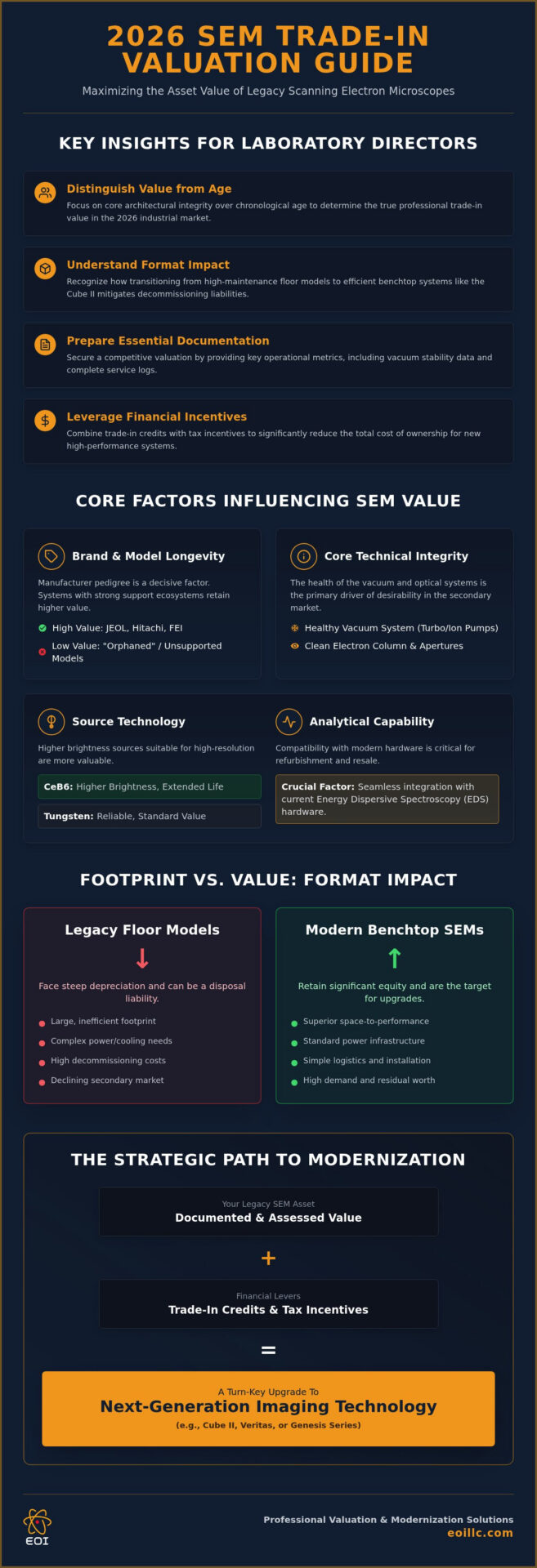
Strategic Trade-Up: Maximizing ROI on New SEM Acquisition
Strategic acquisition in 2026 involves more than selecting a high-performance unit. It requires a clinical assessment of how the trade-in value of an old sem can be utilized to compress the total cost of ownership (TCO). By converting a depreciated asset into immediate capital credit, laboratories bridge the gap between budgetary constraints and technical necessity. This approach effectively eliminates the ‘Zombie Lab’ effect. This occurs when obsolete floor models consume valuable facility resources while providing subpar analytical data. These legacy systems represent stagnant capital that could be better deployed into modern, high-throughput systems.
Choosing a direct trade-in over third-party auctions mitigates several operational risks. Auctions frequently involve unpredictable buyer premiums and significant logistical fees that erode the net recovery. A professional valuation ensures you receive the maximum trade-in value of an old sem, which can be immediately applied to a new Genesis or Veritas unit. This credit directly offsets the initial electron microscope cost, making high-end imaging more accessible. Additionally, US-based laboratories should consult with tax professionals regarding Section 179 deductions. This may allow for the full purchase price of new equipment to be deducted in the year of acquisition, which enhances the financial viability of an upgrade.
The Financial Math of the Trade-Up
Calculating the net cost of a Cube II requires looking beyond the sticker price. You must factor in the sem maintenance savings inherent in new technology. Legacy vacuum systems often require frequent, expensive repairs that disrupt laboratory throughput and inflate operational expenses. A new Veritas or Genesis unit arrives with comprehensive warranty coverage, providing predictable budgeting for the first several years of operation. These avoided costs, combined with the trade-in credit, significantly shorten the period required to achieve a full return on investment.
Operational Efficiency Gains
Modern benchtop systems offer a faster time-to-image that legacy units simply can’t match. Upgrading to advanced sem techniques opens new research funding opportunities and industrial partnerships that require high-resolution analytical microscopy. The reduction in staff training time is another critical factor. Intuitive sem operation software allows technicians to produce high-quality results with minimal oversight. This efficiency translates into higher laboratory output and lower labor costs per sample. To explore how your current asset can fund these improvements, request a formal trade-in evaluation from EOI LLC today.
The Electron Optics Instruments Advantage: Professional Valuation
Securing a competitive trade-in value of an old sem requires a partner with deep technical roots and a global perspective on equipment lifecycles. Electron Optics Instruments, LLC (EOI LLC) brings over 30 years of specialized expertise in electron optics to every valuation. This long-standing industry presence allows us to offer fair market assessments that reflect the true residual worth of major brands like JEOL, Hitachi, and FEI. Unlike general equipment liquidators, our focus is entirely on the intersection of innovation and reliability; we ensure your legacy assets are either responsibly recycled or professionally refurbished to support the next generation of researchers.
Our turn-key trade-in process is designed to eliminate the logistical friction often associated with laboratory modernization. We don’t just provide a credit; we manage the entire developmental arc from the decommissioning of bulky floor models to the precise installation of a Cube II or Veritas system. This integrated approach ensures that your laboratory transition is characterized by meticulous execution and technical excellence, reflecting our status as a seasoned innovator in the field.
Expert Decommissioning and Logistics
The removal of a legacy scanning electron microscope involves significant technical risk, particularly concerning the professional transport of sensitive electron optics. EOI LLC employs rigorous safety protocols to manage the decommissioning of high-voltage systems and vacuum assemblies. Our nationwide logistical reach allows us to coordinate the extraction of floor models with surgical precision. We prioritize the continuity of your research by synchronizing the removal of old hardware with the arrival of your new benchtop SEM. This strategy targets zero downtime, allowing your team to maintain its analytical momentum without the burden of managing complex rigging or hazardous material disposal.
Ongoing Support for Your New Veritas or Cube II
The value of a trade-up extends far beyond the initial installation. As the sole US distributor for EmCraft, EOI LLC provides a comprehensive support ecosystem for your new Veritas or Cube II unit. We integrate on-site technical training into the trade-up package to ensure your staff can fully exploit the advanced capabilities of the new hardware. Our deep inventory of SEM filaments and consumables guarantees that your laboratory remains operational without the delays of international shipping. We also offer customized preventative maintenance visits that bridge the gap between legacy practices and modern digital imaging standards. This commitment to long-term reliability reinforces our position as a high-tech authority and a reliable partner in your laboratory’s success.
Advancing Laboratory Capabilities through Strategic Asset Modernization
The methodical transition from legacy vacuum systems to high-performance benchtop instrumentation represents a critical pivot toward operational excellence. By accurately assessing the trade-in value of an old sem, laboratory directors can unlock stagnant capital and redirect it toward the acquisition of next-generation technology like the Veritas or Cube II series. This guide has detailed how architectural integrity and professional decommissioning serve as the primary pillars of a successful trade-up strategy, ensuring that your facility reclaims valuable square footage while significantly enhancing analytical throughput. Leveraging these legacy assets isn’t just a financial decision; it’s a commitment to the sustainable development of your research infrastructure.
Electron Optics Instruments brings over 30 years of industry expertise to this process, serving as the authorized EmCraft US distributor and providing comprehensive service for all major SEM brands. We ensure that every valuation is conducted with the meticulousness your high-precision hardware deserves. To begin your laboratory’s transformation, Request a Professional Valuation for Your Legacy SEM from Electron Optics Instruments. We look forward to partnering with you to reach new standards of imaging accuracy and reliability.
Frequently Asked Questions
What is the average trade-in value of a 10-year-old floor model SEM?
The valuation of a decade-old floor model is determined by its architectural integrity and the current market demand for its specific components. While these instruments often retain significant core value, the net credit is frequently adjusted based on the logistical complexity of decommissioning large-scale vacuum systems. A professional assessment is required to establish the precise trade-in value of an old sem, as brand reputation and the availability of refurbished parts play decisive roles in the final offer.
Can I trade in a non-functional electron microscope for credit toward a new benchtop unit?
Non-functional instruments frequently qualify for trade-in credit based on the residual worth of their primary structural elements. Even if the electronics are obsolete, the electron column and vacuum chamber may serve as critical chassis for refurbishment programs. EOI LLC evaluates these core assets to provide laboratories with a financial bridge toward modern benchtop technology, ensuring that non-operational hardware doesn’t remain a stagnant liability on the facility floor. This process supports both fiscal responsibility and industrial performance.
How does the condition of the vacuum system affect the trade-in offer?
Vacuum system integrity serves as the baseline for all technical valuations. Instruments that maintain stable vacuum levels without evidence of oil backstreaming or seal degradation command higher offers because they require less intensive refurbishment. Conversely, failures in turbo-molecular or ion pumps can significantly decrease the trade-in value of an old sem. This is because the cost of restoring these critical subsystems must be subtracted from the instrument’s potential resale equity during the professional valuation process.
Does Electron Optics Instruments accept trade-ins from brands other than EmCraft?
Electron Optics Instruments provides valuations and trade-in credits for all major scanning electron microscope brands. Our 30-year legacy in the sector has established a deep technical competency in the repair and relocation of systems from manufacturers such as JEOL, Hitachi, and FEI. While we are the sole US distributor for EmCraft, our refurbishment infrastructure is designed to integrate a diverse range of legacy hardware into our secondary market programs, ensuring a seamless transition for every partner.
Is it better to sell my old SEM at auction or trade it in to a distributor?
Trading in an instrument directly to a specialized distributor typically offers superior ROI compared to the volatility of third-party auctions. Auctions often involve unpredictable buyer premiums and significant logistical expenses that erode the net recovery for the laboratory. By choosing a trade-in, you secure a guaranteed credit that immediately reduces the total cost of ownership for a new Veritas or Cube II unit while offloading the complex decommissioning and removal responsibilities to seasoned experts.
What documentation do I need to provide for a professional SEM valuation?
A professional valuation requires a comprehensive portfolio of technical documentation. Laboratory managers should prepare all preventative maintenance records, service logs, and original manuals to substantiate the instrument’s operational history. Additionally, providing current imaging samples and vacuum stability data allows our technicians to conduct a more accurate remote assessment. These documents act as value multipliers by reducing the uncertainty associated with the hardware’s internal condition and the longevity of the electron column.
How long does the SEM trade-in and installation process typically take?
The timeline from initial valuation to the commissioning of a new system typically spans four to eight weeks. This duration accounts for the technical audit, the coordination of specialized rigging for decommissioning floor models, and the logistical transport of the new benchtop unit. We prioritize a streamlined workflow to target zero downtime, ensuring that the removal of your legacy asset is synchronized with the installation and staff training for your new Veritas series microscope.
Are there tax advantages to trading in old laboratory equipment in 2026?
Laboratory equipment acquisitions in 2026 continue to benefit from significant tax incentives in the United States. Under Section 179 of the tax code, many organizations can deduct the full purchase price of new or refurbished equipment in the year it’s placed into service. Furthermore, SEMs are typically categorized as 5-year or 7-year property for MACRS depreciation. These financial mechanisms, combined with trade-in credits, substantially improve the capital efficiency of upgrading to modern, high-performance imaging technology.