

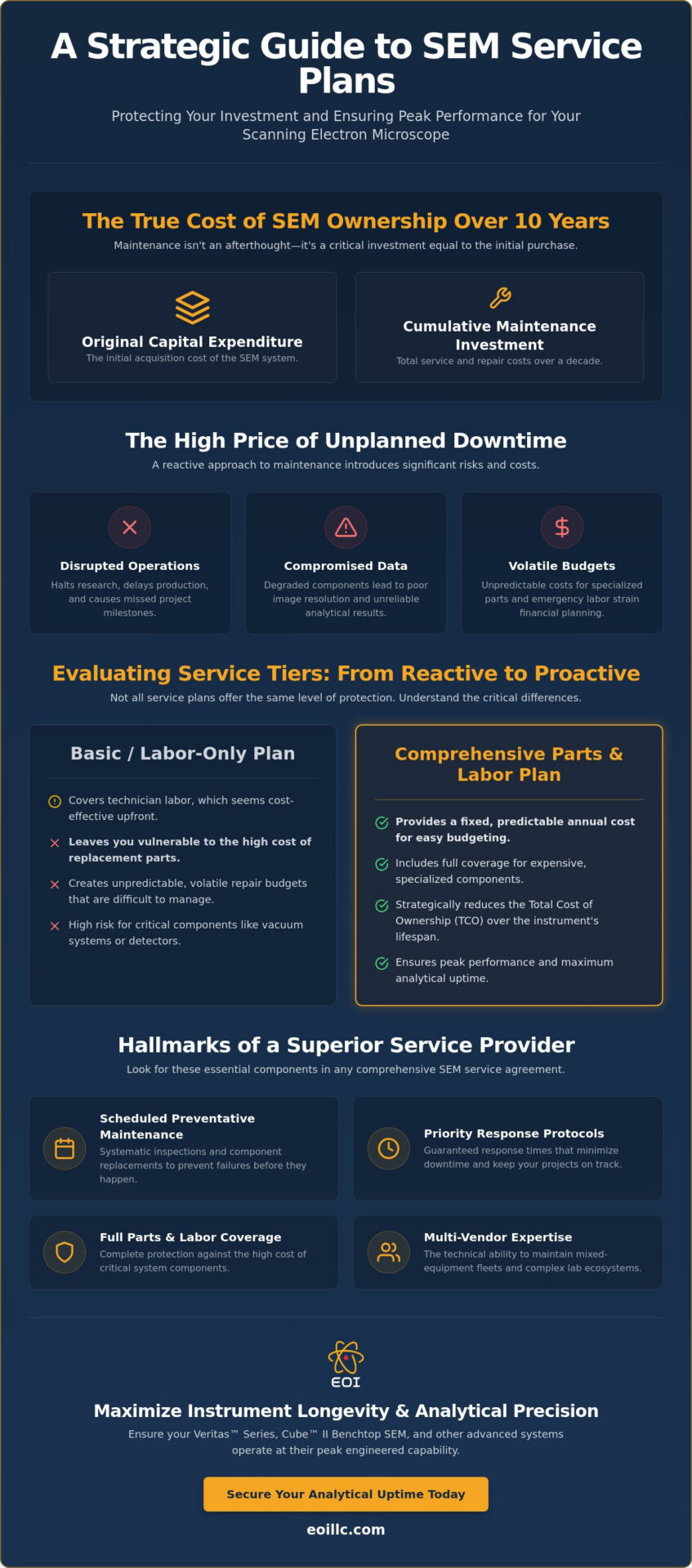
Over a ten-year operational lifecycle, the cumulative investment in maintaining a scanning electron microscope typically equals the original capital expenditure required for its acquisition. For industrial and academic leaders, understanding exactly what to look for in a sem service plan is not merely a logistical detail; it is a critical pillar of long-term fiscal and technical strategy. You likely recognize that unplanned downtime in high-precision environments represents more than a temporary pause in research. It is a significant disruption that threatens analytical integrity and project timelines, particularly when specialized vacuum components fail or OEM response times lag.
This article outlines the rigorous technical and operational benchmarks necessary to evaluate service contracts effectively, ensuring your instrumentation maintains peak performance while providing predictable maintenance budgeting. We will examine the nuances of tiered support structures, the necessity of priority response protocols, and the strategic role of preventative maintenance in extending the functional lifespan of advanced hardware like the Veritas Series or Cube II Benchtop SEM systems. By prioritizing analytical precision through structured service agreements, organizations can transform maintenance from a reactive expense into a proactive asset for global innovation.
Key Takeaways
- Understand the direct correlation between structured maintenance agreements and the preservation of electron optics to ensure consistent image resolution quality.
- Identify exactly what to look for in a sem service plan by evaluating the technical distinctions between basic labor-only coverage and comprehensive parts and labor agreements.
- Analyze how fixed-cost service contracts serve as a strategic financial buffer against volatile repair budgets while reducing the total cost of ownership.
- Recognize the hallmarks of a superior service provider, including the technical expertise required to maintain mixed equipment fleets and multi-vendor systems.
- Discover how specialized preventative care for high-performance systems like the Veritas Series and Cube II Benchtop SEM maximizes instrument longevity and analytical precision.
The Strategic Importance of a Scanning Electron Microscope (SEM) Service Plan
An SEM service plan represents a structured maintenance framework specifically engineered to safeguard the complex electron optics and vacuum architectures of advanced instrumentation. Within the high-stakes environments of material science and industrial quality control, the primary metric for laboratory success is analytical uptime. This concept defines the ratio of time an instrument remains fully operational and calibrated versus its total available time. Because a Scanning Electron Microscope (SEM) relies on the delicate synergy of high-voltage electronics and ultra-high vacuum systems, even minor deviations in environmental or mechanical stability can lead to catastrophic failures. Understanding what to look for in a sem service plan requires a shift in perspective, viewing maintenance not as a reactive necessity but as a strategic investment in long-term technical precision.
The correlation between consistent maintenance and image resolution quality is direct and measurable. Without a rigorous service schedule, the gradual accumulation of contaminants within the column and the degradation of sensitive detectors will inevitably erode the system’s performance. Neglect often manifests as column contamination or vacuum system failure, both of which require extensive and costly remediation. By establishing a proactive service agreement, organizations ensure that their hardware operates at the peak of its engineered capability, preserving the integrity of every scan and measurement.
Mitigating the High Cost of Unplanned Downtime
The financial repercussions of unplanned downtime extend far beyond the immediate repair invoice. For high-throughput production lines or time-sensitive research projects, a single week of equipment failure can result in significant operational losses and missed milestones. This is where the total cost of ownership (TCO) becomes the most relevant financial figure for lab managers. Preventative maintenance is the systematic execution of technical inspections and component replacements aimed at maintaining vacuum stability and preventing catastrophic system failure. By identifying minor anomalies such as failing seals or fluctuating power supplies before they escalate, these scheduled visits transform unpredictable repair costs into a manageable, fixed annual expenditure.
Preserving Technical Precision and Data Integrity
Technical precision is inherently fragile in the context of electron microscopy. Aging filaments and dirty apertures inevitably degrade the signal-to-noise ratio, leading to a measurable loss in image clarity and analytical accuracy. This degradation often happens so gradually that users may not realize their data integrity is being compromised until it’s too late. Regular calibration and cleaning are not optional refinements; they’re requirements for maintaining compliance with ISO standards and ensuring that data remains reproducible over time. When considering the fundamental principles of scanning electron microscopy (SEM), it’s clear that maintaining the stability of the electron beam and the purity of the vacuum environment is the only way to guarantee the validity of your analytical results. A comprehensive service plan ensures these technical variables are meticulously managed by experts who understand the nuances of what to look for in a sem service plan to maintain high-end performance.
Essential Technical Components of a Comprehensive Service Agreement
A foundational SEM service contract must transcend basic repair coverage to address the intricate biological and mechanical requirements of electron optics. When determining what to look for in a sem service plan, the primary distinction lies between labor-only agreements and full-coverage parts and labor contracts. While labor-only plans may appear fiscally attractive on an annual balance sheet, they leave the organization vulnerable to the high costs of specialized vacuum components or detector replacements. A truly comprehensive agreement includes high-wear consumables such as filaments, which are essential for maintaining the electron source’s stability and longevity.
Rigorous attention to the vacuum system is equally paramount. This includes specialized vacuum pump oil changes and meticulous cleaning of the internal chambers to prevent backstreaming and contamination. Engaging in the routine maintenance and management of a scanning electron microscope ensures that these environmental variables don’t compromise the system’s high-voltage stability. Organizations that prioritize these technical details often find that sourcing SEM filaments and consumables through a structured agreement is the most efficient way to maintain peak performance.
Preventative Maintenance (PM) Protocols
Preventative maintenance protocols serve as the backbone of instrument reliability. Standard industry practice dictates a bi-annual or annual frequency for these visits, depending on the intensity of instrument usage and the sensitivity of the research being conducted. During these sessions, technicians perform a suite of critical tasks designed to maintain analytical precision:
- Precise column alignment to ensure beam stability.
- Ultrasonic cleaning of apertures to remove carbon buildup.
- Comprehensive vacuum leak testing using specialized diagnostic tools.
- Calibration of the electron gun for optimal emission.
It’s essential that SEM maintenance includes thorough internal inspections to identify micro-fractures in seals or early-stage degradation of the electron gun assembly before they lead to catastrophic failure.
Emergency Repair and Priority Response
Priority response is a non-negotiable feature for high-throughput laboratories where every hour of downtime translates to lost revenue or research delays. High-quality plans typically guarantee a response window of 24 to 48 hours, providing a safety net that pay-as-you-go models cannot match. Modern service providers also leverage remote diagnostic capabilities, allowing for the immediate identification of software glitches or electronic failures without the delay of physical travel. Ensuring your provider offers these advanced support tiers is a vital part of what to look for in a sem service plan, as it transforms the service provider into a technical partner invested in your lab’s ongoing success.
Evaluating Service Tiers: Priority Support vs. Pay-As-You-Go
When analyzing what to look for in a sem service plan, the financial decision often hinges on the Total Cost of Ownership (TCO) compared to a reactive, pay-as-you-go model. Industry data indicates that over a ten-year operational period, the cumulative cost of a comprehensive service agreement typically aligns with the initial purchase price of the microscope. For standard benchtop or tungsten systems, annual expenditures may range from $5,000 to $20,000, whereas high-end field-emission systems can demand upwards of $120,000 for full support. Contract holders benefit from an insurance value that stabilizes annual budgets against the volatility of catastrophic component failure. Conversely, non-contract users face the hidden financial burdens of hourly field service, which frequently include non-negotiable travel and lodging fees, as well as premium labor rates that can exceed $75 per hour for industrial applications.
Beyond direct costs, service contracts streamline the procurement process during critical failures. In many academic or government institutions, the administrative delay required to secure quotes and approvals for a major repair can extend downtime by weeks. A pre-existing agreement bypasses these bureaucratic hurdles, facilitating immediate dispatch and component replacement. This accelerated response is a fundamental criterion when deciding what to look for in a sem service plan to maintain high-throughput operational continuity and minimize the fiscal impact of research delays.
Full-Coverage vs. Preventative-Only Plans
Choosing between an all-inclusive tier and a preventative-maintenance-only (PM-only) plan requires a rigorous assessment of risk tolerance. While PM-only plans ensure the system remains within calibration through scheduled visits, they offer no protection against the failure of expensive electron guns or EDS (Energy Dispersive Spectroscopy) Systems. For laboratories operating aging or refurbished SEM units, the probability of hardware fatigue often justifies the higher premium of a full-coverage agreement. Predictable annual budgeting is particularly vital for academic and government labs, where unexpected repair costs can exceed remaining quarterly allocations.
The Role of Technical Training in Service Plans
A sophisticated service plan should integrate on-site operator training as a core component of its value proposition. Proper operational technique is the most effective safeguard against avoidable service calls, particularly regarding vacuum management and filament saturation levels. By including customized training sessions within the service framework, organizations empower their staff to achieve superior imaging results while simultaneously reducing the mechanical stress placed on the instrument. This synergy between operator expertise and technical support is essential for maximizing the lifespan of the electron microscope and ensuring long-term analytical precision.
Key Indicators of a High-Quality SEM Service Provider
Selecting a strategic partner for instrumentation maintenance requires a rigorous evaluation of technical pedigree that extends beyond the original equipment manufacturer’s nameplate. When determining what to look for in a sem service plan, the depth of the provider’s engineering background is often more indicative of long-term success than the brand name on the chassis. High-quality providers demonstrate a profound understanding of the underlying physics governing electron beam stability and vacuum dynamics across diverse platforms, ensuring that every adjustment is rooted in scientific accuracy. This technical authority is typically forged through decades of industry immersion; 30 or more years of experience serves as a reliable benchmark for technical maturity and reliability in the specialized field of electron optics, where institutional memory is vital for troubleshooting legacy systems.
Technical Authority and Multi-Vendor Capability
Modern microscopy laboratories frequently operate mixed fleets comprising instruments from various manufacturers to meet diverse analytical needs. A provider capable of servicing all major manufacturers offers a significant strategic advantage by serving as a single point of contact for the entire facility’s maintenance needs, which simplifies administrative workflows and procurement cycles. This multi-vendor capability suggests that the field service engineers possess a generalized yet deep mastery of engineering principles, rather than just rote knowledge of a specific model’s proprietary software. These engineers often possess specialized backgrounds in electrical or vacuum engineering, which allows them to troubleshoot complex system-level issues that might otherwise lead to extended downtime or compromised data integrity.
Logistical Excellence and Parts Availability
The speed of any repair is fundamentally limited by the logistical efficiency of the service provider and the availability of high-quality components. A high-quality SEM service provider maintains a robust, ready-to-deploy inventory of OEM-grade replacement parts and rare filaments, often housed in local warehouses to bypass the delays inherent in international shipping. For organizations utilizing legacy hardware or refurbished SEM units, the provider’s ability to source or certify high-standard refurbished components is critical for maintaining operational continuity. Electron Optics Instruments, LLC ensures that repair lead times are measured in days rather than weeks, directly supporting the overarching goal of maximized analytical uptime through a verified and responsive supply chain.
Ensure your laboratory’s long-term success by partnering with experts who understand the intersection of technical precision and operational reliability; explore our comprehensive preventative maintenance visits to secure your instrumentation’s future with Electron Optics Instruments, LLC.
Maximizing Instrument Longevity with Electron Optics Instruments
The successful management of a microscopy facility requires more than the procurement of high-performance hardware; it necessitates a commitment to the strategic integration of technical support and operational reliability. Electron Optics Instruments, LLC provides an advanced ecosystem of care for systems such as the Cube II Benchtop SEM and the Veritas Series SEM, ensuring that these instruments maintain their analytical precision over decades of service. By focusing on the synergy between expert installation and long-term maintenance, laboratories can establish a stable technical baseline that minimizes the risk of performance drift. Evaluating what to look for in a sem service plan involves understanding this synergy, as the transition from rigid OEM structures to agile, expert third-party support represents a logical evolution for labs seeking to optimize their total cost of ownership without sacrificing quality.
This transition is supported by a commitment to meticulousness and technical authority. High-quality, cost-effective solutions are not merely about price reduction; they’re about the intelligent allocation of technical resources to the components that impact uptime most significantly. By sourcing SEM filaments and consumables through a dedicated partner like Electron Optics Instruments, LLC, organizations ensure their systems are always equipped with OEM-grade parts that meet the highest standards of engineering excellence. This meticulous approach to hardware maintenance safeguards the integrity of the electron optics while supporting the visionary goals of industrial and academic innovators.
Customized Service Contracts for Industrial and Research Labs
Industrial production lines and academic research centers operate under fundamentally different duty cycles, necessitating service agreements that are as unique as their imaging applications. Electron Optics Instruments, LLC, acting as a US-based national distributor and the sole US distributor for EmCraft SEMs, offers the localized agility required to tailor service plans to specific usage patterns and budgetary frameworks. Lab managers are encouraged to perform a rigorous service audit on their current instrumentation to identify potential vulnerabilities in response speed or parts availability. This proactive evaluation is a critical step in determining what to look for in a sem service plan, as it highlights the specific technical gaps that a customized agreement can bridge, ensuring that every EDS (Energy Dispersive Spectroscopy) System remains fully operational.
The Path to Seamless SEM Operations
The roadmap to achieving uninterrupted analytical uptime is built upon the pillars of deep technical expertise, rapid response velocity, and comprehensive inventory management. As a reliable partner in the advancement of high-tech systems, Electron Optics Instruments, LLC ensures that every Veritas FE SEM or Genesis Tabletop SEM under its care benefits from the most rigorous internal processes in the industry. This stability allows researchers and engineers to focus on innovation while the grounded realities of logistical excellence and hardware maintenance are handled by seasoned experts. We invite you to contact our technical team for a comprehensive service evaluation to secure the future of your microscopy operations and extend the functional lifespan of your advanced hardware.
Securing the Future of Analytical Precision
The transition from reactive repairs to a strategic maintenance framework is essential for any laboratory prioritizing long-term operational stability. Understanding exactly what to look for in a sem service plan ensures that your instrumentation remains at the peak of its engineered capability; it’s the most effective way to shield your budget from the volatility of unplanned downtime. By prioritizing technical components like vacuum system care and electron optics calibration, organizations effectively extend the functional lifespan of their hardware while maintaining the highest standards of data integrity across every imaging application.
With over 30 years of industry experience and national service coverage for all major manufacturers, Electron Optics Instruments, LLC provides the rigorous technical authority required to maintain complex microscopy fleets. As the sole US distributor for EmCraft SEMs, we specialize in delivering the meticulous care necessary for sustained innovation and technical growth. We invite you to Request a Customized SEM Service Plan Evaluation from Electron Optics Instruments, LLC to establish a foundation of reliability for your facility. Don’t leave your analytical precision to chance; investing in expert-driven support today creates a trajectory of progress for your future research and production milestones.
Frequently Asked Questions
Is an SEM service contract really necessary for a new instrument?
A service agreement is essential for new instrumentation because standard manufacturer warranties primarily address mechanical defects rather than the operational maintenance required for sustained analytical precision. Implementing a comprehensive plan immediately upon installation ensures that the electron optics are meticulously calibrated from day one. This proactive approach establishes a stable technical baseline and prevents performance drift before it impacts critical research or production milestones.
What is the typical response time for an SEM repair under a service plan?
High-quality service agreements typically guarantee an on-site response within 24 to 48 business hours for priority support tiers. This rapid deployment is a critical factor when determining what to look for in a sem service plan, as it minimizes the fiscal impact of unplanned downtime in high-throughput environments. Modern providers also utilize remote diagnostic tools to identify software or electronic issues immediately, often resolving failures without the delay of physical travel.
Can third-party providers service microscopes from all major manufacturers?
Expert third-party providers possess the technical authority to service instrumentation from all major manufacturers, offering a consolidated point of contact for diverse microscopy laboratories. These engineers leverage a deep mastery of vacuum systems and high-voltage electronics to maintain peak performance across mixed equipment fleets. This multi-vendor capability ensures that a single standard of care is applied to both modern hardware and legacy systems throughout the facility.
Are SEM filaments and apertures usually included in service plans?
Inclusion of high-wear consumables such as filaments and apertures depends on the specific tier of the service agreement. While basic labor-only plans exclude these components, comprehensive full-coverage contracts often include them to ensure that the electron source remains stable. Sourcing these parts through a structured plan prevents the administrative delays associated with individual procurement while guaranteeing that only OEM-grade components are used in the system.
How often should an SEM undergo preventative maintenance?
A scanning electron microscope should undergo professional preventative maintenance at least once or twice per year, depending on the intensity of its operational duty cycle. These scheduled visits are designed to identify early-stage degradation in seals, apertures, or power supplies before they lead to catastrophic failure. Regular maintenance ensures that the vacuum architecture remains robust and that the instrument’s analytical uptime remains predictable for long-term project planning.
What happens if my SEM requires a part that is no longer in production?
When a system requires a component that is no longer in production, a high-quality provider leverages a robust inventory of OEM-grade refurbished parts to restore functionality. Seasoned technical partners maintain extensive pipelines for legacy hardware and rare filaments, ensuring that older systems continue to deliver precise results. This capability is vital for organizations utilizing refurbished SEM units that the original manufacturer may no longer support.
Does a service plan include on-site training for new laboratory staff?
Many sophisticated service plans integrate on-site operator training as a strategic component to reduce the frequency of avoidable service calls. Proper instruction in vacuum management and filament saturation is vital for maintaining the longevity of the instrument. By including customized training sessions within the service framework, organizations ensure that new staff can achieve superior imaging results while adhering to the rigorous standards of the laboratory.
How do I calculate the ROI of an SEM service agreement?
ROI is calculated by comparing the fixed annual cost of the agreement against the cumulative expenses of hourly field service, emergency part procurement, and lost production time. A well-structured plan acts as a strategic asset by stabilizing the total cost of ownership and preventing the high costs of catastrophic component failure. This financial predictability is a core element of what to look for in a sem service plan for industrial and academic leaders.