
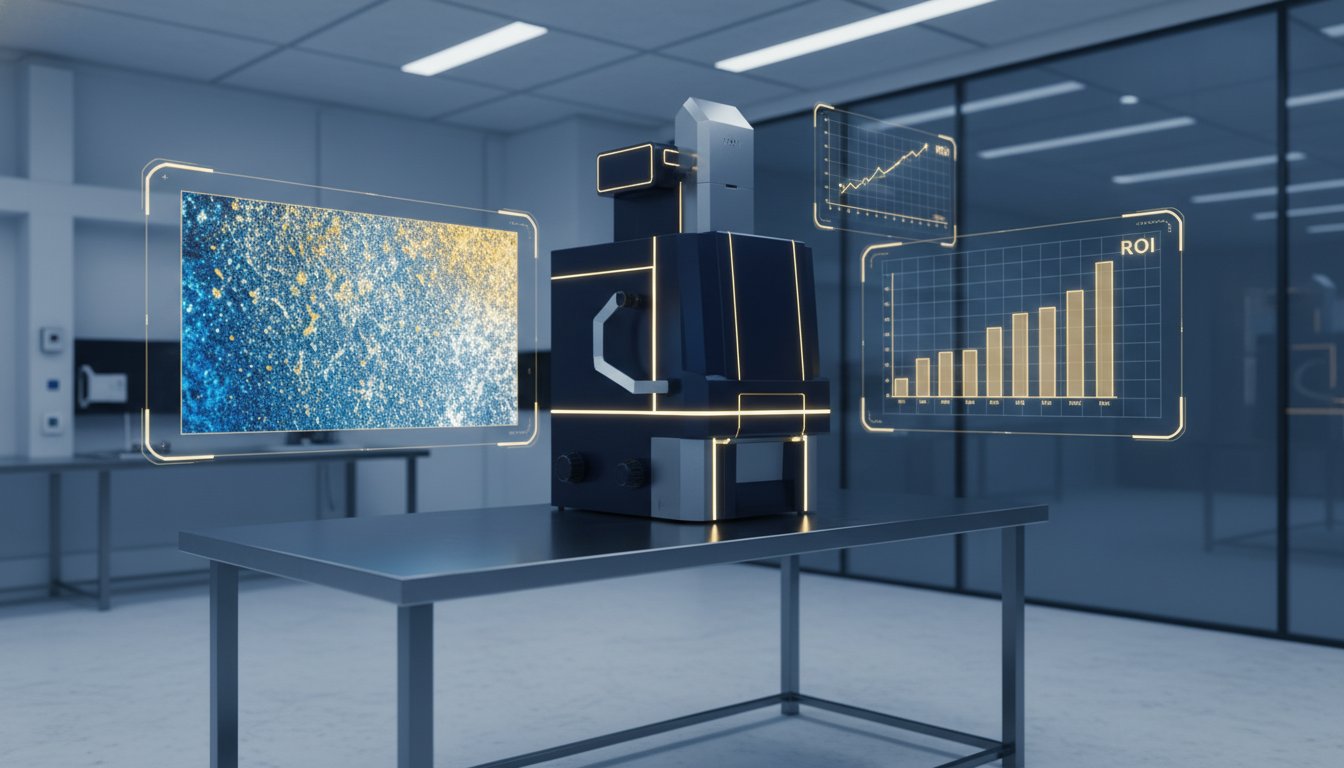
Could a single capital equipment acquisition reduce your analytical lead times by a factor of ten while simultaneously ensuring compliance with the stringent 2026 FDA Quality Management System Regulation? Most principal investigators and laboratory managers recognize the inherent friction of relying on external microscopy services, where the lack of immediate feedback loops often compromises the iterative pace of industrial innovation. It’s frequently challenging to articulate the nuanced technical necessity of high-resolution imaging to financial stakeholders who prioritize quantifiable fiscal returns over qualitative scientific advancement.
By utilizing our structured sem purchase justification template, you’ll transform these complex technical requirements into a professional, authoritative proposal that emphasizes risk mitigation and strategic autonomy. This guide explores the critical intersection of industrial performance and regulatory adherence, providing the analytical framework needed to secure capital expenditure approval for advanced hardware in an increasingly competitive global market. We will outline the methodology for quantifying the ROI of in-house capability while addressing the practical realities of international production and logistical excellence.
Key Takeaways
- Learn to align your laboratory’s technical requirements with organizational KPIs to secure capital expenditure approval for advanced imaging systems.
- Utilize our comprehensive sem purchase justification template to bridge the analytical gap between current limitations and desired in-house capabilities.
- Understand the fiscal and logistical benefits of transitioning to benchtop systems like the Cube II to minimize infrastructure demands and operational overhead.
- Evaluate technical specifications, such as EDS integration and vacuum performance, to ensure your chosen hardware meets specific industrial application standards.
- Discover how integrated service contracts and preventative maintenance visits ensure long-term budget predictability and sustained analytical throughput.
The Strategic Importance of In-House Electron Microscopy
In the context of 2026 laboratory procurement, a Scanning Electron Microscope represents far more than a simple analytical tool; it’s a pivotal asset for high-throughput innovation. While the acronym SEM is frequently conflated with search engine marketing in digital spaces, for the materials scientist or quality control engineer, it’s the foundation of structural characterization. A professional sem purchase justification template serves as the strategic interface between these technical necessities and the rigid fiscal goals of corporate leadership. It’s not merely a request for funding. It’s a visionary document that aligns capital expenditure with long-term industrial competitiveness and meticulous quality standards.
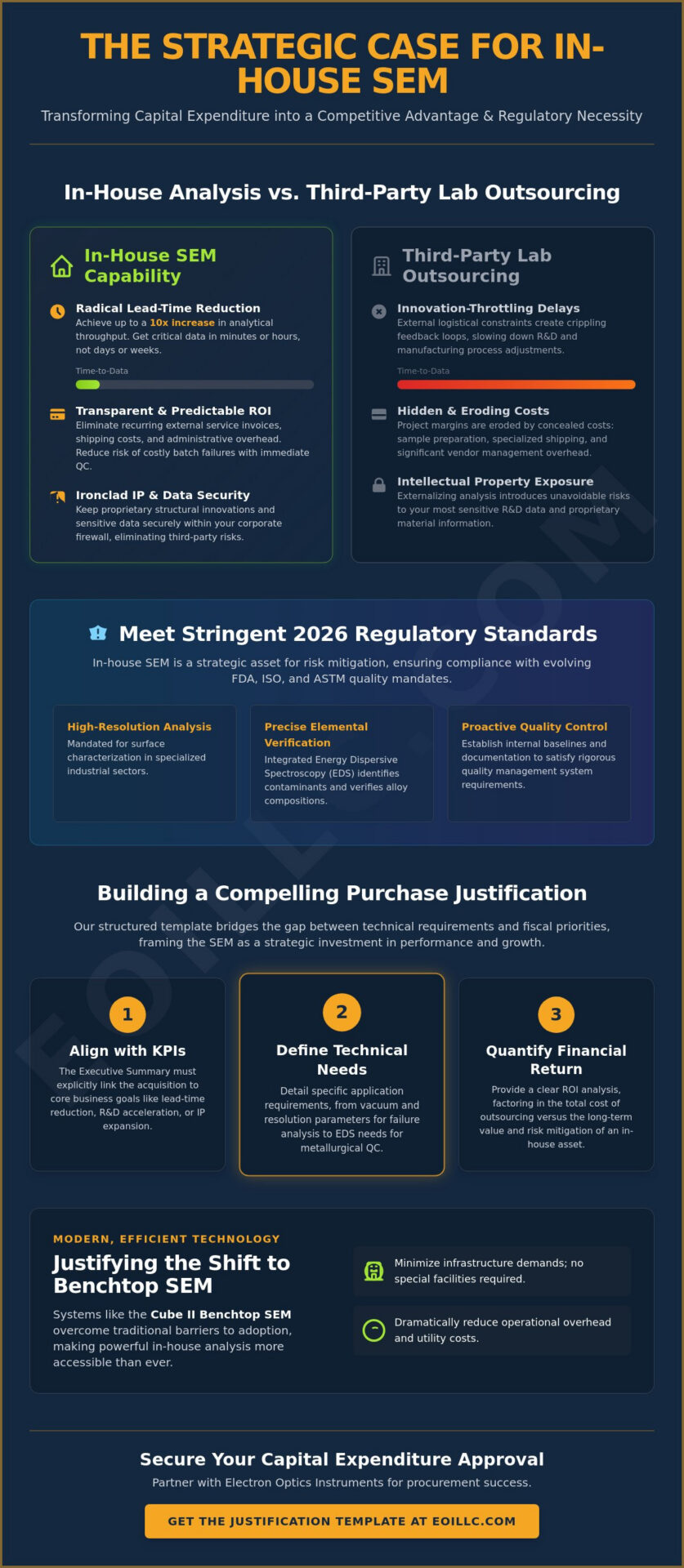
The primary driver behind this investment is the critical metric of ‘Time-to-Data.’ In an era where product development cycles are accelerating, waiting days or weeks for external lab results is no longer a viable strategy. By internalizing microscopy capabilities, organizations can achieve a significant increase in analytical throughput. This allows for real-time adjustments in R&D and manufacturing processes, ensuring that innovation isn’t throttled by external logistical constraints. A well-constructed justification frames the acquisition as a catalyst for growth rather than a static overhead cost.
In-House Analysis vs. Third-Party Lab Outsourcing
Outsourcing microscopy often conceals a variety of logistical friction points that erode project margins. Beyond the direct invoice from a service provider, there are significant hidden costs associated with sample preparation, specialized shipping, and the administrative burden of vendor management. Perhaps more critically, externalizing analysis introduces risks to intellectual property. Keeping sensitive data within the corporate firewall ensures that proprietary structural innovations remain secure. Transitioning to in-house capability creates an immediate feedback loop. This allows engineers to verify material integrity within minutes of production, which directly enhances operational efficiency and reduces the risk of costly batch failures.
Meeting Modern Regulatory and Quality Standards
The regulatory landscape of 2026 demands a level of precision that legacy imaging methods cannot provide. High-resolution surface analysis is increasingly mandated for ISO and ASTM compliance across specialized industrial sectors. Relying on an internal system equipped with Energy Dispersive Spectroscopy (EDS) allows for precise elemental verification. This is essential for identifying contaminants or verifying alloy compositions in high-stakes production environments. Establishing a baseline through the fundamental principles of scanning electron microscopy (SEM) in 2026 provides the technical foundation required to meet these evolving standards. Utilizing a structured sem purchase justification template ensures that these regulatory requirements are clearly communicated to stakeholders, framing the purchase as a necessary step for risk mitigation and global compliance.
Key Components of a Scanning Electron Microscope Justification
A robust sem purchase justification template functions as a bridge between the laboratory’s technical aspirations and the organization’s fiscal realities. The Executive Summary should explicitly align the acquisition with existing Key Performance Indicators (KPIs), such as lead-time reduction or intellectual property expansion. By framing Scanning Electron Microscopy as a strategic investment in industrial performance, procurement officers can better articulate the necessity of high-end hardware to non-technical stakeholders who prioritize quantifiable outcomes over scientific curiosity. This alignment ensures the procurement process is viewed through the lens of corporate growth and risk mitigation.
The Technical Requirement Analysis must go beyond generalities to address specific application needs. For instance, a laboratory focusing on semiconductor failure analysis requires different vacuum and resolution parameters than one conducting metallurgical quality control. Matching these specifications ensures the hardware remains relevant as industrial standards evolve. A detailed analysis of resolution limits, detector sensitivity, and sample chamber volume is essential to prevent the acquisition of underpowered or unnecessarily complex systems that don’t serve the primary operational mission.
Calculating the Return on Investment (ROI)
Quantifying the Return on Investment requires a meticulous analysis of current analytical expenditures. Eliminating third-party laboratory fees provides a direct cost-saving metric that typically justifies the equipment cost over a three to five year horizon. Additionally, internalizing failure analysis reduces the scrap rate by identifying production defects in real-time, preventing the loss of entire batches. For accurate budgetary modeling, stakeholders should consult the comprehensive 2026 price guide to understand the initial capital requirements for various configurations without relying on outdated estimates.
Total Cost of Ownership (TCO) and Operational Stability
Operational stability depends on acknowledging the Total Cost of Ownership beyond the initial purchase price. This includes recurring expenses for consumables like filaments and coating materials, alongside scheduled preventative maintenance visits. Implementing a rigorous schedule for SEM maintenance protects the precision of the optics and extends the system’s operational lifespan. Neglecting these factors introduces a risk of unplanned downtime, which often exceeds the cost of a comprehensive service contract. If you require assistance in selecting a configuration that balances performance with long-term fiscal stability, exploring the Veritas or Cube II series from Electron Optics Instruments, LLC can provide a focused starting point for your procurement strategy.
Risk assessment is a critical, yet often overlooked, component of a justification. The cost of not purchasing an SEM includes continued reliance on external timelines, potential IP leakage, and the inability to respond to urgent quality issues. In a high-stakes manufacturing environment, the absence of immediate analytical feedback can result in catastrophic product recalls or missed market windows. A professional sem purchase justification template must highlight these vulnerabilities to demonstrate that the status quo is a liability to the organization’s future performance.
Justifying the Shift to Benchtop SEM Technology
The “Desktop Revolution” of 2026 has fundamentally altered the procurement landscape for analytical hardware, shifting the focus from massive, centralized floor-standing units to compact, high-performance systems. Traditional electron microscopes often impose prohibitive logistical demands that complicate the approval process, requiring dedicated facilities and specialized infrastructure. A modern sem purchase justification template should highlight the transition toward these streamlined systems, which offer comparable resolution and analytical depth without the excessive footprint. This democratization of electron optics allows organizations to deploy sophisticated imaging capabilities directly at the point of manufacture, fostering a more agile and responsive research environment.
One of the most compelling arguments for this shift is the significant reduction in operational complexity. Modern tabletop models are designed with intuitive user interfaces that lower the barrier to entry for laboratory personnel. Instead of relying on a limited pool of PhD-level microscopists, organizations can empower a broader range of technicians to conduct routine inspections and characterizations. This accessibility ensures that the hardware remains an active driver of productivity rather than an underutilized bottleneck, directly supporting the organization’s goals for technical integration and industrial performance.
Infrastructure and Installation Savings
Traditional floor-standing microscopy suites often require extensive renovations, including electromagnetic shielding, vibration isolation platforms, and specialized floor reinforcement. Benchtop units, however, eliminate these secondary capital expenditures almost entirely. Integrating an SEM purchasing guide into your proposal helps clarify these distinctions for financial directors who may not realize the extensive site preparation costs associated with larger models. The evolutionary shift to high-performance benchtop microscopy demonstrates that these units can be operational within hours of delivery, utilizing standard electrical outlets without the need for dedicated nitrogen lines or water-cooling systems.
Performance Parity: When is a Benchtop Enough?
Many laboratories fall into the “over-speccing” trap, acquiring ultra-high-resolution systems that exceed their actual operational requirements at a significantly higher cost. Modern benchtop models like the Cube II or Genesis series provide the magnification and depth of field necessary for approximately 90% of common industrial failure analysis and material characterization tasks. These systems don’t compromise on analytical power, often featuring integrated EDS for comprehensive elemental mapping. By utilizing a structured sem purchase justification template, procurement teams can demonstrate that a tabletop unit meets the technical baseline for their specific applications while providing a much faster path to ROI through lower initial investment and reduced maintenance overhead.
The SEM Purchase Justification Template
Constructing a formal proposal requires a systematic approach that separates technical requirements from fiscal projections. A professional sem purchase justification template should follow a logical progression to ensure that every stakeholder, from the laboratory manager to the Chief Financial Officer, understands the strategic necessity of the acquisition. This structured framework transforms a simple equipment request into a visionary document that outlines the path toward analytical autonomy. We recommend organizing your justification into the following five core steps:
- Step 1: Define the Analytical Gap. Contrast the current state of delayed external results and limited imaging resolution with the desired state of real-time, high-precision characterization.
- Step 2: Technical Specifications Matrix. Align specific parameters such as resolution limits, vacuum modes, and EDS integration with your primary application milestones.
- Step 3: Comparative Analysis of Vendor Options. Evaluate performance metrics and global support capabilities to demonstrate a meticulous selection process.
- Step 4: Financial Justification. Aggregate initial capital expenditure (CAPEX) with long-term operational expenses (OPEX) to provide a comprehensive fiscal outlook.
- Step 5: Implementation and Training Timeline. Outline the trajectory from installation to full operational throughput, ensuring staff readiness is clearly documented.
Drafting the Technical Necessity Statement
A successful justification begins with a precise articulation of why current methodologies are insufficient for your specific sample types, whether you are analyzing [polymers, metals, or biologicals]. For laboratories handling non-conductive materials, it’s essential to justify the need for advanced SEM techniques like low-vacuum imaging to prevent specimen charging and maintain image integrity. You should anchor this section with a single, clarifying sentence: “The acquisition of an in-house SEM is required to achieve [specific resolution or analytical goal] which is currently unattainable through existing outsourced methods.”
Quantifying Operational Efficiency Gains
To secure financial approval, the proposal must translate technical capability into operational velocity. We suggest including a “Hours Saved Per Week” calculation that aggregates time spent on sample logistics, vendor communication, and waiting for external data sets. Use the following checklist to demonstrate that your laboratory is prepared for immediate system integration:
- Established sample preparation protocols for your primary material classes.
- Documented adherence to SEM operation best practices to ensure data integrity and system longevity.
- Identified primary and secondary operators to maintain cross-functional support.
By demonstrating that the laboratory is prepared for immediate integration, you frame the sem purchase justification template as a low-risk, high-reward initiative. This readiness directly correlates to increased R&D velocity, allowing your organization to iterate on material designs faster than competitors who remain tethered to external laboratory schedules. If you’re ready to begin drafting your specific proposal, contact our technical specialists for a consultation on the Veritas or Cube II configurations that best align with your organization’s operational KPIs.
Partnering with Electron Optics Instruments, LLC for Procurement Success
The final stage of laboratory procurement involves selecting a partner capable of translating your sem purchase justification template into a high-performance analytical reality. Electron Optics Instruments, LLC provides the technical depth and hardware diversity necessary to satisfy the most rigorous fiscal and scientific criteria. Systems such as the Cube II benchtop SEM and the Veritas series offer a spectrum of imaging power, ranging from streamlined characterization to high-resolution field emission capabilities. For organizations operating under more restrictive capital expenditure limits, our inventory of refurbished SEM units presents a strategic entry point. These units allow for the acquisition of sophisticated technology while significantly reducing the initial CAPEX burden, ensuring that even budget-conscious labs can establish in-house microscopy without compromising on precision.
Securing approval for a scanning electron microscope requires more than just a hardware list. It’s about demonstrating a path to long-term operational excellence. Electron Optics Instruments, LLC supports this by offering comprehensive procurement packages that integrate seamlessly into your justification framework. By providing detailed documentation on system longevity and performance benchmarks, we help you articulate a visionary case for how advanced hardware drives industrial progress and sustainable development. We don’t just deliver a microscope; we provide a foundation for technical integration that evolves with your organization’s needs.
Technical Support and Preventative Maintenance
A primary concern for financial stakeholders is the risk of unplanned downtime and the associated loss of productivity. You can justify the choice of Electron Optics Instruments, LLC by highlighting our 30 plus years of multi-manufacturer expertise, which ensures that your investment is backed by a seasoned, global innovator. We offer customized service agreements that include regular preventative maintenance visits, effectively mitigating the risk of laboratory bottlenecks. Our on-site technical training programs ensure that your staff reaches operational proficiency immediately upon installation. This rapid skill acquisition is a critical component of the sem purchase justification template, as it guarantees a faster return on investment through optimized equipment utility from day one.
Finalizing the Procurement Package
To ensure a smooth approval process, your final proposal must account for the total lifecycle of the instrument. We ensure that every quote is comprehensive, including installation, precision calibration, and an initial supply of SEM filaments and consumables. This level of meticulousness prevents the “hidden cost” surprises that can stall capital equipment projects. By positioning the SEM as a long-term analytical asset rather than a one-time expense, you demonstrate a grounded understanding of the practical realities of international production. If you’re ready to refine your justification case and select the ideal configuration for your facility, we invite you to consult with our technical specialists at Electron Optics Instruments, LLC to finalize a procurement package that aligns with your 2026 strategic goals.
Securing the Future of Your Analytical Infrastructure
The successful implementation of in-house characterization capability represents a fundamental evolution in laboratory management and industrial performance. By utilizing a structured sem purchase justification template, you provide executive stakeholders with a technically authoritative roadmap for achieving analytical autonomy. This documentation ensures that the transition from costly external outsourcing to precise internal control is viewed as a strategic advancement that accelerates innovation cycles and guarantees long-term material integrity.
Electron Optics Instruments, LLC stands as a seasoned partner ready to facilitate this transition through technical depth and logistical excellence. As the sole US distributor for EmCraft SEMs and a provider with 30 plus years of industry expertise, we offer comprehensive service for all major SEM brands to ensure your investment remains a reliable anchor for your production standards. Request a Customized Quote and Justification Support from Electron Optics Instruments, LLC to finalize your procurement strategy and secure your facility’s competitive edge. We look forward to supporting your commitment to meticulous characterization and industrial progress.
Frequently Asked Questions
What are the most important factors in an SEM justification?
The primary pillars of a successful justification are analytical throughput, lead-time reduction, and risk mitigation. You must demonstrate how in-house capability accelerates iterative R&D cycles and ensures adherence to modern quality standards like the 2026 FDA Quality Management System Regulation. Aligning these technical advantages with organizational Key Performance Indicators (KPIs) ensures the proposal resonates with financial stakeholders who prioritize quantifiable outcomes.
How do I justify the cost of an SEM service contract?
A service contract should be framed as a strategic investment in operational stability rather than a mere recurring expense. Regular preventative maintenance visits identify potential vacuum or optical misalignments before they result in catastrophic system failure. This proactive approach minimizes the risk of unplanned downtime, which typically incurs costs far exceeding the annual price of a comprehensive service agreement.
Is it better to justify a new or refurbished SEM for a startup lab?
Refurbished SEM units provide a lower entry point for capital expenditure, which makes them an excellent choice for startup environments prioritizing fiscal agility. While a new system like the Cube II offers the latest technological integration, a certified refurbished unit allows a growing laboratory to establish sophisticated characterization capabilities without the immediate burden of a high-CAPEX acquisition. This choice depends on whether the lab requires specific 2026 performance benchmarks or a more conservative budget profile.
Can I justify an SEM purchase based on failure analysis alone?
Failure analysis is a potent primary justification, particularly when the costs of production scrap or product recalls are substantial. Immediate feedback loops provided by an in-house system allow engineers to identify structural defects at the point of manufacture, preventing the loss of entire production batches. In high-stakes industrial sectors, the ability to conduct real-time root cause analysis justifies the hardware as a critical tool for quality assurance and brand protection.
How does benchtop SEM performance compare to floor models in a justification case?
Modern benchtop models achieve performance parity with floor-standing units for approximately 90% of industrial characterization tasks. A justification case should emphasize that tabletop systems eliminate the need for specialized cooling, vibration isolation, and massive floor reinforcement. This allows for high-resolution imaging and EDS analysis without the excessive infrastructure investment required by legacy floor-standing systems, leading to a much faster installation timeline.
What hidden costs should I include in my SEM purchase template?
Your sem purchase justification template must account for consumables such as filaments and stubs, as well as necessary sample preparation tools like sputter coaters. Additionally, you’ll need to factor in the costs of specialized operator training and the logistical requirements of initial installation and calibration. Including these elements ensures the proposal reflects the true Total Cost of Ownership (TCO) and prevents future budgetary friction during the operational phase.
How do I explain EDS analysis to a non-technical procurement officer?
Energy Dispersive Spectroscopy (EDS) is best described as an elemental fingerprinting tool that identifies the chemical composition of a sample. While the SEM provides the visual topography, the EDS system verifies exactly what materials or contaminants are present on the surface. This capability is essential for material verification and identifying the source of foreign object debris, which is vital for maintaining international production standards.
What is the typical ROI period for an in-house scanning electron microscope?
The typical return on investment for an in-house system is achieved within a three to five year period. This calculation, which should be a core component of your sem purchase justification template, aggregates the savings from eliminated third-party lab fees and the fiscal benefits of accelerated product development. By quantifying the reduction in analytical lead times, you can demonstrate a clear trajectory toward organizational profitability and technical autonomy in an increasingly competitive global market.