
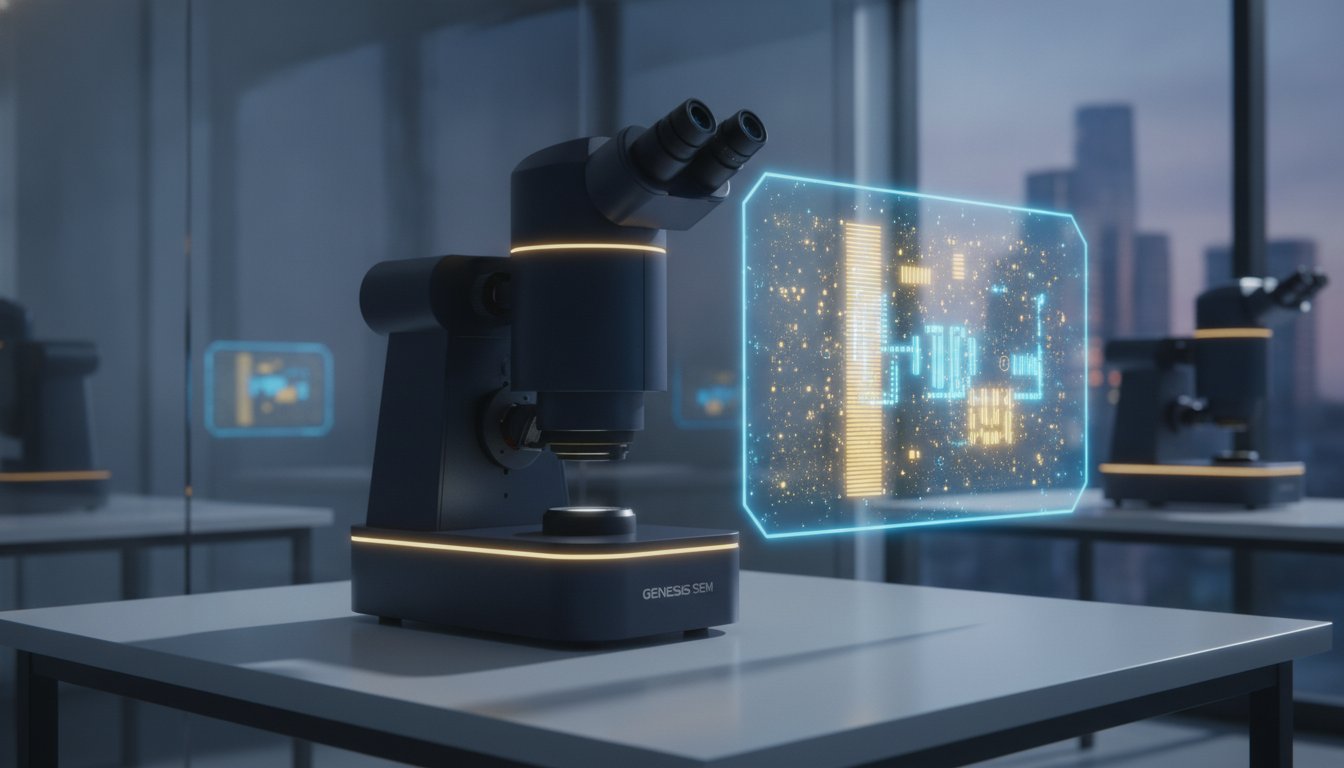
Can a compact benchtop system truly bridge the gap between space-saving convenience and the rigorous sub-5nm resolution requirements of modern materials science? For many industrial laboratories, the traditional reliance on massive floor-model systems has created a bottleneck where facility footprint and escalating capital expenditures limit analytical throughput. The Genesis tabletop SEM addresses these challenges directly, providing a sophisticated alternative for organizations that refuse to compromise on imaging quality. You likely agree that current imaging workflows are often too slow for high-throughput requirements, and maintaining a competitive edge requires a shift toward more agile, yet equally precise, instrumentation.
This definitive guide explores how this platform serves as a primary catalyst for industrial transformation by offering the technical sophistication of larger units within a streamlined format. We’ll provide a meticulous analysis of technical specifications, industrial applications, and the total cost of ownership to help you determine if this technology meets your specific laboratory requirements. By the end of this article, you’ll understand how to integrate elemental analysis into your standard workflows while securing the reliability of an expert, US-based service partner to ensure long-term operational excellence.
Key Takeaways
- Understand how modern vibration-resistant optics allow benchtop systems to achieve sub-5nm resolution, effectively eliminating the need for specialized laboratory infrastructure.
- Evaluate the imaging capabilities of the Genesis tabletop SEM by comparing Tungsten and Field Emission sources to meet your specific surface detail requirements.
- Identify high-ROI applications across semiconductor failure analysis and advanced materials science where streamlined workflows accelerate critical quality control processes.
- Learn to calculate the total cost of ownership by balancing initial capital expenditure with rigorous preventative maintenance strategies to ensure vacuum system longevity.
- Distinguish between the Cube II, Genesis, and Veritas series to select the optimal analytical platform for your laboratory’s specific throughput and resolution benchmarks.
The Evolutionary Shift to High-Performance Desktop SEM in 2026
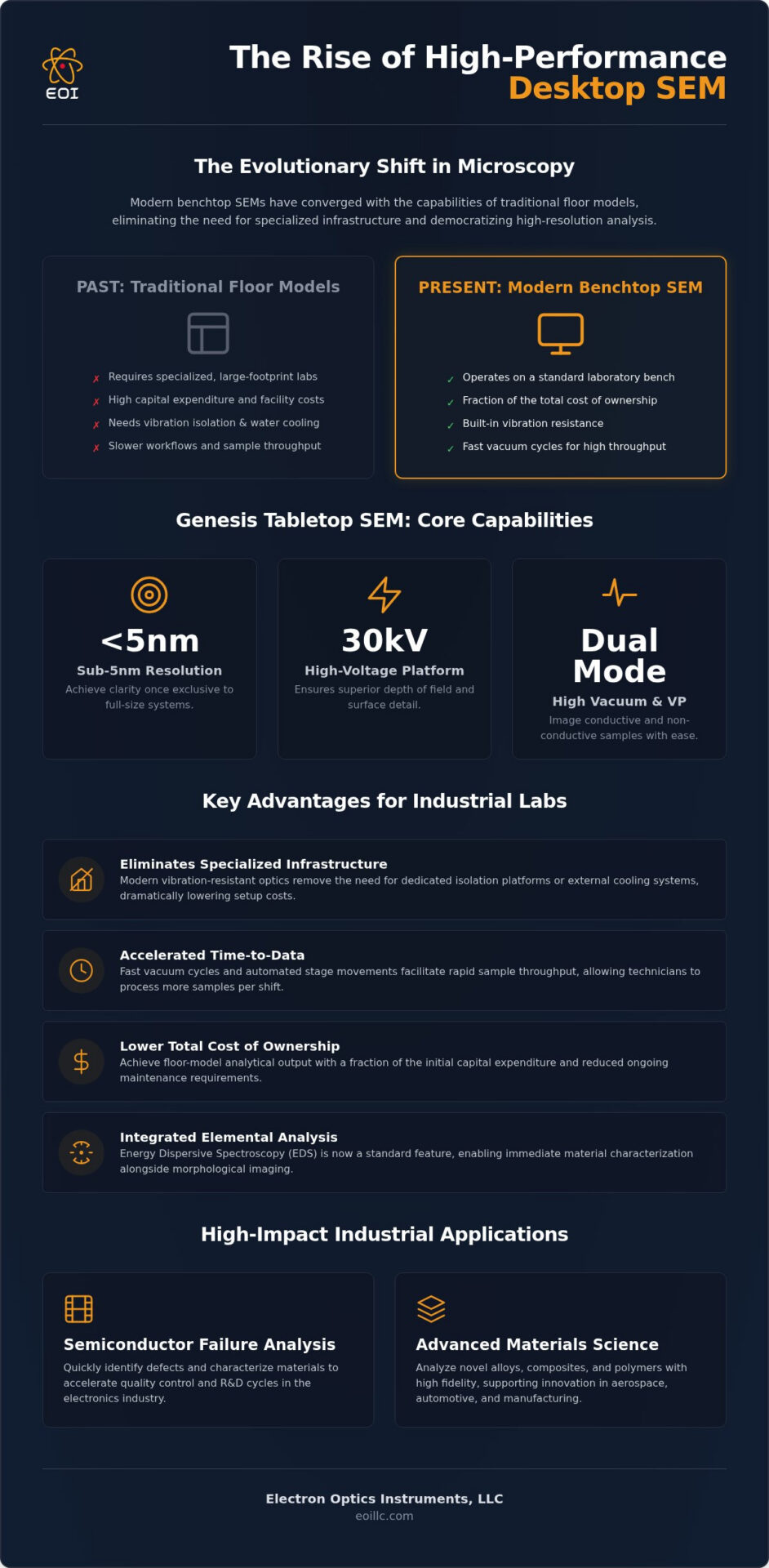
A desktop Scanning electron microscope (SEM) is no longer defined merely by its reduced footprint; it represents a sophisticated category of vibration-resistant instruments engineered for standard benchtop operation. In 2026, the industry has witnessed a significant technological convergence where refined electron optics and improved vacuum systems allow these compact units to achieve sub-5nm resolution. This capability was once the exclusive domain of floor-standing models that required extensive facility modifications. By eliminating the need for specialized infrastructure, organizations are successfully transitioning high-end analysis from centralized suites directly to the production floor. This shift characterizes the democratization of microscopy, where precision imaging becomes an integrated part of the manufacturing lifecycle rather than a remote service.
A common misconception persists that tabletop models serve only as entry-level tools for basic screening. Current data suggests that 2026 tabletop units function as specialized analytical workhorses, capable of handling complex failure analysis and material characterization with high fidelity. The Genesis tabletop SEM exemplifies this evolution, offering the stability and depth of field necessary for modern industrial standards while maintaining a simplified user interface. It’s a move toward efficiency that doesn’t sacrifice the technical depth required by seasoned researchers.
Why Industrial Labs are Transitioning to Benchtop Models
The primary driver for this transition is the drastic reduction in facility requirements. Modern benchtop SEMs don’t require specialized vibration isolation platforms or external water-cooling systems, which significantly lowers the barrier to entry for smaller research facilities. Beyond space savings, these units offer an accelerated time-to-data. Fast vacuum cycles and automated stage movements facilitate rapid throughput, allowing technicians to process more samples per shift. When evaluating the comparative ROI, industrial partners find they can achieve floor-model analytical output with a fraction of the initial capital expenditure and ongoing maintenance costs.
Defining Modern Standards for Desktop Microscopy
In 2026, the industry benchmarks for resolution and magnification have shifted upward. A standard desktop unit must now provide reliable imaging at magnifications exceeding 100,000x while maintaining structural clarity. Integration of Energy Dispersive Spectroscopy (EDS) has transitioned from an optional luxury to a standard feature, enabling immediate elemental characterization alongside morphological imaging. The Genesis series stands as a versatile analytical workhorse engineered specifically for the rigorous demands of multi-user industrial environments. This integration ensures that quality control workflows remain uninterrupted by the logistical delays of external testing labs.
Genesis Tabletop SEM: Technical Specifications and Imaging Capabilities
The architectural integrity of the Genesis tabletop SEM is built upon a high-voltage platform capable of reaching 30kV, a specification that ensures superior depth of field and surface detail across diverse sample types. This power allows researchers to penetrate deeper into material structures, providing the clarity required for advanced failure analysis. As we look toward the future of microscopy, the integration of such high-energy capabilities into a benchtop format signifies a departure from the limitations of previous compact generations. It’s no longer necessary to sacrifice voltage for the sake of lab space, as modern electronics have miniaturized the power supplies without compromising beam stability.
The vacuum system architecture further enhances this versatility through the implementation of both High Vacuum and Variable Pressure (VP) modes. While High Vacuum is the standard for conductive, prepared samples, VP mode allows for the imaging of non-conductive or outgassing materials without the need for extensive gold or carbon coating. This flexibility is supported by sophisticated stage automation, featuring multi-sample holders and intuitive navigation software that streamlines the transition between different points of interest. These systems don’t just capture images; they provide a structured environment for high-throughput data acquisition.
Tungsten vs. Field Emission in the Genesis Series
Selecting the appropriate electron source is a critical decision that impacts both resolution and operational overhead. Tungsten (W) filaments remain the industry standard for general morphology and routine quality control due to their inherent reliability and lower initial cost. These sources are ideal for labs where high-throughput screening of micrometer-scale features is the primary objective. In contrast, the Veritas FE (Field Emission) systems provide superior resolution at lower accelerating voltages, making them indispensable for characterizing nanomaterials that are sensitive to beam damage. While Tungsten filaments typically require more frequent replacement intervals, FE sources offer extended lifespans that justify their higher capital expenditure in high-precision research environments.
Analytical Integration: EDS and Elemental Mapping
Beyond pure imaging, the inclusion of integrated EDS facilitates rapid identification of contaminants and precise material composition analysis. The Genesis platform utilizes dual-detector configurations to maximize data acquisition. Secondary Electron (SE) detectors capture topographic detail, while Backscattered Electron (BSE) detectors provide compositional contrast based on atomic weight. Understanding these mechanisms is essential for any technician, as detailed in our guide on The Fundamental Principles of Scanning Electron Microscopy (SEM) in 2026. For teams seeking to enhance their diagnostic speed, reviewing the full technical profile of the Genesis tabletop SEM can provide the necessary clarity for upcoming procurement cycles.
Industrial Applications: Where the Genesis Series Delivers Maximum ROI
The industrial utility of the Genesis tabletop SEM extends across diverse sectors where precision and throughput are paramount for operational profitability. In semiconductor manufacturing, the system provides critical insights into the structural integrity of wire bonds and Through-Silicon Vias (TSVs), identifying micro-scale fractures that could lead to catastrophic failure. Similarly, in materials science, the characterization of advanced alloys and ceramic structures allows engineers to verify metallurgical properties against rigorous international standards. While many high-end research projects were historically conducted at university SEM facilities, the shift toward localized, production-floor analysis has fundamentally altered the quality assurance landscape. This transition ensures that critical data remains within the organizational ecosystem, accelerating the developmental cycle of new materials.
Beyond traditional engineering, forensic laboratories utilize the automated stage capabilities of the Genesis series for the rapid analysis of gunshot residue (GSR) and trace evidence. This automation reduces the manual labor required for scanning large sample areas, ensuring that evidentiary data is both accurate and reproducible. In the pharmaceutical sector, the instrument’s ability to map morphology and particle size distribution is vital for the development of sophisticated drug delivery systems. These applications demonstrate that the platform isn’t merely a viewing tool but a comprehensive analytical solution that drives measurable value across the entire supply chain. It’s a strategic asset for any facility requiring high-fidelity imaging without the logistical burden of a centralized microscopy suite.
Failure Analysis and Quality Control Workflows
Integrating a scanning electron microscope directly into the production line enables real-time defect inspection, which is a significant advancement over the delayed feedback loops of external testing. By utilizing AI-enhanced imaging software, the Genesis tabletop SEM can execute automated defect recognition, flagging anomalies in micro-components without constant operator supervision. A recent case study in semiconductor manufacturing demonstrated that relocating failure analysis to the production floor reduced equipment downtime by several hours per incident. This localized approach empowers technical teams to make data-driven decisions immediately, preserving the continuity of large-scale production cycles and minimizing the risk of batch-wide defects.
High-Resolution Imaging for Nanotechnology
The characterization of carbon nanotubes and graphene structures requires a level of precision that was previously unattainable in a benchtop format. High-resolution imaging at this scale often necessitates low-voltage techniques to prevent beam-induced damage to sensitive biological or non-conductive samples. For researchers interested in the technical nuances of these processes, our resource on Advanced SEM Techniques: A Comprehensive Guide to High-Resolution Analytical Microscopy in 2026 provides an in-depth analysis of signal optimization. By mastering these methods, labs can achieve the clarity needed to push the boundaries of nanomaterial development while maintaining the logistical advantages of a compact system.
Calculating Total Cost of Ownership and Operational Longevity
Assessing the financial viability of a Genesis tabletop SEM requires a comprehensive analysis that extends far beyond the initial capital expenditure. While the purchase price is often the primary focus during procurement, the long-term operational costs determine the true return on investment for high-throughput labs. These costs encompass a spectrum of variables, including consumables management, energy consumption, and the periodic relocation of equipment within shifting facility layouts. Strategizing the replacement of filaments, apertures, and sample stubs is essential to avoid procurement delays that can halt production. Proper staff training also acts as a safeguard, ensuring that personnel proficiency matches the technical sophistication of the hardware to prevent accidental damage during routine operation.
Lifecycle management is a multi-faceted discipline that balances the immediate needs of researchers with the long-term stability of the vacuum system. For organizations transitioning from floor-model systems, the compact nature of the Genesis series simplifies relocation and facility integration, yet it doesn’t eliminate the need for a rigorous oversight strategy. It’s a matter of technical diligence; neglecting the minor components often leads to major system degradation over time. By accounting for these variables early, lab managers can ensure that their analytical capabilities remain consistent throughout the equipment’s operational life.
The Strategic Value of SEM Service Contracts
Tiered service agreements provide a structured approach to risk management, offering a choice between priority support, comprehensive parts coverage, and repair labor. For laboratories managing mixed-manufacturer fleets, securing an expert third-party service partner is vital for maintaining cross-platform consistency. These contracts ensure that specialized technicians are available to calibrate the optics and verify the vacuum integrity of the Genesis tabletop SEM at scheduled intervals. For a deeper exploration of these protocols, consult The Definitive Guide to SEM Maintenance: Maximizing Precision and Longevity in 2026.
Maximizing Uptime through Preventative Maintenance
Operational longevity is fundamentally linked to the rigor of preventative maintenance cycles. Standard intervals must include vacuum pump oil changes and meticulous column cleaning to prevent the accumulation of contaminants that degrade image resolution. Monitoring filament health is equally critical; it’s the only way to prevent catastrophic mid-analysis failures that can ruin sensitive samples or delay urgent reports. Proactive maintenance reduces emergency repair costs by up to 40% annually. By adhering to these strict technical routines, labs can extend the lifecycle of their instrumentation while maintaining the sub-5nm resolution benchmarks expected in 2026. To secure your lab’s operational future, you can request a comprehensive service consultation to align your maintenance strategy with your analytical goals.
Selecting the Optimal SEM: Genesis vs. Cube II vs. Veritas
Selecting the optimal analytical platform requires a meticulous alignment of hardware capabilities with specific laboratory objectives. While the Genesis tabletop SEM serves as the primary workhorse for diverse industrial applications, other models within the EmCraft ecosystem address specialized operational constraints. The Cube II Benchtop SEM provides entry-level power, prioritized for rapid screening and cost-effective imaging where high-throughput EDS integration is the primary requirement. Conversely, the Veritas Series is engineered for nanometer-scale research, pushing the boundaries of what’s achievable in a desktop format. For institutions navigating significant capital constraints, Refurbished SEM Units represent a strategic alternative, providing access to high-end instrumentation with a reduced initial investment without compromising technical support.
The decision-making process often hinges on the expected sample diversity and the level of expertise among the primary users. Multi-user industrial environments typically favor the Genesis tabletop SEM due to its robust stage automation and intuitive navigation software, which minimize the learning curve for technicians. In contrast, specialized research suites focusing on nanomaterials or complex failure analysis require the enhanced resolution of a Field Emission source. By evaluating these instruments through the lens of specific “jobs to be done,” lab managers can secure a system that delivers maximum ROI over its entire operational lifecycle.
Evaluating the Veritas Series for Specialized Research
The Veritas Series represents the pinnacle of compact electron optics, with the Veritas Pro and Veritas Ultra models offering distinct resolution tiers to match specific material constraints. While both provide exceptional clarity, the Veritas FE (Field Emission) is particularly noteworthy for its ability to achieve floor-model resolution within a compact desktop footprint, making it indispensable for advanced semiconductor and nanotechnology research. Mastering these high-end systems requires a deep understanding of beam dynamics and signal optimization. For a comprehensive overview of these protocols, practitioners should refer to the SEM Operation: The Professional Guide to Scanning Electron Microscopy in 2026.
Partnering with Electron Optics Instruments, LLC
Choosing the right instrument is only the first step in a long-term analytical partnership. Electron Optics Instruments, LLC leverages over 30 years of industry expertise to help organizations customize their microscope configurations based on specific throughput and resolution benchmarks. As the sole US distributor for EmCraft, the company provides direct access to leading-edge scanning electron microscopes and sophisticated EDS systems. This partnership extends beyond the point of sale, encompassing:
- Comprehensive on-site technical training to ensure laboratory staff achieve maximum proficiency.
- Customized preventative maintenance schedules to safeguard vacuum integrity and column cleanliness.
- Direct procurement channels for SEM filaments and high-quality consumables.
By integrating these specialized services, labs can ensure that their scanning electron microscope remains a reliable anchor for their quality control and research initiatives. Secure your facility’s future by consulting with our technical experts to determine the ideal configuration for your 2026 analytical requirements.
Advancing Laboratory Capabilities with Integrated Benchtop Microscopy
The successful implementation of high-performance microscopy in 2026 requires a strategic balance between technical sophistication and operational efficiency. Organizations that leverage the Genesis tabletop SEM successfully bridge the historical gap between floor-model resolution and the agile requirements of a modern production environment. This definitive guide has highlighted the critical importance of selecting a platform that aligns with specific industrial benchmarks while maintaining a rigorous focus on total cost of ownership through proactive maintenance. It’s clear that the democratization of high-end imaging is no longer a future concept but a practical reality for labs seeking to accelerate their time-to-data.
As a seasoned technical partner with 30+ years of industry expertise, Electron Optics Instruments, LLC serves as the sole US distributor for EmCraft. We provide full-lifecycle service for all major SEM brands, ensuring that your laboratory’s analytical capabilities remain at the forefront of innovation. Transitioning to a compact, high-resolution system doesn’t mean sacrificing support or reliability. To ensure your facility’s future performance, Request a Technical Consultation for Your Next Desktop SEM and discover how our expert-driven approach can transform your imaging workflows. We look forward to supporting your organization’s pursuit of technical excellence and industrial progress.
Frequently Asked Questions
What is the typical resolution of a modern tabletop SEM in 2026?
Sub-5nm resolution has become the standard benchmark for high-performance tabletop units in 2026. This level of precision is achieved through advanced electron optics and stabilized power supplies that were once exclusive to larger floor-standing systems. These compact instruments now provide the clarity required for sophisticated nanomaterial characterization and semiconductor failure analysis directly on the laboratory benchtop.
How does the cost of a Genesis tabletop SEM compare to a floor-model system?
A Genesis tabletop SEM represents a significantly lower total cost of ownership when compared to traditional floor-model systems. Beyond the reduced initial capital expenditure, laboratories save on facility modifications since these units don’t require specialized vibration isolation or dedicated water-cooling infrastructure. Ongoing maintenance and consumable costs are also proportionally lower, making high-end microscopy more accessible for diverse industrial applications.
Can I perform elemental analysis (EDS) with a Genesis benchtop microscope?
Yes, the Genesis series fully integrates Energy Dispersive Spectroscopy (EDS) systems for rapid elemental characterization and compositional mapping. This integration allows technicians to identify contaminants and verify material purity simultaneously with morphological imaging. The software environment is designed to streamline the transition between secondary electron imaging and elemental data acquisition, enhancing overall laboratory throughput.
What are the primary maintenance requirements for a tabletop scanning electron microscope?
Primary maintenance involves vacuum pump oil changes, column cleaning, and the periodic replacement of electron sources such as Tungsten filaments. Adhering to a schedule of preventative maintenance visits is essential to safeguard vacuum integrity and prevent catastrophic system failures. Regular calibration of the optics ensures that the instrument continues to meet its resolution benchmarks throughout its operational lifecycle.
Is specialized facility infrastructure required to install a desktop SEM?
No specialized infrastructure is required for the installation of a modern desktop SEM. These units are engineered for standard benchtop operation and utilize conventional electrical outlets without the need for reinforced flooring or external chillers. This portability allows organizations to deploy high-resolution imaging capabilities directly onto the production floor or within standard research environments.
Can a Genesis tabletop SEM handle non-conductive or wet samples?
The Genesis tabletop SEM utilizes Variable Pressure (VP) mode to image non-conductive samples without the need for traditional gold or carbon coating. While wet samples generally require specialized preparation or environmental holders to maintain vacuum stability, the VP capability significantly broadens the range of materials that can be analyzed in their natural state. This flexibility is vital for the pharmaceutical and polymer industries.
What is the difference between Tungsten and Field Emission desktop SEMs?
Tungsten (W) systems utilize a heated filament and are valued for their reliability and cost-effectiveness in general morphology and quality control. In contrast, Field Emission (FE) sources provide a much brighter and more stable electron beam, enabling superior resolution at lower accelerating voltages. FE-SEM units are the preferred choice for characterizing sensitive nanomaterials that require sub-5nm clarity without beam-induced damage.
How long does the installation and training for a benchtop SEM typically take?
Installation and comprehensive on-site technical training are typically completed within one to three business days. This timeframe includes the physical setup of the hardware, vacuum system stabilization, and intensive instruction for laboratory personnel. Our goal is to ensure that your staff achieves full operational proficiency and can generate high-quality analytical data immediately following the commissioning of the instrument.