
The traditional assumption that benchtop electron microscopy requires a fundamental compromise in stage architecture is no longer a functional reality for modern industrial laboratories. While researchers often value the spatial efficiency of compact systems, the limitations of restricted stage travel and sluggish vacuum cycles frequently impede the pace of high-volume failure analysis. This Veritas SEM review provides a rigorous technical evaluation of how the 2026 Veritas Series effectively bridges the gap between desktop convenience and the robust capacity of conventional floor-model systems.
We’ll explore the mechanical precision of the 120mm 5-axis motorized stage, a feature that directly addresses the historical pain points of multi-sample navigation in restricted chambers. By analyzing resolution benchmarks alongside a detailed cost-benefit assessment, this evaluation validates the Veritas Series as a primary productivity workhorse for laboratories seeking to optimize their analytical throughput without the overhead of a full-scale installation. Through this lens of technical integration and industrial reliability, we’ll determine how these benchtop units meet the stringent demands of next-generation production environments and international quality standards.
Key Takeaways
- This Veritas SEM review evaluates how the series integrates a 120mm X-Y motorized stage to overcome the traditional spatial limitations of compact benchtop architectures.
- Identify the performance advantages of the pre-centered Tungsten Filament system, which enables resolution benchmarks of 3.0nm for sophisticated industrial imaging.
- Compare the specific capabilities of the Veritas Plus, HR, and Ultra SEM models to determine which unit aligns with your 2026 laboratory throughput requirements.
- Explore the industrial ROI of these systems in failure analysis workflows, including semiconductor inspection and high-resolution metallurgical studies.
- Gain insight into the critical role of specialized US distribution and preventative maintenance in ensuring the lifecycle longevity of benchtop SEM hardware.
The Evolution of Benchtop Microscopy: Why the Veritas SEM Redefines Large-Sample Analysis
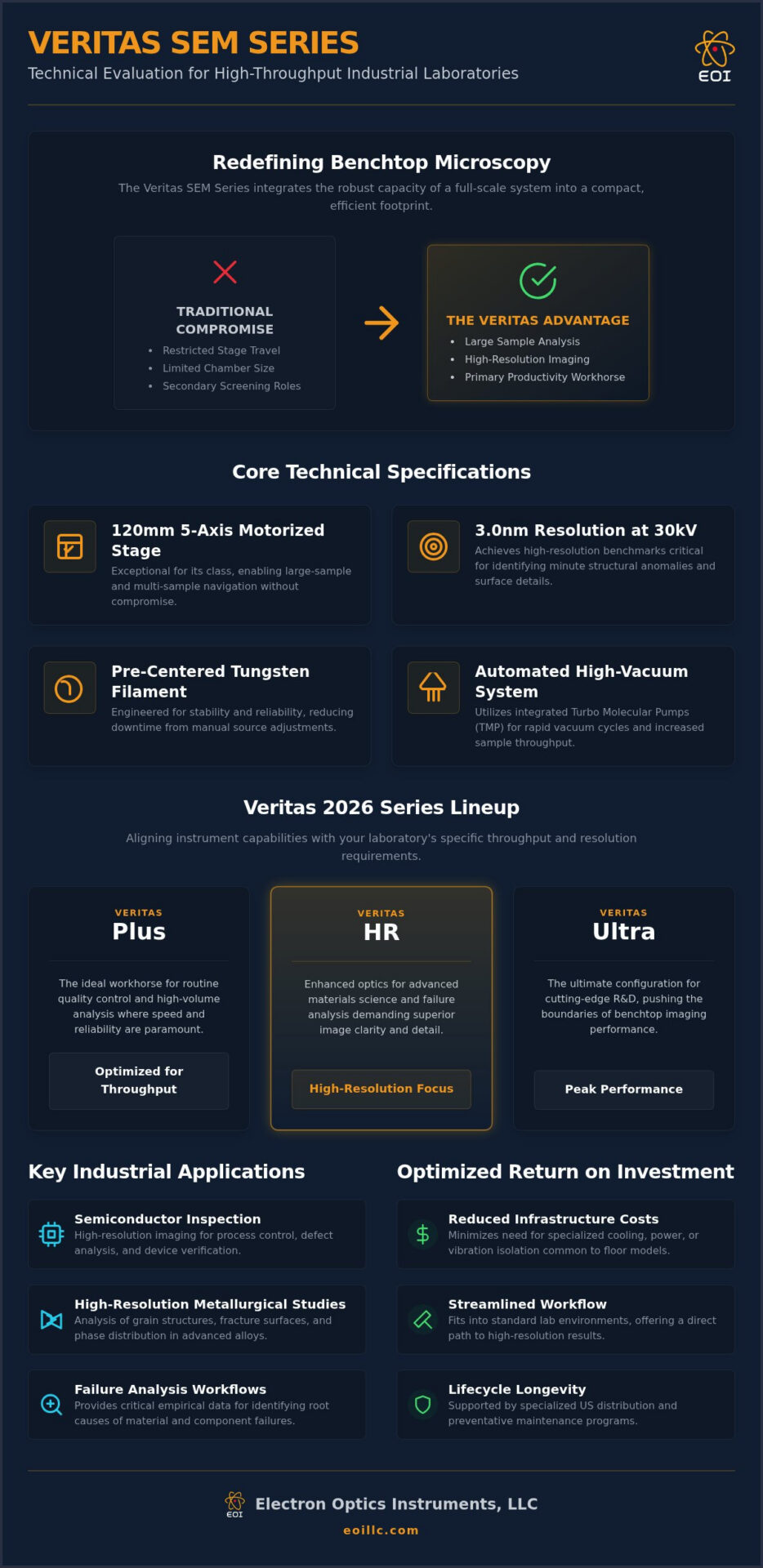
The transition from massive, room-sized instrumentation to high-performance benchtop systems represents a significant milestone in material science and industrial quality control. This Veritas SEM review examines how the series functions as a high-throughput analytical tool, engineered to provide the resolution of traditional floor-standing units within a compact footprint. While older generations of benchtop microscopes were often relegated to secondary screening roles, the current Veritas Series architecture successfully balances spatial efficiency with a substantial analytical volume. It’s no longer necessary to compromise on chamber size or stage travel to achieve the convenience of a tabletop installation. This evolutionary shift reflects a broader trend where technical integration allows for sophisticated electron optics to reside in a more accessible, modular format.
Distinguishing Scientific Hardware from Digital Marketing Tools
When searching for technical evaluations, the acronym overlap between Scanning Electron Microscopy and Search Engine Marketing often creates significant digital noise. For the lab manager or failure analysis engineer, a sem scanning electron microscope is a critical piece of physical hardware, not a digital optimization suite. The precision requirements of modern nanotechnology demand dedicated Scanning electron microscope (SEM) tools capable of resolving features at the sub-micron level. These instruments provide the empirical data necessary for rigorous quality control, fracture analysis, and structural verification. This distinction is vital for B2B partners who prioritize the grounded, practical realities of international production over abstract marketing terminology.
The Strategic Advantage of the Veritas Series Footprint
The shift toward the desktop sem as a laboratory standard stems from its ability to reduce utility requirements and overall infrastructure costs. Traditional floor-standing units often require specialized vibration isolation, dedicated cooling systems, and extensive power modifications. The Veritas Series minimizes these logistical burdens while maintaining a 120mm X-Y motorized stage, a feature that’s exceptionally rare for its class. By optimizing the internal chamber layout, the Veritas Series ensures that industrial laboratories can conduct large-sample analysis without the spatial or financial investment required by older technologies. It’s a productivity workhorse that fits into standard laboratory workflows, offering a streamlined path to high-resolution imaging without the complexity of traditional facilities management. This makes the system an ideal choice for facilities looking to maximize their ROI in 2026.
Technical Specifications: Vacuum Systems, Resolution, and Electron Optics
Technical superiority in benchtop microscopy relies heavily on the precision of the electron source and the stability of the optical column. This Veritas SEM review highlights the integration of a pre-centered Tungsten Filament, a design choice that provides a sophisticated balance between high-resolution output and industrial cost-efficiency. For the Veritas-3000, resolution benchmarks reach 3.0nm for Secondary Electron (SE) imaging at 30kV. This level of detail is critical for engineers who must identify structural anomalies or surface contaminants in advanced materials. The system architecture ensures that the filament remains aligned, reducing the downtime typically associated with manual source adjustments in older electron optics systems.
Vacuum Architecture and Sample Throughput
Efficiency in a high-volume industrial laboratory is often dictated by vacuum cycle times and the speed of sample exchange. The Veritas Series utilizes a fully automated evacuation system powered by integrated Turbo Molecular Pumps (TMP). This configuration allows the chamber to reach vacuum readiness in under three minutes, which is a significant improvement over traditional oil-diffusion pump systems. Maintaining chamber integrity is essential for consistent sem operation, particularly during long-duration mapping sessions. For specialized applications involving non-conductive or hydrated samples, the Veritas-3100 offers low-vacuum modes ranging from 10 to 230Pa. This flexibility prevents sample charging and eliminates the immediate requirement for conductive coating, streamlining the workflow for biological or polymer research.
Electron Beam Control and Detector Arrays
The ability to modulate accelerating voltages from 200V to 30kV allows operators to tailor the electron beam to specific sample sensitivities. Lower voltages are exceptionally useful for surface-sensitive imaging or inspecting delicate, beam-sensitive polymers that might otherwise suffer from structural damage. The detector array features high-sensitivity Secondary Electron (SE) and 4-channel Backscattered Electron (BSE) semiconductor detectors. These sensors provide comprehensive topographical and compositional data, allowing for clear Z-contrast imaging to distinguish between different elemental phases. Variable apertures of 20, 50, and 100μm further empower the user to manipulate the depth of field and beam current for optimal image clarity across varying magnifications.
Central to the system’s utility is the 5-axis motorized stage. With X and Y travel of 120mm, the Veritas Series offers an analytical volume that rivals many larger installations. This motorized precision ensures that multi-sample navigation is both repeatable and accurate. Engineers can easily map large areas or inspect multiple components in a single session without manual intervention. For those evaluating long-term laboratory upgrades, reviewing the full range of Veritas Series SEM configurations provides a clear path toward enhanced analytical capacity and superior throughput.
Performance Benchmarks: Evaluating the Veritas Plus, HR, and Ultra Models
The Veritas Series offers a tiered architectural approach designed to meet the specific resolution and analytical requirements of diverse industrial sectors. Selecting the appropriate model requires a clear understanding of the trade-offs between standard Secondary Electron (SE) imaging and multi-detector configurations. For instance, the Veritas-3000 serves as a robust baseline for high-resolution topography, while the Veritas-3100 integrates dual SE and Backscattered Electron (BSE) capabilities. This dual-detector setup is essential for identifying elemental variations within a sample, providing the Z-contrast necessary for complex metallurgical or semiconductor analysis. This Veritas SEM review notes that while the Cube II Benchtop SEM remains an excellent entry-level solution for rapid screening, the Veritas Series is engineered for those requiring higher analytical volume and more sophisticated electron optics.
The 2026 resolution targets for the Veritas HR and Veritas Ultra FE models push the boundaries of what’s possible in a benchtop format. These units are designed to deliver exceptional clarity at magnifications up to x300,000, where maintaining a high signal-to-noise ratio becomes the primary challenge. By optimizing the beam stability and detector sensitivity, the Veritas Ultra FE provides the precision required for sub-nanometer feature characterization. Such performance ensures that the system remains a viable industrial tool for next-generation material development. It’s this level of technical maturity that allows the series to compete directly with larger, more expensive floor-standing alternatives.
Magnification and Image Fidelity
Achieving high-magnification imaging requires more than just raw power; it demands refined control over the electron beam’s interaction with the sample surface. The Veritas Series incorporates a digital image shift of 100μm, allowing operators to make precise feature alignments without the mechanical vibrations associated with physical stage movement. This electronic fine-tuning, combined with advanced post-processing software, ensures that image clarity is maintained even at the limits of the system’s magnification range. It’s this meticulous attention to image fidelity that defines the series as a leader in specialized industrial microscopy, providing the empirical data required for rigorous failure analysis.
Stage Navigation and Multiple Sample Mounting
Laboratory throughput is significantly enhanced by the 210mm horizontal sample capacity and the inclusion of an internal CCD camera. This camera acts as a macro-navigation tool, allowing users to locate specific regions of interest on large samples or multiple stubs simultaneously. The ability to mass-load samples reduces the frequency of vacuum cycles, directly addressing one of the most common pains in high-volume laboratory environments. When combined with automated stage movement, the Veritas SEM review finds that these systems support persistent, unattended analysis, allowing researchers to focus on data interpretation rather than repetitive mechanical navigation. This synergy between hardware capacity and software automation represents a significant leap in benchtop productivity.
Industrial Efficacy: Veritas SEM Applications in Failure Analysis and QC
The industrial utility of the Veritas Series extends far beyond basic imaging, functioning as a primary tool for rigorous empirical investigation in high-stakes production environments. This Veritas SEM review identifies the series as a critical asset for semiconductor inspection, where detecting micro-defects in integrated circuits is essential for maintaining yield rates and ensuring long-term device reliability. In metallurgical applications, engineers leverage advanced sem techniques to analyze complex grain structures and characterize fracture surfaces, providing the data needed to prevent structural fatigue in critical components. Forensic engineering departments similarly rely on these systems to determine the root causes of mechanical component failure, while pharmaceutical researchers utilize the high-resolution optics to verify particle morphology and size distribution for regulatory compliance.
Failure Analysis at the Nanoscale
Precision at the nanoscale is a prerequisite for modern failure analysis, particularly when evaluating multi-layer materials or composite structures. The Veritas Series facilitates high-fidelity cross-sectional imaging, allowing technicians to inspect internal interfaces for delamination, voids, or thermal degradation. By integrating EDS (Energy Dispersive Spectroscopy) Systems, laboratories can move beyond surface topography to identify chemical contaminants that might compromise product integrity during the manufacturing process. These capabilities are vital for verifying cleanroom standards and ensuring that microscopic debris doesn’t disrupt sensitive assembly lines. The synergy between high-resolution imaging and elemental analysis transforms the SEM from a simple microscope into a comprehensive diagnostic platform capable of resolving the most challenging industrial anomalies.
Quality Control in Large-Scale Manufacturing
Maintaining consistency in large-scale production requires the ability to process high-volume sample batches without sacrificing accuracy or repeatability. The Veritas Series supports this requirement through automated inspection routines that allow for persistent, unattended operation during peak production cycles. The large chamber volume is a strategic advantage for non-destructive testing, as it accommodates oversized components that would otherwise require destructive sectioning for analysis in smaller units. Integrating this high-resolution data into corporate quality management systems enables a data-driven approach to process optimization and sustainable development. By providing a reliable stream of accurate data, these systems support the logistical excellence required in international production. For organizations seeking to enhance their analytical capabilities and throughput, exploring the full range of Veritas Series SEM hardware is a logical step toward industrial excellence.
Long-Term Operational Stability: Service, Maintenance, and US Distribution
The sustained performance of high-resolution hardware is intrinsically linked to the rigor of its ongoing technical support. In this Veritas SEM review, we recognize that the sophisticated electron optics and motorized stage systems require a structured approach to upkeep to maintain their 2026 resolution benchmarks. Implementing a comprehensive strategy for sem maintenance isn’t merely a restorative measure; it’s a proactive requirement for industrial laboratories that prioritize analytical fidelity and equipment longevity. Professional service contracts provide the necessary framework for this stability, offering priority support and scheduled Preventative Maintenance Visits that ensure the system continues to operate within its original engineering tolerances. This expert-driven narrative emphasizes the intersection of innovation and reliability, moving beyond the initial purchase to focus on the full lifecycle of the instrument.
Preventative Maintenance and Calibration
Scheduled inspections are vital for verifying vacuum integrity and electron beam alignment, two factors that directly influence imaging clarity and system uptime. During these visits, specialized technicians perform meticulous 5-axis calibration to ensure that the 120mm motorized stage remains accurate for automated multi-sample navigation. Calibration standards must be strictly adhered to, as even minor deviations in the electron column can result in significant loss of resolution at high magnifications. Modern support frameworks also integrate remote diagnostics, allowing for rapid equipment status assessments that minimize downtime by identifying potential issues before they result in hardware failure. This methodical approach to maintenance creates a sense of stability and thoroughness, suggesting that the laboratory’s internal processes are as rigorous as the hardware they employ.
The Value of Expert US Distribution
Partnering with a specialized entity like Electron Optics Instruments, LLC ensures that laboratories have access to a full lifecycle of technical expertise and logistical excellence. As the sole US distributor for EmCraft Scanning Electron Microscopes, they provide an established narrative of reliability rooted in over 30 years of industry experience. This partnership facilitates immediate access to critical SEM Filaments and Consumables, as well as specialized attachments such as EDS Systems. For laboratories undergoing growth or transformation, expert decommissioning and relocation services are available to manage the transition of sensitive instrumentation without compromising its internal alignment. This ensures that the Veritas Series remains a viable industrial tool for next-generation material development, supported by a partner that understands the grounded, practical realities of international production.
Maximizing the utility of the Veritas Series also requires on-site technical training to empower laboratory personnel with the skills needed for advanced hardware operation. By focusing on the synergy between industrial performance and expert-driven support, Electron Optics Instruments, LLC acts as a national partner for SEM excellence. This comprehensive approach to service ensures that the series remains a reliable asset for high-stakes production environments, providing the precision and accuracy required for superior standards in failure analysis and quality control.
Advancing Analytical Standards with the Veritas Series
The integration of the Veritas Series into a modern laboratory environment represents a strategic commitment to analytical precision and operational efficiency. As detailed in this Veritas SEM review, these systems successfully combine a compact benchtop architecture with the robust 120mm motorized stage travel typically reserved for larger installations. By achieving resolution benchmarks of 3.0nm while maintaining rapid vacuum cycle times, the series addresses the critical throughput requirements of 2026 industrial sectors. This synergy of hardware innovation and methodical technical support ensures that organizations can conduct sophisticated failure analysis with absolute confidence in their empirical data.
Electron Optics Instruments, LLC serves as the sole US distributor for the EmCraft Veritas and Genesis SEM series, leveraging over 30 years of expertise in electron optics and laboratory instrumentation. Our comprehensive service contracts cover all major SEM brands nationwide, ensuring your equipment doesn’t face unnecessary downtime. It’s a partnership designed for excellence. We invite you to Explore the Veritas Series and Request a Technical Demo to witness these capabilities firsthand. Investing in the right hardware today secures the technological standards of tomorrow.
Frequently Asked Questions
What is the primary difference between a Veritas benchtop SEM and a floor-model unit?
The primary difference lies in the spatial efficiency and reduced infrastructure requirements of the benchtop design, which doesn’t require specialized vibration isolation or dedicated cooling systems. Despite the compact exterior, the internal 120mm X-Y stage travel rivals many traditional floor-standing units. This architectural balance allows laboratories to achieve industrial-grade imaging capacity without the extensive facility modifications often associated with larger, conventional electron optics installations.
How does the Veritas SEM handle non-conductive samples without coating?
The Veritas-3100 manages non-conductive samples through a specialized low-vacuum mode ranging from 10 to 230Pa. This environment introduces a controlled amount of gas into the chamber to neutralize surface charging, allowing for high-resolution imaging of polymers, biological specimens, or hydrated samples without the immediate need for a conductive gold or carbon coating. This flexibility streamlines sample preparation workflows and preserves the original surface characteristics of sensitive materials during analysis.
Can the Veritas Series SEM be integrated with third-party EDS systems?
The Veritas Series SEM is designed for seamless integration with advanced Energy Dispersive Spectroscopy (EDS) systems for comprehensive elemental analysis. Electron Optics Instruments, LLC provides these integrated solutions to allow for simultaneous topographical imaging and chemical characterization within a single interface. This capability is essential for researchers performing detailed failure analysis or material identification, ensuring that elemental data is accurately correlated with high-resolution secondary electron images.
What is the maximum sample size accommodated by the Veritas large chamber?
The Veritas large chamber is engineered to accommodate samples up to 210mm in horizontal diameter. This substantial analytical volume is a defining feature mentioned in this Veritas SEM review, as it allows for the inspection of oversized industrial components or the simultaneous mounting of multiple sample stubs. This capacity significantly reduces the frequency of vacuum cycles, which directly addresses common laboratory throughput bottlenecks and enhances overall operational efficiency.
How often does the Veritas SEM require filament replacement?
The frequency of filament replacement depends on cumulative operating hours and accelerating voltage settings, although the pre-centered Tungsten Filament is engineered for extended industrial service. Because the source is pre-aligned, the replacement process is significantly faster than in traditional systems, which minimizes laboratory downtime. Scheduled preventative maintenance visits from qualified technicians can further optimize filament life by ensuring the electron column and vacuum systems remain in peak condition.
Is the 5-axis stage in the Veritas series fully motorized?
The Veritas series features a fully motorized 5-axis stage that provides precise control over X, Y, Z, Tilt, and Rotation movements. The 120mm X-Y travel is an exceptional specification for a benchtop system, enabling automated multi-sample navigation and repeatable mapping across large surface areas. This motorized precision is critical for conducting persistent, unattended analysis and complex structural characterization, as it removes the mechanical variability associated with manual stage adjustments.
What vacuum levels are achievable with the Veritas-3100 model?
The Veritas-3100 model achieves variable vacuum levels to support a diverse range of sample types and research requirements. In its high-vacuum mode, the system maintains the integrity required for 3.0nm resolution imaging, while its low-vacuum settings are adjustable between 10 and 230Pa. These automated transitions allow operators to switch quickly between conductive and non-conductive imaging modes, ensuring the Turbo Molecular Pump architecture remains optimized for both speed and stability.
Does Electron Optics Instruments, LLC provide national service for Veritas units?
Electron Optics Instruments, LLC provides comprehensive national service and technical support for all Veritas units throughout the United States. With over 30 years of industry experience, the firm offers multi-tiered maintenance agreements, on-site training, and hardware repairs. Their extensive service network ensures that laboratories nationwide have access to priority support and preventative maintenance visits, maintaining the long-term operational stability and calibration accuracy of their high-resolution electron microscopy systems.