

The pursuit of sub-nanometer precision often fails not due to a lack of magnification, but because of the volatile interaction between high-energy electrons and delicate sample surfaces. While the global electron microscope market is projected to expand to 6.13 billion dollars by 2033, the industrial utility of this investment depends entirely on an operator’s ability to mitigate electrostatic charging and beam-induced degradation. You likely recognize that achieving consistent results in nanomaterial imaging with sem requires more than just sophisticated hardware; it’s a process that demands a rigorous, methodical approach to electron-matter interactions.
This guide provides the technical framework necessary to stabilize sensitive nanostructures and extract precise morphological data using the latest advancements in high-resolution characterization. We’ll examine the strategic integration of Energy Dispersive Spectroscopy for elemental mapping, the impact of ISO 19749:2021 standards on data reliability, and the deployment of field emission technology to overcome the resolution constraints often encountered with standard benchtop configurations. By mastering these technical intricacies, researchers can ensure their nanoparticles and nanotubes remain intact for accurate, repeatable analysis.
Key Takeaways
- Understand why it’s critical to manage electron-sample interaction volumes to stabilize delicate nanostructures during high-resolution analysis.
- Master the protocols for nanomaterial imaging with sem by applying low-voltage techniques and beam deceleration to enhance surface-specific data.
- Implement specialized sample preparation methods, including strategic substrate selection and dispersion, to prevent the clustering and agglomeration of nanoparticles.
- Explore how the Cube II Benchtop SEM facilitates high-throughput screening while maintaining the rigorous standards required for modern nanotechnology research.
- Learn to integrate EDS systems into your characterization workflow to achieve a comprehensive synergy between morphological imaging and elemental mapping.
The Strategic Importance of SEM in Nanomaterial Characterization
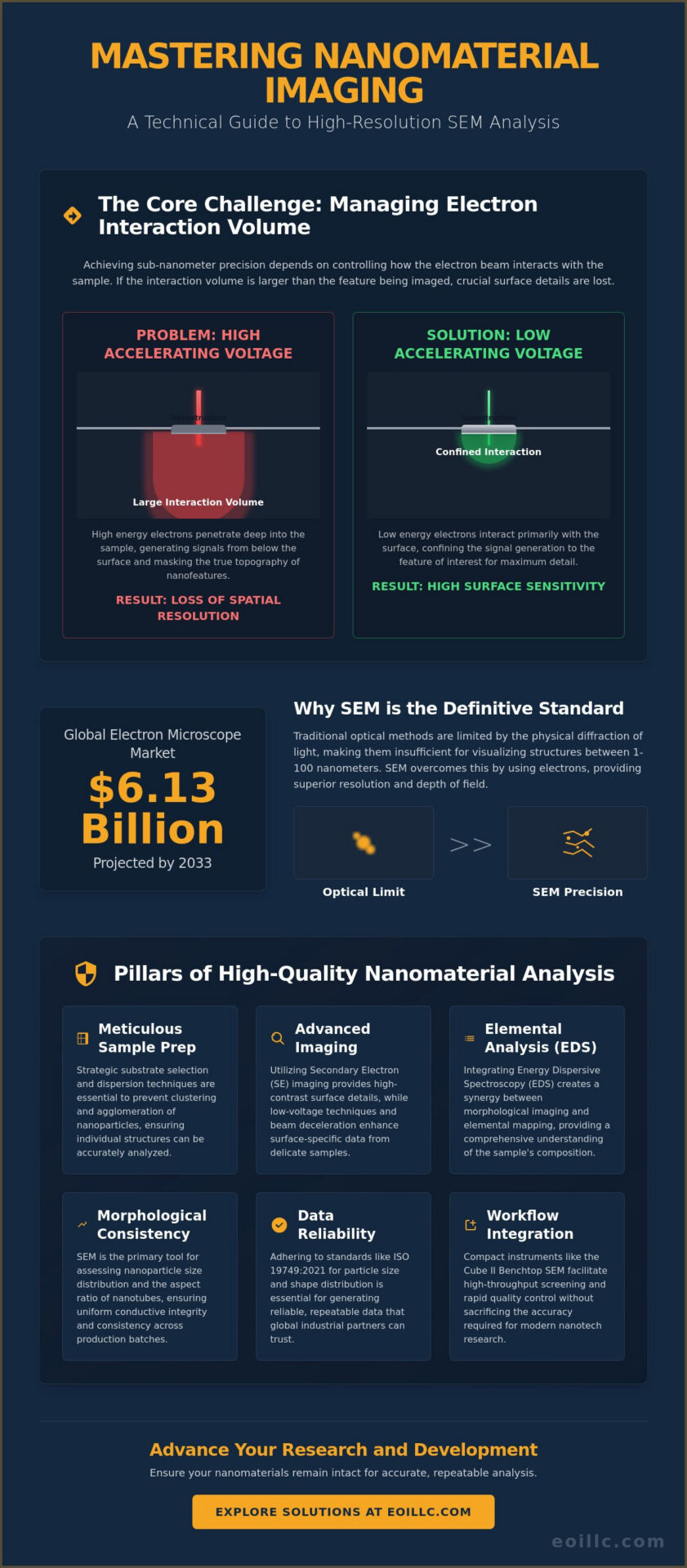
Nanomaterial imaging with sem represents the definitive standard for modern structural characterization, specifically targeting the visualization and meticulous measurement of matter between 1 and 100 nanometers. In this specialized dimension, traditional optical methods encounter their physical diffraction limits, which renders them insufficient for the rigorous demands of 2026 industrial production and engineering. A Scanning electron microscope circumvents these fundamental limitations by utilizing a focused electron beam rather than photons. This creates a depth of field that’s orders of magnitude greater than light-based systems. This technical advantage isn’t merely a matter of raw magnification; it provides the spatial resolution required to map complex three-dimensional architectures in high-performance materials.
The strategic transition from simple qualitative observation to precise quantitative structural analysis now defines the landscape of industrial R&D. In the semiconductor sector, the topography and morphology of nanostructures directly dictate device performance, thermal conductivity, and electrical reliability. Engineers can’t rely on subjective interpretations. They must move toward measuring samples with absolute accuracy. This shift ensures that the visionary designs of today’s laboratories are reliably scaled for international production. It transforms SEM from a diagnostic tool into a cornerstone of large-scale manufacturing excellence, supporting a global market projected to reach 6.13 billion dollars by 2033.
Topographical Analysis at the Nanoscale
Surface roughness and grain boundary integrity remain critical parameters in thin-film applications. Even minor irregularities can lead to catastrophic failure in layered systems. Utilizing secondary electron (SE) imaging allows for the extraction of high-contrast surface details, which provides clear visualization of the outer layers. This meticulous approach enables researchers to distinguish between structural defects and intentional morphological features designed for functional outcomes. High-end systems like the Veritas HR SEM excel here, capturing the subtle variations in surface texture that define next-generation materials.
Morphological Consistency and Quality Control
Maintaining consistency across production batches requires a robust framework for verifying nanoparticle size distribution. SEM remains the primary tool for assessing the aspect ratio of carbon nanotubes and nanowires. This ensures conductive integrity remains uniform throughout the product lifecycle. Adhering to fundamental sem scanning electron microscope principles is essential for generating reliable data, especially when complying with ISO 19749:2021 standards for particle size and shape distribution. Instruments such as the Cube II Benchtop SEM facilitate this level of scrutiny within a compact footprint. It allows for rapid quality control without sacrificing the accuracy that global industrial partners demand.
Physics of Nano-scale Imaging: Managing the Interaction Volume
The efficacy of nanomaterial imaging with sem is fundamentally governed by the management of the electron-sample interaction volume. When the primary electron beam strikes a specimen, it doesn’t simply rest on the surface; instead, it penetrates the material, creating a localized region of excitation. For nanostructures, this volume often exceeds the dimensions of the feature itself. This leads to a loss of spatial resolution as signals originate from beneath the target topography. Achieving unprecedented clarity requires a sophisticated understanding of how accelerating voltage dictates this penetration depth. If the interaction volume is too large, the resulting image captures a composite of internal and surface data, which effectively masks the very nanofeatures researchers intend to analyze.
There’s a strict inverse relationship between accelerating voltage and surface sensitivity. While higher voltages provide the energy necessary for high-magnification work, they also drive electrons deeper into the substrate. This obscures the fine surface details of nanoparticles. To counteract this, modern operators prioritize low-voltage imaging to confine the interaction volume to the topmost atomic layers. This precision is further refined by the electron spot size. Because the ultimate resolution limit is defined by the diameter of the focused probe, reducing the spot size is essential for capturing discrete nanostructures. However, this reduction necessitates a meticulous balance with the probe current to ensure sufficient signal for a clear image without inducing thermal damage.
Secondary vs. Backscattered Electrons in Nanotechnology
Optimizing secondary electron (SE) detectors is paramount for high-resolution surface mapping. These low-energy electrons originate from the shallowest regions of the interaction volume, providing the topographical detail necessary for analyzing nanotubes and nanowires. Conversely, backscattered electron (BSE) imaging allows researchers to identify compositional variations in multi-component nanomaterials through atomic number contrast. Maintaining a high signal-to-noise ratio at extreme magnifications remains a challenge. Professionals often utilize advanced field emission sources, such as those in the Veritas FE SEM, to preserve image integrity while navigating these complex electron-matter interactions.
The Challenge of Sample Charging
Non-conductive polymer nanomaterials present a significant hurdle due to the accumulation of static charge on the specimen surface. These charging artifacts don’t just degrade image quality; they actively distort the electron beam. This leads to false morphological data and inaccurate measurements of grain boundaries. Mitigation strategies involve meticulous hardware adjustments, such as decreasing the accelerating voltage or utilizing specialized scanning modes to minimize dwell time. By controlling the environmental conditions and beam parameters, operators can neutralize surface potential. This creates the stable imaging environment required for rigorous, high-fidelity structural analysis.
Advanced SEM Imaging Techniques for Nanomaterials
High-resolution characterization in 2026 necessitates a shift from standard protocols toward specialized active beam management. While tungsten filaments remain a staple for general industrial microscopy, they lack the brightness and small virtual source size required for sub-10nm analysis. For nanomaterial imaging with sem at the highest tiers of accuracy, a Field Emission (FE) source is mandatory. It provides a coherent, monochromatic beam that minimizes chromatic aberration, which allows for the visualization of discrete nanotubes and quantum dots that would otherwise appear as blurred artifacts. This technical superiority is the foundation upon which all other advanced imaging strategies are built.
The industry’s visionary approach prioritizes capturing high-quality raw data through advanced sem techniques rather than relying on post-processing algorithms to correct poor signal quality. Beam deceleration technology is a critical component of this methodology. By applying a negative bias to the sample stage, the primary beam is slowed immediately before impact. This allows for high-voltage transport through the column, which maintains probe stability, while achieving low-voltage interaction at the specimen surface. This synergy ensures that the delicate morphology of the nanostructure isn’t sacrificed for the sake of signal intensity, providing a level of clarity that standard configurations can’t match.
Implementing Low-Voltage Scanning
Reducing the accelerating voltage to 1kV or less is the gold standard for observing sensitive nanomaterials. This strategy confines the interaction volume to the topmost layers of the specimen, which prevents the beam from penetrating through thin-film structures. It also eliminates the requirement for heavy conductive coatings on organic nanomaterials, as these coatings often obscure the very features under investigation. Achieving a “charge-neutral” state is the objective. It’s a delicate equilibrium where the number of incident electrons equals the number of emitted electrons, preserving the sample’s integrity during prolonged exposure.
High-Resolution Analytical Integration
Modern nanotechnology workflows demand more than just visual data; they require precise chemical context. Integrating Energy Dispersive Spectroscopy (EDS) allows for mapping chemical gradients across heterogeneous nanostructures with extreme localized accuracy. The synergy between high-resolution imaging and simultaneous elemental data enables researchers to correlate morphological changes with compositional shifts. To maintain this performance, detector sensitivity must be meticulously matched to the low-energy signals characteristic of nano-imaging. Systems like the Veritas Ultra SEM are engineered to handle these complex multi-modal requirements, ensuring that every data point contributes to a comprehensive structural narrative.
Meticulous Sample Preparation for Nanoscale Analysis
Excellence in nanomaterial imaging with sem begins long before the electron beam is energized. It’s a common misconception in some academic circles that standard mounting techniques are sufficient for high-resolution analysis. In reality, the extreme sensitivity of nanostructures requires a level of meticulousness that prevents vibrational drift and thermal instability. While competitors might suggest that software can correct for poor mounting, the visionary professional knows that physical stability is the only way to ensure the integrity of morphological data. Secure mounting is a prerequisite for capturing the discrete boundaries of nanoparticles and ensuring that measurements remain accurate at the sub-10nm scale.
Silicon wafers represent the apex of substrate selection for industrial researchers who prioritize topographical clarity. Their atomic flatness and superior conductivity provide a neutral background that doesn’t compete with the sample’s signal. In contrast, carbon tabs often introduce unwanted background noise and topographical interference when working at extreme magnifications. Managing sample drift is equally critical. Secure bonding and allowing the specimen to reach thermal equilibrium within the vacuum chamber are essential steps. These protocols prevent the subtle shifts that result in blurred images and unreliable data during long-exposure analytical sessions.
Nanoparticle Dispersion Protocols
Preventing agglomeration is paramount for accurate size distribution analysis. Nanoparticles naturally tend to cluster due to van der Waals forces, which obscures their true morphology. Utilizing ultrasonication in volatile solvents like ethanol or isopropanol remains the most effective method for creating a uniform distribution on the stub. These solvents evaporate quickly, leaving a clean, residue-free surface. It’s vital to verify the dispersion quality using a high-resolution benchtop unit before committing to a full analytical run in a field emission system. This preliminary check ensures that the sample is representative of the production batch.
Conductive Coating Optimization
Applying a conductive layer is often necessary to mitigate charging, yet the thickness must be meticulously controlled. Sputter coating with ultra-thin layers of Iridium is generally preferred over Gold for nanotechnology because Iridium possesses a significantly smaller grain size. This prevents the coating itself from masking fine nano-features. Integrating sem operation best practices into the prep workflow allows for a synergy between sample preparation and beam deceleration. By using a 1-2nm Iridium coat in conjunction with low-voltage imaging, operators can achieve high-contrast surface mapping without sacrificing structural detail. To maintain these rigorous standards in your laboratory, you can find high-purity SEM Filaments and Consumables designed for high-resolution stability.
Integrating Benchtop SEM into Modern Nanotechnology Workflows
The historical reliance on centralized laboratory facilities often created substantial R&D bottlenecks that delayed the iterative cycles of product development. This paradigm has shifted as the desktop sem has evolved into a high-performance instrument capable of achieving sub-5nm resolution within a compact footprint. By bringing high-resolution characterization directly to the production line, industrial partners can capture morphological data in real-time. This localized approach ensures that nanomaterial imaging with sem remains an integrated component of the manufacturing workflow, allowing for immediate verification of nanoparticle size and structural integrity without the logistical delays associated with off-site analysis.
Decentralizing high-resolution microscopy depends on the ability to maintain rigorous analytical standards through sophisticated hardware refinements. Modern benchtop systems now incorporate automated calibration routines and advanced stigmation controls that were previously exclusive to floor-standing models. These enhancements ensure that even at the extreme magnifications required for nanoscale analysis, the resulting data is crisp and free from astigmatism. By empowering production teams with these tools, organizations can accelerate their innovation cycles while maintaining the meticulousness required for international industrial excellence.
Cube II: Precision at the Nanoscale
The Cube II Benchtop SEM is specifically engineered for high-throughput nanomaterial screening, featuring a high-brightness electron source and an advanced detector array designed to capture low-energy signals with minimal noise. Its user-friendly interface significantly reduces the training burden, which allows engineers to prioritize data interpretation over complex instrument tuning. The system utilizes a rigorous vacuum management protocol to ensure clean, artifact-free imaging sessions. This is a critical requirement when observing carbon-based nanostructures that are highly susceptible to hydrocarbon contamination.
Veritas Pro and Ultra: The Research Powerhouses
For applications demanding extreme magnification and field emission capabilities, the Veritas Pro and Veritas Ultra serve as the definitive research powerhouses. These systems bridge the gap between benchtop accessibility and research-grade performance, offering customizable stages to accommodate diverse nanomaterial geometries. Preserving this level of sub-nanometer precision requires a commitment to regular sem maintenance and professional calibration. Adhering to a structured preventative maintenance schedule protects the integrity of the electron optics, ensuring that the Veritas series continues to provide the visionary insights necessary for pushing the boundaries of advanced hardware systems.
Advancing the Frontiers of Nanoscale Characterization
Achieving unprecedented clarity in nanomaterial imaging with sem requires a meticulous synergy between theoretical understanding and practical application. Mastery of electron-matter interactions, combined with the strategic implementation of low-voltage beam management, ensures that delicate nanostructures remain preserved for accurate morphological analysis. As global industrial standards become increasingly rigorous, the transition toward high-resolution benchtop systems like the Cube II and Veritas series represents a visionary step for any research facility. These instruments provide the necessary precision to transform qualitative observations into the quantitative data required for large-scale production excellence.
Electron Optics Instruments, LLC serves as a reliable partner in this journey, leveraging over 30 years of specialized electron optics expertise to support your technical objectives. As the sole US distributor for EmCraft SEMs, we’re dedicated to providing the most advanced hardware alongside comprehensive on-site training and technical support. We don’t just deliver a microscope; we provide the foundation for your next industrial milestone. Explore the Cube II and Veritas Series for Your Nanotechnology Lab to secure the analytical tools your future innovations demand. Your pursuit of accuracy defines the boundaries of what’s possible in the nanoworld.
Frequently Asked Questions
What is the best accelerating voltage for imaging sensitive nanomaterials?
Low accelerating voltages, typically ranging from 0.5 kV to 2 kV, are superior for observing sensitive nanostructures without inducing thermal degradation. Confining the interaction volume to the specimen’s topmost layers prevents the electron beam from penetrating through thin-film architectures. This strategy preserves the structural integrity of delicate polymers and organic nanotubes, ensuring that the captured data reflects the true surface morphology rather than internal densities.
Can benchtop SEMs really achieve the resolution needed for nanoparticles?
Modern high-performance systems like the Cube II achieve sub-5nm resolution, which is more than sufficient for the majority of industrial nanoparticle characterization tasks. These compact units utilize advanced electron optics and high-brightness sources that rival the performance of traditional floor-standing models. For researchers performing nanomaterial imaging with sem, these benchtop solutions provide a localized, efficient alternative for verifying particle size and distribution directly on the production line.
How do I prevent my nanomaterials from charging during high-magnification imaging?
Mitigating electrostatic charging requires a strategic balance between accelerating voltage reduction and the use of conductive coatings. Operating at the “charge-neutral” point, where electron emission equals the incident beam current, is the most effective hardware-based solution. If charging persists, applying an ultra-thin iridium coat or utilizing beam deceleration technology can stabilize the surface potential. This ensures that the resulting images remain free from the distortions that often compromise morphological measurements.
Is gold coating necessary for all nanomaterial samples?
Gold coating isn’t always the optimal choice for nanotechnology because its relatively large grain size can mask discrete sub-10nm features. Many professionals prefer iridium or chromium for their finer grain structures, which provide a more uniform conductive layer without obscuring topographical detail. In some instances, utilizing low-voltage imaging on a field emission system allows for the characterization of non-conductive samples in their native state, completely bypassing the need for any metallic deposition.
What is the difference between SE and BSE imaging in nanotechnology?
Secondary electron (SE) imaging is primarily utilized for topographical mapping, as these low-energy electrons originate from the specimen’s immediate surface. Conversely, backscattered electron (BSE) imaging provides critical compositional contrast based on the atomic number of the constituent elements. This distinction is vital when analyzing multi-component nanomaterials, as it allows researchers to distinguish between different chemical phases within a single heterogeneous nanostructure while maintaining high spatial resolution.
How often should an SEM used for nanomaterials undergo preventative maintenance?
Systems dedicated to high-resolution nanoscale analysis should undergo professional preventative maintenance visits every 6 to 12 months to ensure peak performance. Maintaining column cleanliness and aperture alignment is critical for preserving the sub-10nm precision required for advanced characterization. Regular servicing prevents the accumulation of hydrocarbon contamination, which can otherwise lead to significant imaging artifacts and a loss of resolution during prolonged analytical sessions at high magnifications.
Can I perform elemental analysis (EDS) on individual nanoparticles?
Elemental analysis on individual nanoparticles is entirely feasible when utilizing high-sensitivity EDS systems integrated with a field emission source. Success depends on confining the interaction volume to ensure the X-ray signal originates solely from the nanoparticle rather than the underlying substrate. By optimizing the take-off angle and using low accelerating voltages, researchers can achieve precise chemical mapping that correlates composition with the discrete morphology observed during nanomaterial imaging with sem.
What are the common artifacts to watch for in nanomaterial SEM images?
Operators must remain vigilant for charging artifacts, beam-induced shrinkage, and hydrocarbon contamination “dots” that appear during stationary spot analysis. Charging often manifests as localized bright spots or image shifts, while thermal damage can cause delicate nanowires to melt or deform under the beam. Recognizing these phenomena is essential for ensuring that the final structural narrative is based on the sample’s actual physical properties rather than artifacts introduced by the imaging process itself.