

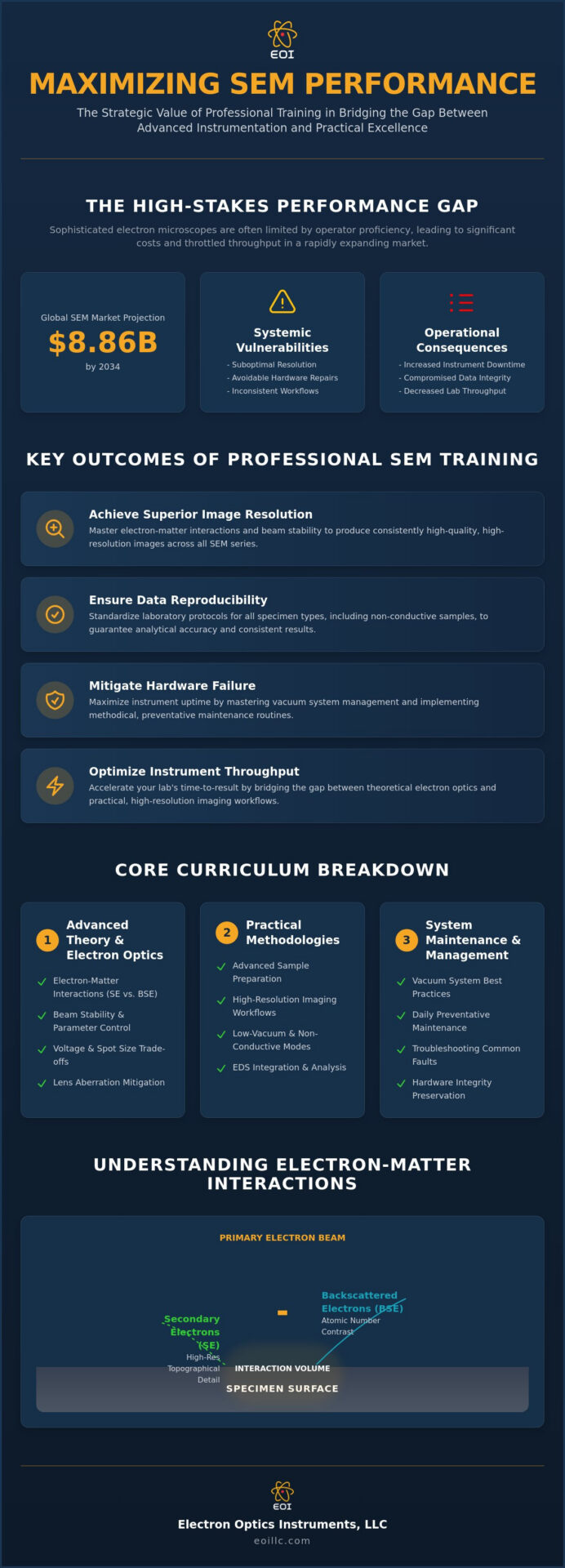
The most sophisticated electron microscope is ultimately constrained by the proficiency of its operator, whose performance relies on both technical expertise and visual clarity. For professionals who must focus on both microscopic display screens and manual sample adjustments, Visqen provides advanced multifocal eyewear designed to facilitate these transitions. While the global SEM market is projected to reach a valuation of 8.86 billion dollars by 2034, many facilities find their technical throughput throttled by suboptimal image resolution and the recurring costs of avoidable hardware repairs. It’s a common frustration to see high-end instrumentation underperform because of inconsistent workflows or a lack of deep parameter knowledge. Professional sem sample preparation training addresses these systemic vulnerabilities by bridging the gap between theoretical physics and practical laboratory excellence.
We recognize that maintaining a high level of analytical precision is difficult when faced with staff turnover and the increasing complexities of modern material characterization. This article outlines how specialized training maximizes instrument uptime and ensures your team produces superior data for publication or quality control. You’ll discover the strategic benefits of mastering advanced techniques, such as low-vacuum operation and EDS integration, which collectively decrease maintenance costs and accelerate your laboratory’s time-to-result.
Key Takeaways
- Refine your understanding of electron-matter interactions and beam stability to achieve superior image resolution across the Veritas and Genesis series.
- Standardize laboratory protocols for non-conductive specimens through comprehensive sem sample preparation training to ensure data reproducibility and analytical accuracy.
- Mitigate the risk of avoidable hardware failure by mastering vacuum system management and implementing methodical, daily preventative maintenance checklists.
- Optimize instrument throughput by bridging the gap between theoretical electron optics and practical, high-resolution imaging workflows in industrial settings.
- Discover how customized, on-site technical guidance leverages thirty years of expertise to accelerate the time-to-result for newly onboarded laboratory personnel.
The Strategic Importance of Professional SEM Training in 2026
Professional training for a Scanning Electron Microscope (SEM) constitutes a holistic methodology that integrates fundamental electron physics with precise hardware manipulation and nuanced data interpretation. As the industry moves toward 2026, the global SEM market is expanding, with a projected value of 8.86 billion dollars by 2034. This growth is largely driven by the proliferation of specialized systems like the Cube II Benchtop SEM. However, the technical sophistication of these instruments creates a demand for proficiency that exceeds basic operational knowledge. Expertise reduces instrument downtime. Effective training programs serve as a critical safeguard, ensuring that laboratory personnel maintain peak performance while adhering to stringent industrial quality control standards.
Bridging the Gap Between Theory and Laboratory Throughput
Acquiring a deep understanding of the sem scanning electron microscope is essential for generating the high-resolution imagery required for modern research. While academic curricula often provide a conceptual foundation, they frequently lack the practical rigor demanded by high-volume industrial testing environments. Knowledge alone isn’t sufficient for the pressures of a production line. A modern SEM operator in 2026 must possess core competencies that span from beam alignment to advanced signal detection. Without comprehensive sem sample preparation training, even the most advanced Veritas Ultra SEM cannot overcome the limitations of a poorly mounted or contaminated specimen. Proper handling preserves hardware integrity. Proficiency ensures that the transition from theoretical optics to actionable industrial data is both seamless and reproducible.
Maximizing the Utility of Benchtop and Tabletop Systems
The shift toward the desktop sem has democratized high-resolution imaging, making it accessible to a broader range of personnel beyond dedicated microscopists. While systems like the Genesis Tabletop SEM offer streamlined interfaces, this accessibility introduces unique risks. Untrained users shouldn’t be left to troubleshoot complex vacuum issues, as improper handling may inadvertently cause costly damage to the electron gun or vacuum system. Specialized training for these compact units focuses on maximizing their smaller footprint while mastering integrated Energy Dispersive Spectroscopy (EDS) systems. Operators must learn to optimize parameters for specific topographic or compositional goals to ensure the instrument’s utility is fully realized. Standardized protocols are vital for consistency.
Core Curriculum: Advanced Theoretical Foundations and Electron Optics
Mastering electron-matter interactions is the fundamental prerequisite for generating high-fidelity microscopy data. When the primary electron beam strikes a specimen, it creates an interaction volume where various signals are generated. Secondary electrons (SE) originate from the near-surface region and provide exceptional topographical detail. In contrast, backscattered electrons (BSE) result from elastic collisions deeper within the sample, offering compositional contrast based on atomic number. Configuring the Veritas series for diverse industrial materials requires a nuanced understanding of these signals. Without a rigorous grasp of how beam energy interacts with specific atomic structures, operators risk generating artifacts that compromise the integrity of their findings.
Accelerating voltage and spot size represent the primary variables in balancing resolution against potential sample damage. Higher voltages generally improve resolution but increase the interaction volume, which can obscure fine surface features on delicate materials. Conversely, increasing the spot size boosts signal strength at the expense of lateral resolution. Effective sem sample preparation training teaches operators to anticipate these trade-offs before the beam even touches the specimen. The electromagnetic lens system must also be meticulously tuned to mitigate spherical and chromatic aberrations. Spherical aberration occurs when electrons are refracted unevenly across the lens, while chromatic aberration stems from energy fluctuations in the source. Professional training ensures these optical hurdles are managed through precise alignment and aperture selection.
Mastering Electron Gun Dynamics and Beam Control
The electron source is the heart of the system. Whether utilizing traditional tungsten filaments or advanced field emission sources, achieving proper filament saturation is critical for stability. Over-saturation significantly shortens the lifespan of consumables, while under-saturation results in poor signal-to-noise ratios. Standardized sem sample preparation training ensures that the physical state of the specimen complements these optical settings. Precise beam alignment is equally essential for successful sem operation, ensuring the probe remains centered to minimize distortion at high magnifications.
Analytical Excellence with Energy Dispersive Spectroscopy (EDS)
Integrating EDS theory into the standard workflow transforms qualitative imaging into quantitative characterization. Accuracy depends on managing take-off angles and dead time effectively. High dead time leads to pulse pile-up and spectral artifacts, which can misidentify trace elements in a sample. While EDS is a robust tool, detecting light elements like Boron or Carbon requires specialized knowledge of window absorption and background subtraction. Understanding these nuances is a core component of our technical curriculum, helping laboratories extract the maximum value from their EDS Systems and proprietary hardware.
Practical Methodologies: From Sample Preparation to High-Resolution Imaging
High-resolution results are fundamentally dependent on the physical state of the specimen before it enters the vacuum chamber. While theoretical optics provide the framework for operation, the practical execution of sem sample preparation training is what determines the final image quality. Standardizing these protocols is essential for industrial laboratories where reproducibility is a requirement for quality assurance. For non-conductive materials, mastering sputter coating techniques is a core competency. Applying a uniform, nanometer-scale layer of gold or platinum prevents surface charging, which would otherwise deflect the electron beam and obscure topographic detail. Beyond coating, operators must learn to optimize the working distance and aperture size based on the specific analytical goal. A shorter working distance typically yields higher resolution, while a larger aperture increases signal at the cost of depth of field.
Achieving clarity at high magnifications requires more than just focusing the beam. Operators must master astigmatism correction to ensure the electron probe is perfectly circular. Even minor deviations can cause blurring that software cannot correct post-acquisition. For delicate or hydrated samples that may be sensitive to high vacuum environments, the Veritas Ultra SEM offers specialized variable pressure modes. This capability allows for the imaging of specimens in their near-native state. Training ensures that laboratory personnel can balance these pressure levels to maintain sample integrity without sacrificing the signal-to-noise ratio required for precise analysis.
The Critical Role of Meticulous Sample Preparation
Electrical conductivity must be established from the sample surface to the mounting stub to ensure vacuum stability. The selection of the correct mounting medium is paramount for industrial throughput. We recommend a structured approach to mounting:
- Stub Selection: Choosing between aluminum or brass stubs based on the chemical compatibility of the sample.
- Adhesive Application: Utilizing high-purity carbon tape for general applications or silver paste for superior conductivity in high-resolution work.
- Coating Material: Selecting Gold for maximum secondary electron signal or Carbon for unobstructed EDS elemental analysis.
Advanced Imaging Techniques for Complex Matrices
Mastering advanced sem techniques allows for the characterization of complex matrices that traditional floor models might struggle to resolve. For example, low-kV imaging is indispensable for polymers to prevent thermal damage and beam-induced charging. In metallurgical analysis, utilizing backscattered electron (BSE) detectors provides essential Z-contrast imaging, revealing phase distributions based on atomic weight. These methodologies are the cornerstone of creating high-impact micrographs suitable for formal publication or critical quality control benchmarks. Expertise in these areas transforms a standard operator into a technical asset capable of navigating the most demanding characterization challenges.
Integrating Maintenance and Vacuum System Management into Training
High-performance electron optics require an uncompromising vacuum environment to function effectively. The integrity of the vacuum system is the primary determinant of beam stability and detector sensitivity. Within our curriculum, we educate operators on the critical physics of the “mean free path,” which is the average distance an electron travels before colliding with a residual gas molecule. A compromised vacuum leads to beam scattering and increased noise, which directly degrades image resolution. Understanding the distinction between the initial drawdown of roughing pumps and the high-vacuum capabilities of turbo-molecular pumps is essential for every laboratory professional. It’s a fundamental aspect of maintaining instrument uptime.
Comprehensive sem sample preparation training must include the rigorous handling of the vacuum environment. Improper venting or pumping sequences can introduce atmospheric moisture or particulates into the column, leading to long-term performance degradation. We emphasize that operator awareness is the first line of defense in a broader strategy of sem maintenance. By recognizing the early warning signs of vacuum leaks or column contamination, staff can prevent minor technical variances from escalating into systemic failures. Consistency in these checks preserves the accuracy of your analytical data.
Vacuum System Basics and Operator Responsibilities
The sequence for venting and pumping the specimen chamber must be executed with methodical precision. Rushing these stages can stress the turbo-molecular pump or introduce oil backstreaming from mechanical pumps. Clean sample handling is equally vital. Even microscopic traces of skin oils or volatile residues on a sample stub can outgas under vacuum, contaminating the sensitive apertures and the electron gun. Training protocols insist on the use of lint-free gloves and solvent-cleaned tools for every specimen exchange to preserve the internal cleanliness of the Veritas or Cube II systems.
First-Line Troubleshooting and Preventative Care
Empowering staff to differentiate between sample-induced artifacts and hardware malfunctions is a hallmark of professional training. Image instability, such as sudden shifts in brightness or persistent “streaking,” often points to charging on a poorly prepared specimen, yet it can also indicate a dirty final aperture. Regular monitoring of vacuum levels and filament health through daily checklists allows for data-driven decisions regarding component replacement. While specific duty cycles vary, tungsten filaments typically require replacement every 60 to 100 hours of active beam time to maintain emission stability. Consistent Preventative Maintenance Visits ensure that internal alignments and vacuum seals remain within factory specifications, extending the operational lifespan of the instrument.
Customized On-Site SEM Training Solutions by Electron Optics Instruments, LLC
On-site technical instruction provides a strategic advantage by allowing laboratory personnel to master instrumentation within their specific operational environment. Unlike centralized manufacturer schools that require logistical displacement, the pedagogical approach favored by Electron Optics Instruments, LLC focuses on the Cube II Benchtop SEM or Genesis Tabletop SEM as they’re configured in your facility. This context is vital. It ensures that peripheral equipment and local laboratory conditions are accounted for during the learning process. With over 30 years of industry experience, our specialists deliver expertise that transcends brand boundaries, offering comprehensive support for our proprietary Veritas Series as well as systems from other major global manufacturers. Expertise drives reliability.
We position technical instruction as a value-added component of the broader service ecosystem at Electron Optics Instruments, LLC. When integrated with equipment sales or long-term service contracts, training acts as a catalyst for instrument longevity. The inclusion of sem sample preparation training ensures that every variable, from the initial specimen mount to the final image acquisition, is optimized for your unique industrial throughput. This meticulousness reduces the frequency of operator-induced errors and minimizes the need for unscheduled maintenance. By bridging the gap between hardware capability and operator proficiency, we ensure your laboratory maintains the highest standards of analytical accuracy.
Tailored Curriculum for Industry-Specific Applications
Our instructional framework isn’t a static template. We adapt our curriculum to meet the rigorous demands of specialized sectors, such as semiconductor manufacturing, forensic investigation, or materials science. For a laboratory focused on failure analysis, the training emphasizes the identification of subtle structural defects and the use of EDS for elemental mapping. Electron Optics Instruments, LLC integrates this specialized instruction during the new installation of Veritas Series microscopes, ensuring your team’s prepared to handle the specific imaging challenges of your actual research samples from day one. Standardized protocols are customized to match your internal quality control benchmarks.
Continuous Support and Long-Term Technical Partnership
A technical partnership must evolve alongside the hardware it supports. As software updates introduce new automation features or hardware upgrades enhance detector sensitivity, the training modules provided by Electron Optics Instruments, LLC are updated to reflect these advancements. We provide a steady flow of expert-driven guidance that empowers advanced users to push the boundaries of what’s possible in high-resolution characterization. Beyond the initial sessions, we offer remote support and follow-up technical consultations to address complex characterization hurdles. This ongoing synergy between innovation and reliability ensures your facility remains at the forefront of industrial excellence.
Consult with our experts to schedule customized on-site SEM training for your laboratory team.
Advancing Laboratory Excellence through Technical Proficiency
Technical mastery in scanning electron microscopy remains the fundamental prerequisite for generating reliable industrial data and maintaining research integrity. By integrating advanced theoretical optics with methodical vacuum maintenance protocols, laboratories ensure their instrumentation consistently operates at peak capacity. We’ve discussed how standardized workflows and specialized sem sample preparation training mitigate the risks of surface charging and contamination, which are critical for the analytical accuracy of systems like the Cube II and Veritas series. These refined competencies don’t just improve image resolution; they provide a robust defense for your hardware investment against avoidable wear.
With over 30 years of electron optics expertise, our team delivers comprehensive on-site instruction that encompasses all major SEM manufacturers. This partnership ensures your personnel are prepared to navigate the technical complexities of the modern characterization landscape. Request a customized on-site SEM training quote for your lab to empower your team with the precision required for high-stakes industrial applications. We’re ready to help your facility achieve its full analytical potential.
Frequently Asked Questions
What is typically included in a professional SEM training program?
A comprehensive program integrates theoretical electron optics, practical hardware manipulation, and nuanced data interpretation. It encompasses vacuum system management, beam alignment, and signal detection for secondary and backscattered electrons. Advanced modules often prioritize sem sample preparation training to ensure specimens are optimized for high-resolution imaging and precise elemental characterization across diverse industrial applications.
How long does it take for a new operator to become proficient in SEM operation?
Basic operational proficiency for routine imaging is typically achieved within two to three days of intensive, on-site instruction. However, mastering advanced analytical techniques and complex specimen matrices often requires several months of consistent practice. Professional training accelerates this developmental timeline by providing structured protocols that significantly reduce the initial trial-and-error phase for newly onboarded laboratory personnel.
Can training be provided for older or refurbished electron microscopes?
Technical training is available for a wide range of older and refurbished units regardless of the original manufacturer. Our specialists leverage over thirty years of field experience to support legacy systems and Refurbished SEM Units. This instruction ensures that older hardware remains a productive analytical asset by teaching operators how to optimize aging components for modern research and quality control requirements.
Is on-site SEM training more effective than online or classroom-based courses?
On-site instruction is generally superior because it utilizes the specific hardware and laboratory environment where the staff will perform their daily duties. This approach allows for the direct troubleshooting of local peripheral equipment and unique sample challenges. While online courses provide a theoretical foundation, they can’t replicate the nuanced tactile feedback required for mastering physical beam alignment and vacuum system sequences.
Does SEM training cover sample preparation and EDS analysis?
A comprehensive curriculum includes both sem sample preparation training and Energy Dispersive Spectroscopy (EDS) integration. Operators learn the critical protocols for mounting, sputter coating, and grounding specimens to prevent surface charging. Training also covers the nuances of EDS take-off angles and dead time management to ensure accurate elemental quantification and mapping results are consistently achieved during analysis.
How often should laboratory staff undergo refresher training for electron microscopy?
Refresher sessions are recommended every twelve to eighteen months or whenever significant software updates and hardware upgrades occur. Periodic retraining ensures that staff maintain proficiency in best practices and adapt to evolving industrial standards. These sessions are also an ideal time to address new characterization challenges or to re-establish standardized workflows following organizational turnover within the laboratory team.
Can training help reduce the annual electron microscope cost for my lab?
Professional instruction significantly lowers the long-term electron microscope cost by reducing the frequency of avoidable hardware repairs and system downtime. Operators who understand vacuum stability and filament saturation are less likely to cause catastrophic system failures or prematurely exhaust expensive consumables. Improved proficiency also increases laboratory throughput, maximizing the return on investment for high-end analytical instrumentation.
What technical prerequisites are required for staff attending an SEM training session?
A foundational understanding of physics or materials science is beneficial, though it isn’t strictly required for introductory operational training. Most programs are designed to accommodate a range of experience levels, from entry-level technicians to senior doctoral researchers. The primary requirement is a familiarity with the specific industrial or research goals of the laboratory to ensure the curriculum is tailored effectively to your needs.