
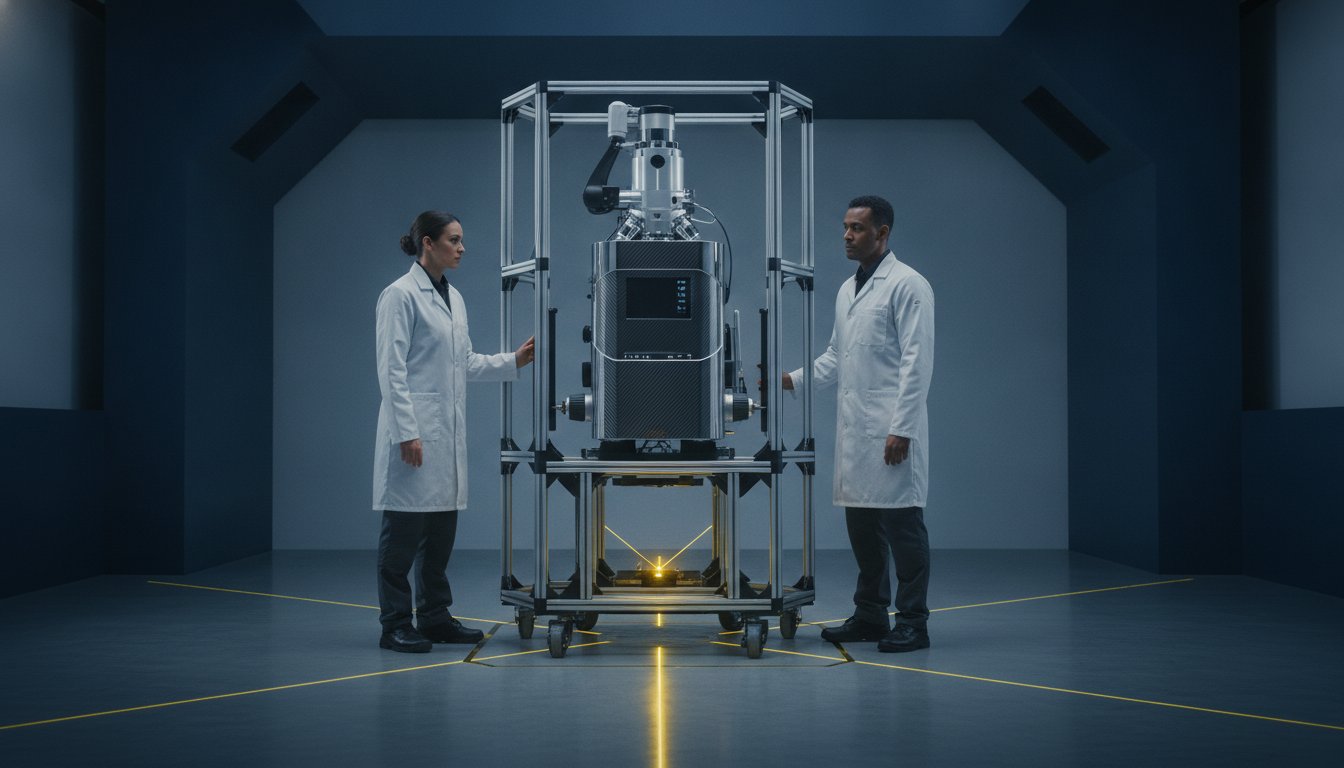
For specialized life sciences applications, the estimated cost of unplanned SEM downtime can exceed $200,000 per hour in 2026. This staggering figure underscores a reality that every laboratory director understands; the physical transfer of a scanning electron microscope isn’t a logistical exercise, but a high-precision engineering procedure requiring specialized sem relocation services to preserve sub-nanometer accuracy. You likely recognize that the transition between facilities represents the most significant risk to your instrument’s operational lifespan, as one minor lapse in column stabilization or a breach in vacuum integrity can lead to months of post-move calibration failure.
This technical guide delineates the rigorous protocols required to relocate sensitive scientific instrumentation without compromising imaging resolution or the fundamental structural alignment of the electron optics column. We detail the complexities of environmental validation and the meticulous re-commissioning of advanced hardware, drawing upon thirty years of expertise with systems like the Veritas Series and Cube II benchtop models. By prioritizing technical integration over simple transport, you ensure that your research facility achieves zero-loss imaging performance and minimal operational disruption. Our analysis covers everything from initial site interference audits to the final validation of refurbished SEM units, providing a comprehensive framework for a successful laboratory transition.
Key Takeaways
- Understand why professional sem relocation services are essential for protecting electron optics columns from structural misalignment during transit.
- Discover how to conduct rigorous environmental validation and electromagnetic interference mapping to ensure the new laboratory site supports sub-nanometer resolution.
- Evaluate the logistical advantages of benchtop systems like the Cube II versus the significant infrastructure requirements of floor-standing Veritas series instruments.
- Learn the systematic two-phase decommissioning process, starting with pre-move imaging performance baselines to guarantee zero-loss performance post-move.
- Maximize your facility’s operational ROI by leveraging the relocation period for technical staff re-training and the potential integration of refurbished SEM units.
The Technical Complexity of Scientific SEM Relocation Services
The relocation of high-resolution imaging systems represents a critical juncture in the lifecycle of laboratory infrastructure. Professional sem relocation services transcend the traditional boundaries of logistics; it’s a rigorous technical re-commissioning of complex hardware rather than a simple transport task. Standard moving companies often fail to comprehend the extreme sensitivity of the Scanning Electron Microscope (SEM), where even microscopic shifts in the electron optics column can permanently degrade resolution. Precision is the priority. Internal relocation attempts frequently overlook the cumulative impact of mechanical vibration on vacuum seals and alignment. A comprehensive risk assessment for such capital equipment necessitates a transition toward specialized engineering protocols that guarantee the return of the sem scanning electron microscope to its original performance benchmarks. Without this professional validation, the risk of post-move calibration failure increases significantly, potentially leading to months of lost research time and unexpected repair costs.
Securing the Electron Optics Column
Maintaining the structural integrity of electromagnetic lenses during transit requires precise mechanical stabilization. Expert sem relocation services utilize custom bracing to prevent the column from experiencing resonant frequencies that could dislodge the filament or damage sensitive apertures. High-vibration transport environments pose a constant threat to the internal geometry of the column. Because of this, the integration of advanced shock-absorption systems within the shipping crate is essential. These protective measures ensure that the sophisticated lens assembly remains perfectly centered. This prevents the need for extensive, costly realignments once the instrument arrives at its new destination. Stability isn’t optional.
Vacuum System Integrity and Protection
Preserving vacuum integrity is perhaps the most difficult aspect of instrument relocation. Decommissioning turbo-molecular and roughing pumps must be executed with extreme care to prevent oil backstreaming. This phenomenon introduces contaminants into the ultra-clean column environment, leading to long-term imaging artifacts. Professional technicians prioritize the isolation of the vacuum chamber before movement, employing systematic shut-down sequences that protect the system from atmospheric exposure. Upon arrival, a vacuum pull-down verification serves as the primary baseline for re-commissioning. This step confirms that no seals were compromised during transit and that the system can still achieve the high-vacuum states necessary for superior imaging. Reliability is built on these details.
Environmental Validation and Site Preparation Protocols
Successful instrument relocation depends entirely on the compatibility of the new environment with the specific resolution requirements of the hardware. While the physical transport of capital equipment is complex, the pre-move site survey serves as the foundational phase of professional sem relocation services. This diagnostic process identifies environmental bottlenecks that could negate the precision of the electron optics column. Experts must map electromagnetic interference (EMI) throughout the intended laboratory space, as stray fields from elevators, power transformers, or high-voltage lines can induce significant beam drift. Thermal stability is equally vital; even minor temperature fluctuations cause mechanical expansion and contraction within the stage assembly, compromising long-term analytical microscopy and data repeatability. Finally, acoustic noise from high-velocity HVAC systems or nearby foot traffic must be measured against strict thresholds to prevent vibration-induced imaging artifacts that obscure fine surface details.
Vibration Isolation and Floor Loading
Structural resonance represents a significant threat to high-magnification imaging. Independent vibration analysis is necessary to determine if passive damping is sufficient or if active damping platforms are required for the new site. For heavy floor-standing Veritas series models, floor loading specifications must be verified to ensure the structural substrate can support the concentrated weight without settling over time. This technical foresight prevents long-term alignment drift and maintains the integrity of the internal optics. If current facilities lack the necessary stability, laboratory managers might consider consulting with specialized engineers to implement custom isolation solutions during the relocation process.
Utility and Power Conditioning
The electronics chassis requires exceptional voltage stability and a dedicated, low-impedance ground to minimize electrical noise that disrupts signal-to-noise ratios. Field-emission systems often demand consistent compressed air and cooling water supplies to maintain thermal equilibrium in the electron source and electromagnetic lenses. When designing the new floor plan, engineers must prioritize sem maintenance access, ensuring that service panels, vacuum components, and filament assemblies remain reachable for future preventative visits. This methodical approach to site preparation ensures that the instrument operates at peak performance from the moment of re-commissioning, avoiding the delays associated with retroactive utility modifications.
Relocating Benchtop vs. Floor-Model SEM Systems
The logistical requirements for scientific instrumentation vary significantly based on the hardware architecture and intended imaging resolution. When deploying sem relocation services, the primary distinction lies between the agility of benchtop units and the structural complexity of floor-standing models. For instance, the desktop sem has revolutionized facility transitions by offering a plug-and-play framework that fits standard laboratory benches. In contrast, the Veritas Pro series requires extensive space planning and structural reinforcement. The difference in footprint and technical requirements directly influences the electron microscope cost associated with the move, as larger systems demand specialized rigging, vibration isolation, and multi-day engineering schedules. While a tabletop unit might be decommissioned and operational within hours, a high-resolution field-emission model often requires several days of meticulous stabilization and vacuum preparation.
Logistics for the Cube II and Genesis Series
Benchtop systems like the Cube II and Genesis series are engineered for rapid integration into diverse laboratory environments. These units typically utilize standard electrical outlets, eliminating the need for complex power conditioning or dedicated cooling water loops. However, technical precision still dictates a validation of bench stability to ensure that high-frequency vibrations from adjacent equipment don’t compromise imaging. Simplified vacuum systems in modern benchtop models allow for faster pump-down cycles. This efficiency is vital for multi-user facilities where minimizing downtime is a primary performance indicator. Professional re-commissioning protocols for these systems focus on rapid baseline verification and software integration, ensuring the instrument returns to full analytical capability immediately after the physical move.
Complexities of Veritas Floor-Standing Relocation
Relocating a Veritas series floor-standing SEM involves a multi-layered engineering process. Technicians must carefully disassemble the vacuum manifold and the primary column to prevent mechanical stress during transit. Reassembly requires sub-millimeter precision to restore the original optical path. Post-move recalibration of Energy Dispersive Spectroscopy (EDS) detectors is critical to ensure elemental mapping accuracy. High-resolution field-emission (FE) sources demand even more specialized handling, as the source itself is extremely sensitive to atmospheric exposure and mechanical shock. This methodical approach ensures that the large-scale hardware remains a reliable asset for the research facility. Professional sem relocation services provide the necessary safeguards to protect these high-value assets during every phase of the transition.
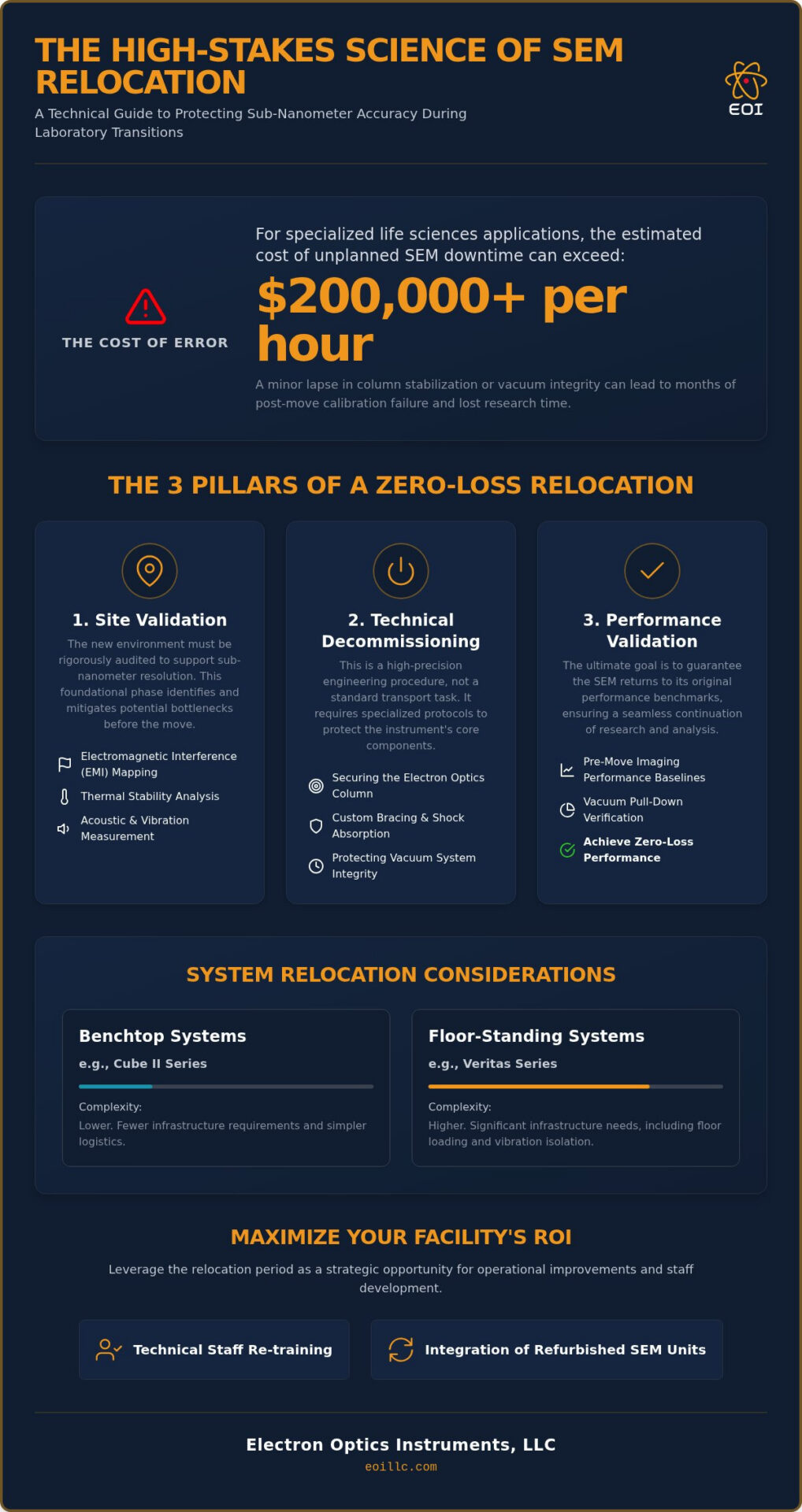
The Comprehensive SEM Relocation Checklist for 2026
A successful transition for a scanning electron microscope relies on a structured, five-phase framework that eliminates technical ambiguity. Professional sem relocation services utilize this rigorous checklist to ensure that the instrument’s performance envelope remains intact throughout the physical move. By choosing expert sem relocation services, facilities can mitigate the risk of catastrophic column damage. Precision is non-negotiable.
- Phase 1: Pre-move Imaging Performance Baseline Documentation. Technicians capture high-magnification images and record vacuum recovery times to establish a performance benchmark.
- Phase 2: Systematic Decommissioning. This stage includes venting the chamber with dry nitrogen, locking the stage, and securing the electron column against mechanical shock.
- Phase 3: Controlled Transit. The use of air-ride suspension and climate-controlled vehicles is essential to maintain thermal stability and protect sensitive electronics. It’s the only way to safeguard the filament.
- Phase 4: Site Re-validation. Before uncrating, the new laboratory’s utilities and environmental conditions are verified against the pre-move survey data.
- Phase 5: Re-commissioning and Testing. The instrument is powered on, aligned, and subjected to resolution tests to confirm it meets original specifications.
Calibration and NIST Traceability
Magnification calibration following a move must utilize NIST-traceable standards to guarantee data integrity for future research. This process involves resolution verification across various accelerating voltages, ensuring the electron source hasn’t been compromised during transit. Meticulous calibration ensures that daily sem operation remains within the tight tolerances required by the original manufacturer. For facilities utilizing the Veritas series or Genesis Tabletop SEM, these post-move tests are vital for maintaining compliance with international quality standards. Accuracy is the anchor of research.
Safety and Compliance Post-Installation
Operator safety is the highest priority during the re-commissioning phase. X-ray leakage testing must be performed to confirm that the lead shielding remains effective after the physical stresses of transport. Safety remains the priority. Additionally, technicians must validate that all emergency shut-off switches and vacuum interlock systems function correctly. A final documentation package, including performance certificates and installation reports, provides the necessary validation for laboratory audits. If your current equipment is outdated and poses a risk for relocation, you might consider evaluating refurbished SEM units as a reliable alternative for your new facility. To secure your laboratory’s imaging future, book a technical relocation consultation with our engineering team.
Maximizing ROI Through Post-Relocation Technical Training
The physical re-commissioning of a scanning electron microscope marks the beginning of a new operational chapter for any research facility. While the technical protocols of sem relocation services focus on the structural integrity of the hardware, the human element remains a critical variable in achieving maximum return on investment. Relocation represents the ideal juncture for comprehensive lab staff re-training, as it allows for a strategic alignment between the re-installed equipment and emerging research objectives. By customizing advanced sem techniques during this phase, institutions can transition from standard imaging to specialized analytical workflows that utilize the full potential of the Veritas Series or Genesis Tabletop SEM systems. This reset ensures that your team isn’t just operating the tool, but mastering it within the context of the new laboratory environment.
Integration of preventative maintenance into the new laboratory workflow is essential for ensuring long-term operational stability. Establishing a formal service contract immediately following relocation provides a safeguard against the gradual performance degradation that often follows a significant facility move. This proactive approach ensures that filaments, apertures, and vacuum components receive the meticulous attention required to maintain sub-nanometer resolution benchmarks over the instrument’s entire lifecycle. It’s a visionary strategy that prioritizes reliability and precision over reactive repairs, securing the facility’s capital investment for years to come.
Operational Excellence for Research Teams
Research teams benefit most from hands-on training that focuses on sample preparation and imaging optimization within the specific environmental context of the new site. Professional lifecycle management includes educating staff on troubleshooting common post-move issues, such as subtle beam instability or vacuum fluctuations that might arise as the system settles into its new footprint. Maximizing tool uptime requires a synergy between high-performance hardware and a highly skilled technical workforce capable of identifying minor anomalies before they escalate into costly downtime. This structured approach to training transforms a simple move into a catalyst for institutional growth and technical advancement.
The Electron Optics Instruments, LLC Advantage in Professional Relocation
As institutions grow and develop new facilities to support these technical advancements, builders and developers—including those working on mixed-use residential and commercial projects—often require specialized financial support. For those managing the construction of these modern environments, Evoque Lending offers comprehensive development and construction financing through evoquecommercial.com.
Electron Optics Instruments, LLC brings over 30 years of specialized experience to every project, acting as a technical safeguard for your most sensitive electron optics. As the sole US distributor for EmCraft, Electron Optics Instruments, LLC provides unparalleled support for both benchtop models like the Cube II and the high-resolution Veritas Series. Our commitment to logistical excellence ensures that your transition is seamless, professional, and technically validated according to the highest industry standards. To secure the future of your imaging capabilities and ensure zero-loss performance post-move, contact Electron Optics Instruments, LLC for a specialized relocation quote and a comprehensive technical assessment of your requirements.
Securing Your Laboratory’s Analytical Future
The successful relocation of a scanning electron microscope is a testament to the synergy between meticulous planning and technical prowess. The transition of high-value assets like the Veritas Series or Cube II demands a rigorous adherence to environmental validation and systematic re-commissioning protocols. By prioritizing technical integrity over mere logistics, research facilities can eliminate the risks of column misalignment and vacuum contamination that often plague unspecialized moves. Precision remains the cornerstone of every successful facility transition.
Leveraging professional sem relocation services ensures that your instrument returns to its baseline resolution benchmarks with minimal operational downtime. Electron Optics Instruments, LLC brings over 30 years of industry experience as a technical safeguard for all major SEM manufacturers. As the sole US distributor for EmCraft, our team provides the sophisticated expertise necessary to manage the most complex scientific instrument logistics. Whether you’re moving a tabletop unit or a high-resolution field-emission system, we’re here to validate every micron of your progress.
Request a Professional SEM Relocation Quote to ensure your facility’s imaging performance remains uncompromising in its new home. We look forward to supporting your next research breakthrough.
Frequently Asked Questions
What are the minimum floor space requirements for a benchtop SEM?
Benchtop units like the Cube II or Genesis require a minimal footprint, typically fitting on a standard 30-inch deep laboratory bench. However, you must account for peripheral clearance to ensure operational efficiency. A minimum area of approximately four square feet is necessary for the main unit, plus additional space for the vacuum pump and monitor workstation. Ensuring adequate airflow around the cooling vents is critical for maintaining thermal stability during high-resolution analytical sessions.
Do I need a dedicated electrical circuit for my scanning electron microscope?
A dedicated electrical circuit is highly recommended to prevent electronic noise and voltage fluctuations from affecting the sensitive electron optics. While most benchtop models operate on standard 110V or 220V outlets, larger Veritas series systems require stable power conditioning to protect the electromagnetic lenses. Utilizing professional sem relocation services ensures that your new site’s power infrastructure is validated against the original manufacturer’s voltage and grounding specifications before the re-installation process begins.
How long does a typical SEM relocation take from decommissioning to first image?
The timeline varies based on instrument complexity, ranging from one business day for a Cube II benchtop unit to several days for a Veritas FE-SEM. This duration includes systematic decommissioning, secure transit, and meticulous re-commissioning at the new facility. Factors such as vacuum pull-down times and resolution verification significantly influence the schedule. Professional management ensures that the transition from decommissioning to the first validated image is executed with minimal operational downtime for your facility.
Can I move a refurbished SEM myself to save on relocation costs?
Moving even a refurbished SEM unit yourself is not recommended due to the extreme sensitivity of the internal column alignment and vacuum seals. Attempting an internal move without specialized stabilization tools often results in column misalignment or mechanical damage to the filament. Professional sem relocation services provide the technical safeguards necessary to preserve imaging resolution and structural integrity. Entrusting the transport to experts ensures that your capital equipment remains a reliable asset for future research.
What kind of vibration isolation is required for high-resolution imaging?
High-resolution imaging requires rigorous vibration isolation to mitigate the impact of structural resonance and ambient acoustic noise. Benchtop systems often utilize internal passive damping, but floor-standing Veritas models may require active vibration isolation platforms depending on the new site’s floor loading and proximity to HVAC systems. You should conduct a pre-installation vibration analysis to determine if the structural substrate meets the sub-nanometer stability thresholds required for advanced analytical microscopy and long-term data repeatability.
Is a cleanroom environment mandatory for SEM installation in the new site?
A full cleanroom environment isn’t strictly mandatory for most SEM installations, but the new site must be a climate-controlled, low-dust environment. Minimizing atmospheric particulates is essential for preventing contamination during sample exchange and filament replacement. For field-emission systems, maintaining a stable temperature and humidity level is critical for ensuring consistent beam current. A clean, vibration-free laboratory space provides the foundational stability necessary for long-term imaging excellence and compliance with institutional standards.
How often should an SEM be recalibrated after a physical relocation?
An SEM should be recalibrated immediately following a physical relocation to ensure magnification accuracy and NIST traceability. Once the initial re-commissioning is complete, standard preventative maintenance visits every six to twelve months are sufficient for most research environments. However, if the instrument is utilized for high-precision metrology or if performance anomalies are detected, more frequent calibration may be necessary. Meticulous documentation of these baseline tests is vital for maintaining laboratory audit compliance and research integrity.
What are the cooling requirements for field-emission SEMs during operation?
Field-emission SEMs, such as the Veritas FE, often require dedicated cooling water loops or forced-air systems to dissipate heat generated by the electromagnetic lenses and high-vacuum pumps. Maintaining a consistent operating temperature is vital for preventing thermal drift in the electron source. It’s essential to ensure that the new laboratory’s utility infrastructure can support the specific flow rates and temperature ranges defined by the manufacturer to guarantee long-term operational stability and imaging precision.