

The ability to resolve features at the nanometer scale isn’t just an incremental improvement in optics; it represents a fundamental shift in how we perceive the physical world through electron interaction. You likely recognize that achieving this level of precision requires more than just high magnification, yet the technical complexity of the hardware often makes it difficult to explain specific requirements to non-expert stakeholders. Understanding the sem working principle is the critical bridge between simply operating a system and mastering the evolutionary synergy of electron optics and vacuum physics that defines modern industrial excellence.
This guide provides a rigorous analysis of the mechanisms that transform invisible electron signals into high-precision data. You’ll master the distinction between Secondary Electrons and Backscattered Electrons while learning how vacuum levels impact image fidelity according to ISO 16700:2016 standards. We’ll explore the hardware architecture of systems like the Veritas FE and Cube II units to provide the technical authority needed to differentiate models, whether you’re evaluating a $60,000 benchtop system or an $800,000 field emission microscope. From electron-matter interaction to the latest SEMView8000 software integration, you’ll gain a comprehensive understanding of the engineering excellence that drives nanometer-scale resolution.
Key Takeaways
- Identify how the transition from photon-based optics to high-energy electron beams enables the nanometer-scale resolution required for advanced industrial analysis.
- Master the sem working principle by differentiating between Secondary Electron topography and Backscattered Electron atomic contrast for precise material characterization.
- Analyze the architectural synergy of electromagnetic lenses and electron sources in generating a focused primary beam for consistent data acquisition.
- Understand the operational necessity of multi-stage vacuum systems in preventing electron scattering and maintaining the integrity of the imaging environment.
- Explore how evolutionary engineering in benchtop systems like the Cube II facilitates high-resolution imaging through integrated automation and miniaturized electron columns.
The Core Mechanism: Understanding Electron-Matter Interaction
The Scanning Electron Microscope (SEM) is a high-precision instrument that transcends the physical limitations of traditional light-based systems by utilizing a focused beam of high-energy electrons. This technological shift is fundamental to the sem working principle, where the interaction between the primary electron beam and the specimen generates the data required for nanometer-scale analysis. Unlike systems that rely on the reflection or refraction of photons, an SEM probes the atomic structure of a sample, producing a variety of signals that reveal topographic, morphological, and compositional information with unparalleled clarity.
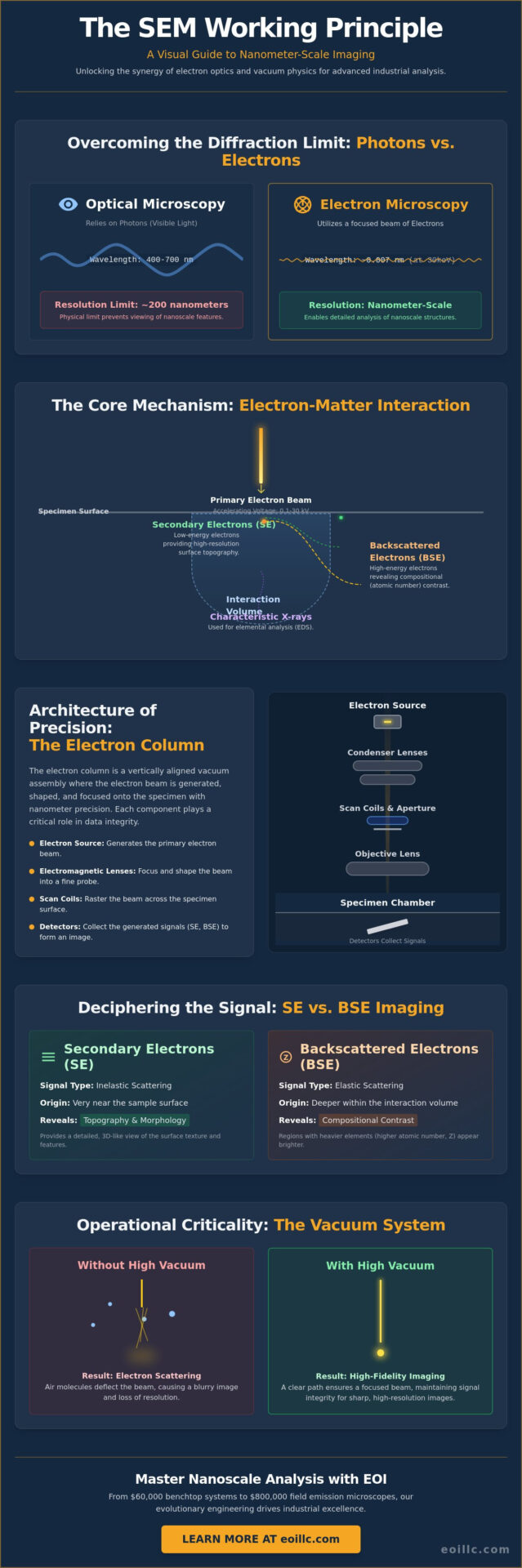
When the primary electron beam strikes the specimen, it doesn’t simply stop at the surface. Instead, it penetrates the material, creating a three-dimensional zone of excitation known as the interaction volume. This volume typically assumes a teardrop or pear-like shape, extending from a few nanometers to several microns deep depending on the accelerating voltage, which usually ranges from 0.1 to 30 kV. The specific “signals” analyzed by the detector are the measurable byproducts of these sub-surface interactions, capturing the complex evolutionary behavior of electrons as they dissipate energy within the sample lattice.
Why Electrons? Overcoming the Diffraction Limit
The transition from photons to electrons is driven by the de Broglie wavelength hypothesis, which posits that particles like electrons exhibit wave-like properties. While visible light is restricted by a diffraction limit of approximately 200 nm due to its relatively long wavelengths (400 to 700 nm), electrons accelerated at 30 keV possess a wavelength of roughly 0.007 nm. This drastic reduction in wavelength allows for the precision necessary to resolve features that are invisible to even the most advanced optical solutions. For a deeper technical analysis of these differences, industry professionals should consult our guide on the electron microscope vs light microscope. This evolutionary leap in optics ensures that modern laboratories can achieve the excellence required for rigorous quality control and scientific discovery.
The Kinetic Energy Exchange
The sem working principle relies heavily on the efficient transfer of kinetic energy from the primary beam to the atoms of the specimen. As electrons decelerate within the interaction volume, they undergo various scattering events that result in electronic excitation, the emission of secondary particles, and the generation of heat. These events are categorized based on the nature of the collision between the beam and the sample’s atomic nuclei or electrons.
- Electronic Excitation: The primary beam displaces inner-shell electrons, leading to the emission of characteristic X-rays used in EDS analysis.
- Thermal Dissipation: A portion of the beam’s energy is converted into heat, necessitating careful management of beam current to prevent sample damage.
- Signal Generation: The emission of secondary and backscattered electrons provides the raw data for image construction.
Elastic scattering involves electron deflection with minimal energy loss, whereas inelastic scattering entails significant energy transfer to the specimen atoms, resulting in signal emission or heat. This distinction is critical for researchers who require high-fidelity imaging without compromising the structural integrity of sensitive materials.
The Architecture of Precision: Components of the Electron Column
The electron column serves as the vertically aligned vacuum assembly where the primary beam is generated, shaped, and directed with absolute precision. This sequential hardware logic is the physical manifestation of the sem working principle, as every component must maintain strict electromagnetic alignment to ensure nanometer-scale data integrity. In professional environments, the performance of these components determines whether a system can resolve sub-10 nm features or remains limited to micro-scale observations. The column creates a controlled environment where electrons are accelerated and focused before interacting with the specimen housed in the sample chamber.
A standard industrial column consists of the electron gun, a series of electromagnetic lenses, scanning coils, and apertures. These elements work in synergy to transform a raw stream of electrons into a coherent, high-energy probe. For organizations seeking to maintain peak performance in these complex systems, Electron Optics Instruments, LLC provides specialized preventative maintenance visits to ensure that column alignment and filament health meet rigorous industrial standards.
The Electron Source: Thermionic vs. Field Emission
The electron source, or gun, is the origin of the primary beam. Traditional systems utilize thermionic emission, typically via a Tungsten filament, where heat is applied to overcome the material’s work function. While reliable and cost-effective, these sources have a larger spot size and lower brightness compared to advanced Field Emission (FE) sources. Field emission guns, like those integrated into the Veritas FE SEM, utilize a sharp monocrystalline tip and a high electric field to extract electrons. This results in a beam with 100 to 1,000 times the brightness of tungsten filaments, enabling the ultra-high resolution required for semiconductor and nanotechnology sectors. The choice between these sources often dictates the system’s price point, with FEG systems typically ranging from $300,000 to over $800,000 as of 2025.
Electromagnetic Lenses and Beam Manipulation
Because electrons are charged particles, they can be manipulated by magnetic fields. Electromagnetic lenses consist of copper coils encased in a soft iron yoke, creating a magnetic field that converges the electron path. This mechanism is central to the SEM working principle, as it allows for the precise control of the beam’s diameter and current. The condenser lens is the first stage of manipulation, determining the amount of current that passes through the column. A stronger condenser lens field results in a smaller, more focused spot, which is essential for high-resolution imaging but reduces the total signal strength.
The objective lens performs the final focus, concentrating the beam into its smallest possible spot on the sample surface. The distance between the bottom of the objective lens and the sample is known as the “working distance.” Shorter working distances generally provide superior resolution by minimizing the effects of lens aberrations, though they limit the depth of field. To achieve a comprehensive view of the sample surface, scanning coils deflect the beam in a raster pattern, similar to how a television screen is scanned, allowing the detectors to map signals to specific coordinate points on the specimen.
Deciphering the Signal: Secondary vs. Backscattered Electrons
The sem working principle culminates in the detection and processing of diverse signals generated within the interaction volume. While the primary beam provides the initial energy, the resulting emissions, secondary electrons, backscattered electrons, and characteristic X-rays, carry the specific data required for industrial characterization. Mastering these signals allows engineers to reconstruct a specimen’s surface and subsurface properties with mathematical precision. According to ISO 22493:2014 standards, clear signal differentiation is essential for maintaining a standardized technical vocabulary in high-resolution microscopy.
In a professional laboratory environment, the ability to switch between or combine these signals represents the difference between basic observation and advanced failure analysis. Detectors are positioned strategically within the sample chamber to capture specific trajectories and energy levels, ensuring that the final digital image is an accurate representation of the physical specimen. This synergy of multiple detectors provides a comprehensive material profile that is critical for global manufacturing and quality control.
Topographic Imaging with Secondary Electrons
Secondary electrons (SE) are low-energy particles, typically defined as having kinetic energy less than 50 eV, that result from inelastic scattering events within the sample’s outer electronic shells. Because of their low energy, only those generated within the top 5 to 10 nanometers of the surface can escape to reach the detector. This makes SE imaging exceptionally sensitive to surface morphology and “edge effects,” where tilted surfaces or sharp edges emit more electrons than flat planes. The standard Everhart-Thornley detector (ETD) uses a collector screen and a scintillator to capture these signals, providing the high-resolution topographic maps essential in sem applications such as micro-fracture analysis and semiconductor defect inspection.
Compositional Mapping with Backscattered Electrons
Backscattered electrons (BSE) consist of high-energy primary electrons that have undergone elastic scattering with the atomic nuclei of the specimen. Unlike SE signals, BSE particles originate from deeper within the interaction volume and retain a significant portion of the primary beam’s energy. The efficiency of backscattering is directly proportional to the atomic number (Z) of the target material. Consequently, heavier elements like gold or tungsten appear significantly brighter than lighter elements like carbon or aluminum. This Z-contrast is a cornerstone of the sem working principle for phase identification in metallurgy and contaminant detection. By correlating BSE compositional maps with data from an EDS analysis guide, laboratories achieve an evolutionary level of insight into both the physical structure and chemical makeup of a sample. Modern systems, including the Veritas HR and Veritas Ultra SEM, utilize multi-detector arrays to collect these signals simultaneously; this ensures that no technical detail is overlooked during high-stakes industrial evaluations.
Operational Criticality: Vacuum Systems and Image Resolution
The stabilization of the internal environment is a prerequisite for high-fidelity imaging, as the sem working principle relies on an unobstructed path for the primary electron beam. Because electrons possess a low mass and are easily deflected by atmospheric gas molecules, a high-vacuum environment is non-negotiable for achieving nanometer-scale resolution. Without this vacuum, the beam would scatter prematurely, leading to a loss of focus and significant signal attenuation. Maintaining this vacuum integrity is not merely a technical requirement; it’s a foundational pillar of industrial excellence that prevents column contamination and catastrophic filament burnout.
Modern SEM systems utilize a multi-stage pumping architecture to reach the necessary pressure levels, typically between 10-5 and 10-7 Torr for tungsten systems, and even lower for field emission models. The process begins with mechanical roughing pumps that evacuate the chamber to a preliminary level, followed by high-vacuum turbomolecular or ion getter pumps. For specialized applications involving hydrated or non-conductive samples, Environmental SEM (ESEM) allows for higher chamber pressures, utilizing a gaseous environment to neutralize surface charges while maintaining the integrity of the electron probe.
Vacuum Levels and Beam Stability
The efficiency of the electron beam is dictated by the “mean free path,” which is the average distance an electron travels before colliding with a gas molecule. In a poor vacuum, frequent collisions increase image noise and cause beam drift, undermining the precision of long-term data acquisition. Vacuum fluctuations often stem from degraded seals or outgassing from contaminated samples, which is why rigorous sem maintenance is essential for sustaining the longevity of the electron column. Ensuring airtight integrity through scheduled inspections prevents the evolutionary degradation of image quality that occurs over years of industrial operation.
The Role of Conductive Coating
Non-conductive specimens present a unique challenge to the sem working principle due to the “charging” effect. When the primary beam strikes an insulating surface, electrons accumulate rather than dissipate, creating a negative potential that repels the incoming beam and distorts the resulting image. To mitigate this, researchers apply a conductive sputter coating, typically using gold, platinum, or carbon, to create a reliable return path for electrons. This process ensures that the interaction volume remains stable and the signal remains representative of the sample’s true morphology.
- Dehydration: Ensure the sample is completely dry to prevent outgassing in the high-vacuum chamber.
- Mounting: Use conductive carbon tape or silver paste to secure the specimen to the stub.
- Sputter Coating: Apply a 5 to 20 nm layer of conductive material for optimal signal-to-noise ratios.
- Plasma Cleaning: Remove hydrocarbon contaminants to prevent “carbon tracking” during high-magnification imaging.
To ensure your laboratory maintains the highest standards of operational precision, Electron Optics Instruments, LLC offers comprehensive preventative maintenance visits and high-quality consumables designed to protect your vacuum integrity and maximize system uptime.
Evolutionary Advancements: The Principle Applied in Benchtop SEM Systems
The industrial landscape is witnessing a significant shift as the sem working principle is successfully miniaturized into compact, high-performance benchtop systems. While traditional floor-standing units remain essential for ultra-high-end research, benchtop models like the Cube II and Genesis series demonstrate that a reduced footprint doesn’t necessitate a sacrifice in analytical precision. These systems utilize the same fundamental physics of electron generation and signal detection previously discussed. They leverage evolutionary advancements in electromagnetic lens design and vacuum miniaturization to deliver laboratory-grade data directly on the production floor. This transition democratizes high-resolution imaging, allowing for rapid quality control and failure analysis without the logistical delays associated with centralized core facilities.
The synergy between hardware and software is particularly evident in modern digital electron microscopy. By integrating automated routines for alignment, stigmation, and focus, these systems significantly reduce the complexity of sem operation. This automation ensures that even non-expert technicians can acquire high-fidelity images that meet ISO 16700:2016 standards for magnification calibration. Modern platforms like SEMView8000, compatible with Windows 11, provide integrated user interfaces and remote operation capabilities over the internet. The result is a more efficient workflow that maintains the rigorous technical authority required for global manufacturing excellence.
Cube II: A Case Study in Benchtop Precision
The Cube II Benchtop SEM serves as a definitive example of how engineering excellence can condense a complex electron column into a tabletop format. Despite its compact size, the system achieves a remarkable 5 nm resolution, a feat previously reserved for much larger installations. Its user-friendly interface represents an evolutionary step in accessibility, providing intuitive control over accelerating voltages and signal detection. For organizations exploring this technological transition, our desktop sem pillar provides a deeper analysis of how these systems are reshaping industrial research and development. By maintaining a high degree of brightness and stability, the Cube II ensures that the sem working principle is applied with absolute fidelity in any laboratory environment.
The Future of Scanning Electron Microscopy
Looking forward, the field of electron microscopy will continue to evolve through the integration of artificial intelligence and machine learning. We anticipate a future where AI-driven feature recognition and automated EDS mapping become standard, allowing for autonomous particle analysis and crystallographic characterization. These advancements will further enhance equipment ROI by increasing throughput and reducing the margin for human error. Understanding the underlying mechanisms of microscopy is the first step toward leveraging these visionary tools. Contact Electron Optics Instruments, LLC today for an expert consultation to determine which Veritas series or benchtop system aligns with your specific industrial requirements and technical milestones.
Advancing Industrial Precision through Electron Microscopy
Mastering the sem working principle isn’t merely an academic exercise; it’s a strategic requirement for organizations committed to nanometer-scale excellence. We’ve analyzed the intricate synergy of electromagnetic optics and signal processing that allows for the resolution of features below 10 nm. By differentiating between topographic secondary electrons and compositional backscattered signals, engineers can extract actionable data that drives industrial innovation. This technical foundation ensures that every imaging session contributes to a broader narrative of precision and reliability.
As the sole US distributor for EmCraft SEM technology, EOI LLC bridges the gap between complex physical mechanisms and practical manufacturing applications. With over 30 years of electron microscopy expertise, we provide the comprehensive on-site training and technical support necessary to maximize your equipment ROI. Whether you’re integrating the Veritas series for ultra-high-resolution research or a Cube II system for production-floor quality control, our team ensures your operations remain at the forefront of optical technology. Explore our range of high-precision Benchtop and Tabletop SEMs and empower your laboratory with the precision required for the next phase of industrial evolution.
Frequently Asked Questions
What is the basic working principle of a scanning electron microscope?
The scanning electron microscope generates high-resolution images by scanning a focused electron beam across a specimen in a raster pattern. As the beam interacts with the sample, it produces various signals that are collected by detectors to reconstruct a digital map of the surface. This sem working principle allows for precision imaging that exceeds the 200 nm diffraction limit inherent to traditional optical systems.
How does an SEM differ from a transmission electron microscope (TEM)?
An SEM imaging system relies on electrons that are scattered from or emitted by the surface of a bulk specimen, whereas a TEM requires ultra-thin samples for the beam to pass through. While the SEM provides three-dimensional topographic data, the TEM offers higher resolution at the atomic level by detecting transmitted electrons. These instruments serve distinct but complementary roles in industrial failure analysis and advanced material science.
Why is a vacuum necessary for the SEM working principle to function?
A vacuum is required to ensure that the primary electron beam reaches the sample without being deflected by atmospheric gas molecules. In a standard atmosphere, electrons would collide with air particles, causing the beam to scatter and the signal to degrade. Maintaining high-vacuum levels, which often reach 10-7 Torr in field emission systems, is critical for achieving the stability needed for nanometer-scale resolution.
What is the difference between secondary and backscattered electrons in imaging?
Secondary electrons (SE) are low-energy particles emitted from the top 5 to 10 nanometers of a sample, providing detailed topographic information. Backscattered electrons (BSE) are high-energy primary electrons that reflect off deeper atoms within the specimen. BSE signals are highly sensitive to the atomic number of the material, making them ideal for identifying phase differences and elemental contrast in complex industrial alloys.
Can an SEM determine the chemical composition of a sample?
Yes, an SEM can perform elemental characterization when it’s equipped with an Energy Dispersive Spectroscopy (EDS) system. When the primary beam strikes the sample, it generates characteristic X-rays that are unique to each element. By analyzing these X-ray energies, researchers can create precise chemical maps and quantitative reports of the material’s composition, ensuring rigorous quality control.
What factors limit the resolution of a scanning electron microscope?
The ultimate resolution of an SEM is primarily limited by the electron beam’s spot size and the interaction volume within the sample. Factors such as lens aberrations, external vibration, and the brightness of the electron source also play significant roles. Field emission sources provide much smaller spot sizes than tungsten filaments, allowing systems like the Veritas HR to resolve features at significantly finer scales.
Does a benchtop SEM use the same working principle as a full-size unit?
Benchtop SEMs utilize the same fundamental sem working principle as floor-standing units, including electron generation, vacuum stabilization, and signal detection. Systems like the Cube II miniaturize the electron column through advanced engineering without sacrificing the ability to resolve nanometer-scale features. This evolution allows for high-precision imaging in smaller laboratory environments where floor space is a limited resource.
What happens if a sample is not conductive in an SEM?
Non-conductive samples accumulate negative charge from the primary electron beam, which leads to image distortion and bright artifacts known as “charging.” To resolve this, specimens are typically coated with a thin layer of gold or carbon using a sputter coater to provide a discharge path. Alternatively, specialized systems use low-vacuum modes to neutralize surface charge with gas ions, ensuring the integrity of the data remains intact.