
What if the traditional pursuit of high-vacuum environments is actually the primary obstacle to achieving true analytical fidelity in your laboratory? For many industry professionals, the persistent challenges of sample charging on non-conductive materials and the inherent risks of dehydration artifacts in biological specimens represent significant barriers to precise characterization. While conventional methods often mandate time-consuming sputter coating, the evolution of variable pressure sem applications in 2026 has transformed these workflows by neutralizing surface charge through controlled gaseous environments that maintain sample integrity.
You’ve likely recognized that the requirement for conductive coatings often obscures fine surface details or introduces unwanted elemental interference during critical EDS analysis. This comprehensive guide demonstrates how Variable Pressure SEM (VPSEM) overcomes these limitations to preserve samples in their near-native state. We’ll explore technical strategies to minimize artifacts in low-vacuum modes and evaluate how high-performance benchtop systems, such as the Cube II, provide the resolution and accelerating voltage necessary for sophisticated industrial research. This analysis provides the necessary framework to determine the optimal configuration for your specific material requirements while maintaining the highest standards of technical accuracy and operational excellence.
Key Takeaways
- It’s essential to understand how controlled gas ions facilitate charge neutralization, effectively eliminating the requirement for conductive sputter coatings on sensitive specimens.
- Identify specialized variable pressure sem applications for the detailed analysis of polymers, textiles, and hydrated materials while preserving original surface morphology.
- Master the integration of Energy Dispersive Spectroscopy (EDS) within low-vacuum environments by accounting for the electron scattering effects that influence X-ray spatial resolution.
- Develop a systematic framework for selecting between variable pressure and conventional high-vacuum modes based on sample conductivity and the specific resolution requirements of the research.
- Assess the technological advancements of the Cube II benchtop SEM, which offers high-performance variable pressure functionality within a streamlined architecture for industrial applications.
What is Variable Pressure SEM (VPSEM) and How Does it Work?
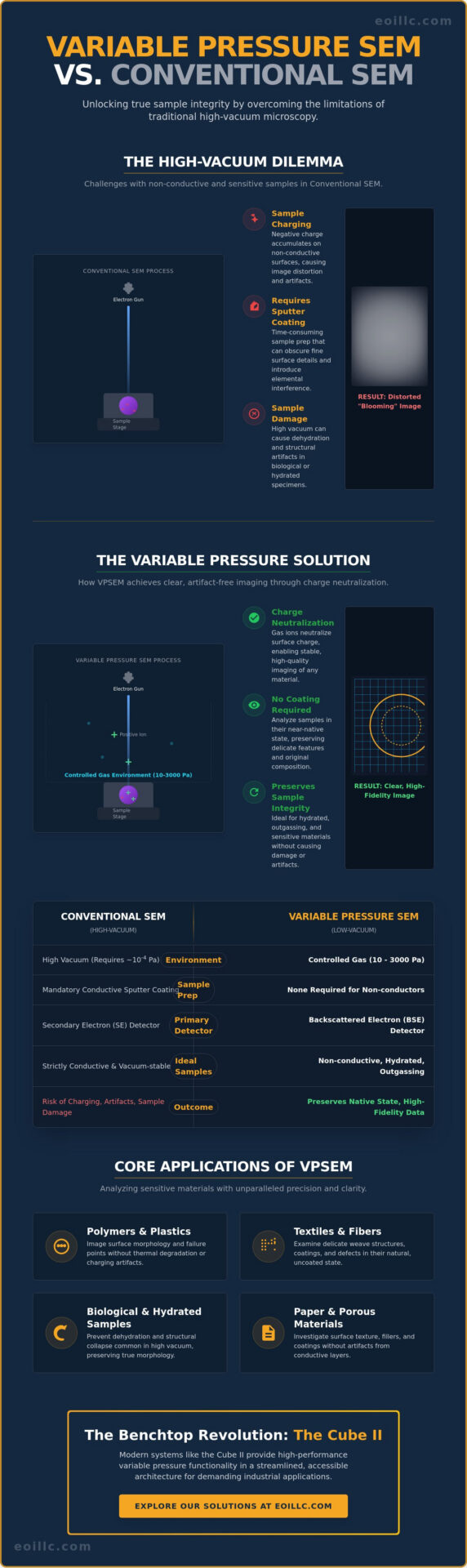
Variable Pressure Scanning Electron Microscopy (VPSEM) represents a critical departure from traditional high-vacuum protocols by operating within a controlled gaseous environment, typically ranging between 10 and 3000 Pa. This architectural shift allows for the direct characterization of non-conductive, outgassing, or hydrated samples that would otherwise suffer from significant charging or structural degradation under conventional high-vacuum conditions. By introducing a precise volume of gas into the specimen chamber, the system facilitates a stable imaging environment where the primary electron beam interacts with gas molecules to produce a cascade of ions. This capability is foundational to modern variable pressure sem applications, as it removes the technical requirement for conductive coatings that can mask fine surface features or contaminate delicate specimens.
Because secondary electrons are easily scattered by the gas molecules in these higher-pressure environments, the Backscattered Electron (BSE) detector becomes the primary tool for imaging in this mode. BSE detectors provide high-contrast topographic and compositional data. This is essential for identifying phase distributions or surface defects in complex materials without the interference of surface charge buildup. The integration of these detectors within systems like the Veritas Series or the Cube II benchtop SEM ensures that researchers maintain high analytical standards while bypassing the preparation bottlenecks of traditional microscopy.
The Physics of Charge Neutralization
The fundamental efficacy of charge neutralization in VPSEM relies on the ionization of the chamber gas by the primary electron beam and the resulting secondary electrons. As the electron beam traverses the gas-filled gap between the final lens and the sample, it strikes gas molecules, stripping away electrons and creating a cloud of positive ions. These ions are naturally attracted to the negative charge accumulating on the surface of non-conductive specimens, effectively neutralizing the potential and preventing the “blooming” or deflection artifacts common in high-vacuum SEM. In 2026, the mean free path is defined as the average distance an electron travels between successive collisions with gas molecules, a metric that dictates the optimal working distance and pressure settings for maintaining beam stability.
Variable Pressure vs. Environmental SEM (ESEM)
While often used interchangeably in casual discussion, a clear distinction exists between standard variable pressure systems and the more specialized Environmental Scanning Electron Microscope (ESEM). VPSEM typically utilizes pressures up to 3000 Pa to manage non-conductive materials, whereas ESEM configurations can reach significantly higher pressures and incorporate water vapor to study fully hydrated or dynamic processes. For the majority of materials science and failure analysis tasks, VPSEM remains the industry standard due to its balance of high-resolution capability and operational flexibility. Maintaining these pressure differentials requires a sophisticated vacuum system utilizing multiple pumping stages and pressure-limiting apertures to protect the electron gun. This engineering precision ensures that variable pressure sem applications provide reliable data even when examining the most challenging industrial polymers or composite structures.
Core Applications: Analyzing Non-Conductive and Sensitive Materials
The strategic utilization of variable pressure sem applications has redefined the analytical parameters for polymers and plastics, where traditional high-vacuum environments frequently induce thermal degradation or significant surface deformation. By bypassing the requirement for sputter coating, researchers can image surface morphology with extreme precision; this ensures that delicate features are not masked by a metallic layer. This non-destructive approach is equally vital for the examination of paper and textiles. In these sectors, the ability to analyze fiber orientation and chemical coatings in their natural state provides a level of insight that was previously unattainable without introducing preparation-induced artifacts.
Biological specimens, particularly botanical and entomological samples, present unique challenges due to their inherent moisture content. Variable pressure modes allow for the observation of these samples without the total dehydration typically required for high-vacuum stability. This preservation extends to the field of forensic science, where evidence integrity is paramount. By avoiding destructive coating processes, forensic experts can maintain the original state of a sample for subsequent legal review or additional analytical testing. For those transitioning from traditional methods, understanding the fundamental principles of scanning electron microscopy (SEM) provides the necessary baseline context for these advanced workflows.
The ‘No-Coating’ Advantage for Industrial Throughput
The integration of VPSEM into high-throughput industrial environments yields a substantial ROI by eliminating the iterative vacuum-prep-coat-vacuum cycle. This efficiency gain isn’t merely about speed; it’s about maintaining the original chemistry of the sample for precise EDS analysis. Because there’s no foreign conductive layer, the resulting X-ray spectra are free from gold or carbon interference. Furthermore, VPSEM is the only viable solution for samples that would otherwise outgas in high vacuum, such as certain adhesives or volatile composites. This capability ensures that industrial laboratories can maintain a steady flow of data without the bottlenecks of traditional specimen preparation. If your facility requires this level of operational agility, exploring the capabilities of the Veritas Series SEM can provide a significant competitive advantage.
Geological and Cultural Heritage Applications
Geological research and the preservation of cultural heritage benefit immensely from the non-destructive nature of low-vacuum imaging. Researchers can examine mineral specimens, soil porosity, and delicate archaeological artifacts without the permanent modification associated with conductive coatings. In concrete and soil studies, the variable pressure environment prevents the micro-cracking that often occurs during the dehydration process in high-vacuum chambers. This meticulousness ensures that the structural integrity of the sample remains intact, providing a more accurate representation of the material’s performance in its intended environment. The versatility of variable pressure sem applications continues to expand as global innovators develop new protocols for these sensitive, high-value specimens.
Advanced Analytical Applications: EDS and Microanalysis in VPSEM
The architectural synergy between Energy Dispersive Spectroscopy (EDS) and variable pressure sem applications is pivotal for laboratories requiring elemental data from untreated, non-conductive specimens. Integrating EDS within a gaseous environment allows for the chemical characterization of materials that would otherwise require a conductive carbon or gold layer, which often introduces spectral interference. However, this integration necessitates a sophisticated understanding of the “skirting effect.” This phenomenon occurs when gas molecules scatter the primary electron beam, creating a wider distribution of electrons that generate X-rays from areas surrounding the primary analysis point. This scattering can degrade spatial resolution and introduce noise into the quantitative data if not properly managed through precise hardware calibration and advanced software correction.
Achieving accurate quantitative analysis in low-vacuum modes requires a methodical approach to chamber geometry. Minimizing the working distance is the most effective strategy to reduce the electron beam’s path through the gas, thereby limiting the probability of scattering events. Modern detectors and variable pressure sem applications in 2026 are designed to optimize this geometry, ensuring that the X-ray take-off angle remains consistent even at higher chamber pressures. These advancements are particularly critical in semiconductor failure analysis, where identifying discrete phase contaminants on non-conductive substrates is essential for maintaining production standards and ensuring long-term component reliability.
Overcoming Gas Scattering Artifacts
To isolate true sample signals from the background noise generated by gas interactions, researchers often employ pressure variation methods. By comparing spectra acquired at different pressure levels, analysts can identify and subtract the contribution of the gas skirt from the final data set. Maintaining a short working distance remains the gold standard for minimizing beam spread and preserving high-resolution elemental mapping. Modern 2026 analytical suites utilize sophisticated mathematical models to deconvolute the X-ray signal, effectively subtracting the ‘skirt’ contribution by calculating the gas-scattering probability relative to current chamber pressure and accelerating voltage. This level of meticulousness ensures that even complex, heterogeneous materials are characterized with the highest degree of accuracy.
Failure Analysis and Quality Control
In the high-stakes environment of industrial quality control, the ability to analyze wear debris and lubricants without intensive sample cleaning is a transformative capability. Removing contaminants or cleaning a sample often destroys the very evidence needed to determine the root cause of a mechanical failure. VP-EDS allows for the direct identification of metallic particles or corrosive elements within their native environment. For organizations managing complex material characterization, leveraging advanced SEM techniques is necessary to bridge the gap between basic imaging and deep analytical insight. This approach not only accelerates the diagnostic process but also ensures that the resulting data is a true reflection of the sample’s operational state.
Decision Framework: When to Use VPSEM vs. Conventional SEM
The selection between variable pressure and conventional high-vacuum (HiVac) modes requires a rigorous evaluation of the specimen’s physical properties and the desired analytical outcome. The primary filter in this decision tree is sample conductivity. If a specimen is inherently non-conductive and the research objectives prohibit the application of a metallic coating, variable pressure sem applications become the necessary standard. While HiVac systems provide the highest possible resolution on conductive surfaces, they fail to manage the surface charge that accumulates on insulators, leading to beam deflection and image distortion. Consequently, the decision to utilize VP mode is often a strategic choice to prioritize structural integrity over absolute maximum resolution.
Sample volatility and hydration levels also dictate the appropriate vacuum environment. Conventional SEM requires a high-vacuum state that can cause hydrated samples to collapse or oily specimens to outgas, potentially contaminating the electron column. VPSEM provides a stable buffer that accommodates these challenging materials by maintaining a moderate pressure environment. However, this flexibility introduces operational complexity, as the user must balance pressure levels against the required signal-to-noise ratio to ensure data accuracy. For professionals managing high-throughput environments, establishing clear protocols for SEM operation is vital for maintaining consistency across diverse sample sets.
Pressure vs. Resolution: Finding the Sweet Spot
The core trade-off in low-vacuum imaging is the relationship between chamber pressure and the primary electron beam’s spot size. As pressure increases to facilitate charge neutralization, the frequency of electron-gas collisions also rises, which can broaden the beam and reduce the sharpness of fine surface details. Choosing the correct imaging gas is a sophisticated technical decision; while ambient air is often sufficient for basic charge suppression, high-purity Nitrogen or Water Vapor can be utilized to optimize signal detection or maintain specific hydration states. Achieving the “sweet spot” requires a methodical adjustment of accelerating voltage and working distance to minimize the volume of the gas-scattering zone while still suppressing surface charging.
Total Cost of Ownership and Lab Efficiency
Evaluating the economic impact of VPSEM involves more than the initial capital expenditure. It requires a comprehensive analysis of laboratory throughput and the reduction of preparation-related bottlenecks. While a VP-capable system may involve different maintenance considerations, the elimination of sputter coating consumables and the reduction in preparation errors often result in a lower cost-per-sample over the system’s lifecycle. Industrial QC labs frequently find that the time saved by bypassing the coating process allows for a higher volume of samples to be processed daily. When considering these upgrades, reviewing a detailed electron microscope cost guide helps administrators align their technical requirements with long-term budgetary goals. To ensure your facility selects the most efficient configuration for its specific variable pressure sem applications, we recommend consulting with our technical specialists to evaluate the Veritas Series capabilities.
The Benchtop Revolution: Variable Pressure in the Cube II
The transition from bulky, floor-standing electron microscopes to streamlined benchtop architectures represents one of the most significant advancements in industrial characterization. While variable pressure was once regarded as a specialized feature reserved for high-capital installations, the 2026 landscape sees this capability integrated into compact systems like the Cube II. This evolution allows for the seamless execution of variable pressure sem applications within quality control labs and mobile research units where space is a premium. The “Plug-and-Play” nature of these modern systems ensures that sophisticated imaging is accessible without the extensive infrastructure traditionally required for electron microscopy.
The Cube II provides a resolution of 5.0 nm and a maximum magnification of 200,000x, rivaling many larger predecessors while maintaining an incredibly efficient footprint. With vacuum-ready times of approximately 90 seconds, these units facilitate high-throughput environments where rapid data acquisition is paramount. By utilizing a dedicated Charge Reduction Mode, the Cube II effectively neutralizes surface charge on non-conductive specimens, allowing technicians to bypass the complex preparation stages discussed in earlier sections. This capability, paired with an accelerating voltage range of 1-30 kV, ensures that the system is versatile enough to handle everything from delicate biological structures to robust industrial polymers.
Cube II: Performance Without the Footprint
The operational simplicity of the Cube II is specifically engineered for lab technicians who may not be specialized SEM microscopists. Automated functions such as auto-focus and auto-gun alignment minimize user-induced variability, ensuring consistent results across multiple shifts. Integrating Energy Dispersive Spectroscopy (EDS) directly into the benchtop workflow allows for rapid elemental microanalysis, providing a comprehensive characterization suite on a single desk. This technical integration is supported by the national service network of Electron Optics Instruments, LLC, which provides the meticulous calibration and logistical excellence required to maintain international production standards. By deploying variable pressure sem applications in a benchtop format, organizations can achieve high-end analytical fidelity without the traditional overhead of a dedicated microscopy suite.
Ensuring Long-Term Reliability
Maintaining the integrity of a variable pressure system requires a rigorous approach to preventative care. The presence of gas in the chamber puts unique demands on vacuum seals and apertures, making regular SEM maintenance essential for preserving precision and longevity. Electron Optics Instruments, LLC complements this hardware reliability with on-site training services designed to maximize equipment utility and ensure that internal processes remain as rigorous as the hardware itself. To elevate your laboratory’s analytical throughput and precision, explore the Cube II Benchtop SEM and its Variable Pressure capabilities to witness the future of compact microscopy.
Advancing Analytical Fidelity through Variable Pressure Innovation
The transition toward variable pressure environments represents a fundamental advancement in the preservation of sample integrity and the acceleration of laboratory throughput. By mastering the physics of charge neutralization and leveraging the “no-coating” advantage, researchers can achieve precise characterization of non-conductive materials that were once deemed incompatible with high-vacuum scanning. These variable pressure sem applications ensure that sophisticated characterization is no longer restricted by sample preparation bottlenecks or the risks of thermal degradation.
Electron Optics Instruments, LLC leverages over 30 years of electron microscopy expertise to provide the technical integration your facility requires. As the sole US distributor for EmCraft Cube II systems, Electron Optics Instruments, LLC provides national on-site training and dedicated service contracts to support your strategic research goals. You’re encouraged to Request a Technical Consultation on VPSEM Solutions to explore how these systems enhance your analytical capabilities. Embracing these advanced methodologies ensures that your facility remains at the intersection of reliability and visionary industrial performance.
Frequently Asked Questions
What is the primary benefit of using Variable Pressure SEM?
The primary benefit is the ability to image non-conductive specimens without the technical requirement for a conductive sputter coating. By introducing a controlled gaseous environment, the system facilitates charge neutralization through ion creation. This preserves the sample’s original surface morphology and chemical composition, which is critical for accurate downstream analysis and high-throughput industrial workflows where specimen preparation time must be minimized.
Does Variable Pressure SEM reduce image resolution compared to High Vacuum?
A technical trade-off exists because gas molecules in the chamber scatter the primary electron beam, which can slightly broaden the beam’s spot size. While this effect can reduce absolute resolution compared to high-vacuum modes, modern systems utilize sophisticated pressure-limiting apertures and optimized working distances to mitigate these losses. For many variable pressure sem applications, the gain in analytical fidelity from suppressed charging far outweighs the marginal loss in resolution.
Can I perform EDS analysis in a Variable Pressure SEM environment?
Energy Dispersive Spectroscopy (EDS) is fully compatible with variable pressure environments and is frequently used to characterize untreated materials. Users must account for the “skirting effect,” where scattered electrons generate X-rays from areas outside the primary beam’s focus. Utilizing short working distances and advanced 2026 software algorithms ensures that elemental mapping remains accurate even when operating at higher chamber pressures.
What types of samples require Variable Pressure SEM instead of conventional SEM?
Samples that are non-conductive, hydrated, or prone to outgassing typically require variable pressure modes to maintain structural and vacuum stability. This includes industrial polymers, ceramics, geological specimens, and delicate biological tissues that would otherwise suffer from surface charging or dehydration artifacts. VPSEM is also essential for examining oily components or adhesives that could potentially contaminate the high-vacuum integrity of the electron column.
Is sputter coating necessary for samples in a VPSEM?
Sputter coating is generally unnecessary in a VPSEM because the chamber gas provides the ions needed to neutralize surface charge. This “no-coating” approach is a significant advantage for labs that need to preserve the sample’s original chemistry for EDS analysis or avoid masking fine surface details. However, if extremely high resolution is required on a non-conductive sample, a light coating may still be utilized in conventional high-vacuum mode.
How does gas scattering affect microanalysis results in VPSEM?
Gas scattering produces an electron “skirt” that generates background X-rays from the area surrounding the target point, potentially diluting the signal from very small features. This phenomenon complicates quantitative analysis but can be managed by reducing the gas path length through shorter working distances. Modern analytical suites in 2026 incorporate mathematical models to subtract this background contribution, ensuring that variable pressure sem applications deliver reliable elemental data for industrial quality control.
Are benchtop SEMs capable of high-quality variable pressure imaging?
Modern benchtop systems, such as the Cube II, are fully capable of providing high-quality variable pressure imaging that rivals many larger floor models. These compact units incorporate dedicated charge reduction modes and sophisticated vacuum controls to manage non-conductive samples effectively. Their streamlined architecture allows industrial QC labs to perform advanced microanalysis with a resolution of 5.0 nm without the infrastructure requirements of traditional installations.
What maintenance is specific to Variable Pressure SEM systems?
Maintenance for VPSEM systems focuses on the integrity of vacuum seals and the cleanliness of pressure-limiting apertures, which are subjected to more frequent pressure cycles. Regular preventative maintenance visits ensure that the multiple pumping stages required for pressure differentials remain efficient. It’s also vital to monitor the condition of the O-rings and the final lens assembly to prevent leaks that could compromise beam stability during low-vacuum operations.