
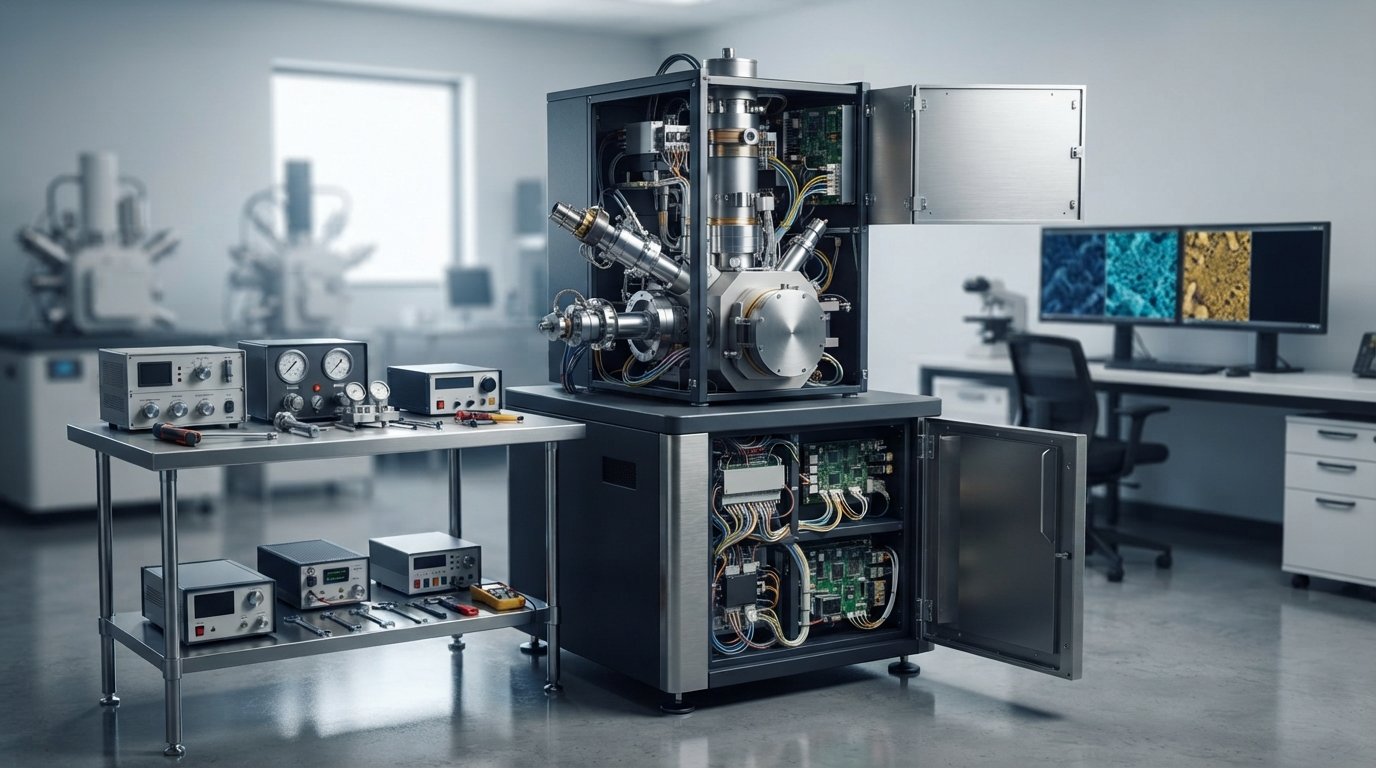
Between 2020 and early 2026, the Producer Price Index for laboratory analytical instruments rose by approximately 23%, forcing global research facilities to reconsider the inherent value of their existing hardware assets. You likely recognize that acquiring high-performance imaging shouldn’t necessitate a compromise on reliability, yet the uncertainty surrounding “as-is” used equipment often creates a significant barrier to procurement. It’s a valid concern, as the intersection of budget constraints and the requirement for nanometer-scale precision demands a solution that’s both economically viable and technically uncompromising.
This guide provides a definitive answer to the question: what does a full sem refurbishment include? We’ll move beyond superficial repairs to detail a rigorous engineering restoration that addresses vacuum integrity, optical precision, and digital modernization. You’ll discover the multi-stage process required to restore a scanning electron microscope to factory-standard performance, including the integration of Windows 11 control platforms and the transition to Peltier-cooled Silicon Drift Detectors. We’ll preview the meticulous checklist that ensures your refurbished unit, whether a floor-standing model or a specialized Veritas system, delivers the longevity and accuracy required for modern industrial applications.
Key Takeaways
- Distinguish between a comprehensive engineering restoration and standard used equipment sales to ensure long-term instrument reliability and technical performance.
- Discover the specific technical milestones that define what does a full sem refurbishment include, ranging from the ultrasonic cleaning of optical columns to the replacement of all vacuum seals.
- Learn how upgrading legacy electronics and integrating modern EDS systems can provide factory-standard imaging performance while significantly reducing capital expenditure.
- Identify the essential quality benchmarks, such as vacuum log data and resolution tests, required to validate the technical integrity of a refurbished unit.
- Evaluate the necessity of selecting partners with factory-trained engineers to secure specialized technical training and ongoing preventative maintenance.
Defining Full SEM Refurbishment vs. Used Equipment Sales
The acquisition of laboratory instrumentation often presents a critical choice between the high capital expenditure of new systems and the operational risks inherent in the secondary market. Understanding exactly what does a full sem refurbishment include is essential for procurement officers and research leads who require factory-standard performance without the premium cost of new hardware. While “as-is” used sales typically involve broker transactions with unverified operational histories, a certified refurbishment represents a comprehensive engineering restoration. It isn’t merely a repair; it’s a rigorous process of returning an instrument to its original factory specifications for signal-to-noise ratios and resolution benchmarks.
Full SEM Refurbishment is a multi-system overhaul of vacuum, optics, and electronics.
Unlike basic servicing, which might only address immediate mechanical failures, a full refurbishment involves a total teardown of the instrument. This ensures that the fundamental scanning electron microscope operation and architecture are preserved while modernizing the specific components that suffer from technical or digital obsolescence. This methodical approach transforms a legacy asset into a high-performance tool capable of meeting modern industrial demands.
The Three Pillars of Professional Refurbishment
To understand what does a full sem refurbishment include at a granular level, one must examine the three technical foundations of the process:
- Vacuum Integrity: Ensuring leak-free operation through the total disassembly of the manifold and the replacement of all gaskets and O-rings with high-grade fluoroelastomer components.
- Electron Optics: Restoring the column and lens systems to pristine condition via ultrasonic cleaning of the gun assembly and precise alignment of the anodes.
- Digital Modernization: Replacing legacy analog scan generators with modern DSP/FPGA boards and integrating Windows 11 control platforms to meet 2026 cybersecurity standards.
Why Refurbishment is a Strategic Capital Investment
Choosing a refurbished instrument is a sophisticated financial strategy that prioritizes long-term reliability and accuracy. By extending the operational lifespan of high-quality chassis, such as those in the Veritas series, laboratories can realize a capital expenditure reduction of 30% to 70% compared to new floor-standing models. This approach is particularly relevant given the 23% increase in the Producer Price Index for analytical instruments observed since 2020. Beyond the immediate ROI, this practice supports industrial sustainability through equipment circularity and modernization. It allows facilities to maintain superior standards while adhering to the grounded, practical realities of modern production and logistical excellence.
Stage 1: Vacuum System Overhaul and Leak Detection
The vacuum environment serves as the foundational infrastructure for any high-resolution imaging system. Without a stable, ultra-high vacuum (UHV), the electron beam can’t travel unimpeded, and the specimen chamber becomes a source of contamination rather than a controlled observation environment. When assessing what does a full sem refurbishment include, the vacuum system overhaul represents the most technically demanding phase of the mechanical restoration. It requires a complete disassembly of the vacuum chamber and manifold, followed by a rigorous cleaning process to remove decades of accumulated debris. Every gasket, O-ring, and seal is replaced with high-grade fluoroelastomer components to ensure structural integrity under extreme pressure differentials.
This stage also involves a comprehensive evaluation of SEM instrumentation and EDS integration, as vacuum stability directly impacts the energy resolution of X-ray detectors. To guarantee performance, engineers utilize Helium mass spectrometer leak detection. This protocol targets a threshold lower than 10-9 mbar·L/s, ensuring the system maintains the necessary base pressures, typically between 1 x 10⁻⁴ Pa and 1 x 10⁻⁵ Pa for high-vacuum chambers. Such meticulousness is why research facilities trust a refurbished SEM unit to deliver factory-standard results.
Pump Maintenance and Performance Verification
A professional refurbishment doesn’t simply verify that a pump is operational; it restores the unit to its peak efficiency. Rotary vane pumps undergo complete oil changes and internal component inspections to identify wear in the vanes or springs. For turbomolecular pumps, the process is even more specialized, involving bearing replacement and precision balancing to prevent vibrations that could compromise imaging at high magnifications. In modern 2026 standards, many labs opt to replace legacy oil-sealed pumps with dry scroll pumps to eliminate hydrocarbon backstreaming, a service often detailed in The Definitive Guide to SEM Maintenance. Documenting base pressure recovery times provides the final validation of a successful overhaul.
Chamber Decontamination Protocols
Years of operation inevitably lead to hydrocarbon buildup and sample residues that degrade the signal-to-noise ratio. Factory-trained engineers employ specialized solvents for ultrasonic cleaning of all internal components. This is followed by plasma cleaning of the chamber, a process that utilizes ionized gas to eliminate carbon contamination at the molecular level. It’s a critical step in restoring the system’s ability to produce clear, high-contrast images. By addressing these often-overlooked mechanical details, the refurbishment ensures that the instrument’s physical assets are as robust as its modernized electronics. This methodical approach to what does a full sem refurbishment include reflects our commitment to technical integration and superior standards in every project.
Stage 2: Electron Optical Column Restoration
While the initial vacuum overhaul ensures a stable physical environment, the second stage focuses on the precision of the electron path. A professional restoration must address the optical column with extreme meticulousness, as even microscopic contamination can lead to beam instability and significant charging artifacts. This phase involves the complete removal and ultrasonic cleaning of the electron gun assembly and anodes to eliminate carbonized residues. It’s during this intricate process that engineers define what does a full sem refurbishment include by restoring the original beam brightness and focus capabilities. Scrubbing the column liner tube is a critical, often-overlooked step that removes contaminants responsible for inducing unwanted electrostatic charging throughout the column’s length.
The restoration extends to the replacement of essential consumables, specifically the filament or cathode, whether Tungsten loops or LaB6 crystals, and the aperture strips. These components are the primary drivers of image resolution and probe current stability. Following the SEM vacuum system and column alignment requirements, factory-trained engineers calibrate the electromagnetic lenses, including both the condenser and objective systems. This ensures optimal focus across the entire accelerating voltage range. This methodical alignment is what separates a certified refurbishment from a simple used equipment sale, providing a guarantee of performance that meets modern industrial standards.
Aperture and Filament Alignment
Achieving sub-nanometer resolution requires more than just clean parts; it demands precision centering of the electron beam through the final aperture. Engineers optimize the gun tilt and shift parameters to achieve a stable emission current, which is foundational for reproducible analytical results. This process includes documenting filament life expectancy and determining exact saturation points to prevent premature failure. For those looking to master these technical nuances during daily operation, our SEM Operation: The Professional Guide provides deep insights into managing these parameters. Such stability is essential for high-performance imaging in 2026.
Stigmator and Deflection Coil Testing
The final stage of column restoration involves the rigorous testing of the stigmator and deflection coils. These electromagnetic components must provide perfectly symmetrical beam correction to eliminate astigmatism at high magnifications. Simultaneously, scan generators are evaluated for linearity and image stability, ensuring that the raster pattern remains distortion-free. By validating these electronic-optical interfaces, the refurbishment process guarantees that instruments like the Veritas series perform with the same precision as a newly commissioned system. This level of stability is a core requirement for any facility prioritizing technical integration and superior imaging standards.

Stage 3: Electronics Modernization and EDS Integration
After the structural integrity of the vacuum and the precision of the column are established, the focus shifts to the electronic architecture. This phase is a pivotal component of what does a full sem refurbishment include, as it bridges the gap between legacy hardware and modern data requirements. Many older systems rely on linear power supplies and aging transformers that are prone to drift and thermal instability. During a professional modernization, these are replaced with high-stability solid-state equivalents. This transition not only improves beam stability but can also reduce total power consumption by up to 70%, reflecting a commitment to both industrial performance and ecological responsibility.
Digital acquisition is another critical area of focus. Upgrading analog-to-digital (A/D) converters allows the system to handle the higher bit-depths and scan rates required for 2026 research standards. This modernization ensures that the instrument’s output is compatible with modern 8K resolution imaging, delivering up to 64 megapixels of frame density. If your laboratory needs to achieve these high-performance benchmarks, you can explore our certified refurbished SEM units to see how modern electronics transform legacy chassis like the Veritas series.
Control System and Software Upgrades
The transition from legacy proprietary operating systems to modern, supported Windows environments is a prerequisite for institutional network compliance. Since Microsoft ended mainstream support for Windows 10 in October 2025, current refurbishments utilize Windows 11 64-bit platforms to resolve cybersecurity liabilities. These updates enable remote diagnostics and automated imaging routines, which streamline high-throughput workflows. High-fidelity digital image acquisition at 16-bit or 32-bit depth is essential for capturing the subtle grayscale variations required in advanced materials science. This technical synergy is detailed further in our guide on the Fundamental Principles of SEM.
EDS and Analytical Capability Enhancements
Analytical throughput is fundamentally transformed through the integration of modern Energy Dispersive Spectroscopy systems. Obsolete liquid-nitrogen cooled Si(Li) detectors are retrofitted with Peltier-cooled Silicon Drift Detectors (SDD). These modern units deliver energy resolutions between 127 eV and 129 eV at throughputs exceeding 100,000 counts per second, allowing for much faster elemental mapping and more accurate quantitative analysis. Calibrating the interface between the SEM column and the EDS pulse processor ensures that the analytical data is perfectly synchronized with the secondary electron signal. This level of technical integration allows a refurbished system to compete directly with new high-end models in both speed and accuracy.
Selecting a Refurbishment Partner: Quality Benchmarks
Selecting a refurbishment partner is a critical procurement decision that extends beyond the initial capital savings. To truly understand what does a full sem refurbishment include in a professional context, one must evaluate the technical pedigree of the service provider. The complexity of electron-optical systems requires factory-trained engineers with extensive industry experience, often exceeding 20 years, to ensure the restoration meets original manufacturer benchmarks. Trust is established through transparent documentation, specifically ‘before and after’ resolution tests using Gold-on-Carbon standards and comprehensive vacuum log data. These metrics provide objective proof that the instrument’s signal-to-noise ratio and vacuum integrity have been restored to factory-standard performance.
A reputable partner should also provide a comprehensive warranty, typically ranging from 6 to 12 months, which covers parts, vacuum integrity, and on-site labor. This contrasts sharply with the restrictive 30-day “parts-only” clauses often found in the secondary broker market. Evaluating the availability of post-sale service contracts is equally vital for maintaining long-term technical integration and operational stability. By prioritizing these quality benchmarks, research leads can ensure that their investment in a refurbished SEM unit delivers the same reliability as a newly commissioned system.
The Importance of On-Site Support
On-site installation and calibration are non-negotiable for sensitive optics. Even the most meticulously restored column can suffer from alignment shifts during international production and logistical transport. Professional engineers must perform final calibration at the instrument’s permanent location to account for local electromagnetic interference and floor vibrations. Furthermore, customized training programs are essential to ensure laboratory staff can maximize the tool’s utility for specific industrial applications. Understanding these logistical nuances is a key factor when considering how much an electron microscope costs, as professional support significantly impacts the total cost of ownership.
Refurbished SEM Checklist for Buyers
Before finalizing a procurement agreement, buyers should verify the following technical milestones to confirm the depth of the restoration. A professional checklist ensures that the instrument’s longevity is secured through rigorous engineering rather than superficial cleaning. It’s important to verify that the refurbishment includes:
- Vacuum System Verification: Documentation of pump rebuild dates and helium mass spectrometer leak detection results.
- Optical Integrity: Confirmation of ultrasonic column cleaning and the replacement of all aperture strips.
- Software Compliance: Integration of Windows 11 64-bit platforms to meet current institutional cybersecurity protocols.
- Parts Retention: Assurance of hardware spare parts availability, especially for legacy circuit boards that have exceeded the OEM 7-to-10-year retention window.
If you’re ready to modernize your laboratory’s imaging capabilities with a high-performance system, contact Electron Optics Instruments, LLC for a refurbished SEM consultation. Our team of factory-trained engineers brings over 30 years of experience to every project, ensuring your hardware meets the superior standards required for 2026 research.
Securing High-Performance Microscopy through Engineering Excellence
Achieving factory-standard imaging in 2026 requires a transition from the risks of the secondary market to the precision of a certified restoration. Understanding what does a full sem refurbishment include is the first step in identifying a system that balances capital efficiency with technical uncompromisingness. By addressing the critical pillars of vacuum integrity, optical column cleanliness, and digital modernization, laboratories can secure instruments that perform with the same accuracy as newly manufactured hardware. This rigorous multi-stage process ensures that every component, from the fluoroelastomer seals to the Windows 11 control interface, contributes to a stable and reliable imaging environment.
Electron Optics Instruments leverages over 30 years of SEM engineering expertise to deliver these high-performance solutions. Our factory-trained technicians, who specialize in all major brands, provide the meticulousness required for complex system overhauls and Energy Dispersive Spectroscopy integration. We support your facility’s long-term success through comprehensive on-site training and robust service contracts that safeguard your technical assets. We invite you to Explore Our Certified Refurbished SEM Inventory and Service Solutions to discover how our visionary approach to hardware restoration can empower your next phase of industrial innovation.
Frequently Asked Questions
Is a refurbished SEM as reliable as a new model?
Professional refurbishment resets the instrument’s operational lifespan, providing reliability comparable to a new model. By addressing the fundamental pillars of vacuum integrity and optical precision, factory-trained engineers restore the system to original performance benchmarks. This process transforms a legacy asset into a high-performance tool capable of meeting modern industrial demands. Understanding what does a full sem refurbishment include is critical for procurement officers who require factory-standard performance without the premium cost of new hardware.
How long does a full SEM refurbishment typically take?
A comprehensive restoration typically requires a window of 4 to 8 weeks, depending on the instrument’s initial condition and the complexity of the digital upgrades. This period allows for a total teardown, ultrasonic cleaning of the column, and the integration of modern electronics. Every stage, from helium leak detection to final resolution testing on Gold-on-Carbon standards, is executed with the meticulousness necessary to meet factory-standard performance and reliability benchmarks in 2026.
Can I upgrade my existing SEM to include modern EDS during refurbishment?
Integrating modern Energy Dispersive Spectroscopy (EDS) systems is a standard component of our modernization protocols. During the refurbishment process, engineers can replace obsolete liquid-nitrogen cooled detectors with Peltier-cooled Silicon Drift Detectors (SDD) from leading manufacturers like Oxford or Bruker. This upgrade significantly enhances analytical throughput and elemental mapping speed. Calibrating the interface between the optical column and the new EDS pulse processor ensures that your existing hardware achieves current industrial standards for quantitative chemical analysis.
What is the typical warranty period for a professionally refurbished SEM?
Professional refurbishments typically include a comprehensive warranty period ranging from 6 to 12 months. This coverage encompasses critical systems such as vacuum integrity, electron optics, and electronic hardware, providing a level of security that “as-is” used equipment sales don’t match. This guarantee reflects our confidence in the meticulousness of our factory-trained engineers and ensures that your laboratory maintains operational stability throughout the initial deployment phase of the restored instrument.
Will a refurbished SEM support the latest Windows operating systems?
Modern refurbishments prioritize cybersecurity and network integration by transitioning legacy proprietary systems to supported environments like Windows 11 64-bit. This update is essential for connecting instruments to institutional local area networks (LANs) following the end of support for Windows 10 in October 2025. By upgrading the underlying control hardware and scan generators, we ensure that your refurbished unit meets 2026 IT security protocols while enabling advanced features like remote diagnostics and automated imaging routines.
What happens if a component fails in a refurbished unit after the warranty?
If a component failure occurs beyond the warranty period, Electron Optics Instruments, LLC provides multi-tiered service contracts and billable field service rates to ensure continued operational stability. Our factory-trained engineers, who possess an average of 20 years of experience, handle hardware repairs and component replacements for all major manufacturers. We also offer preventative maintenance visits and a consistent supply of SEM filaments and consumables to minimize downtime and extend the productive lifespan of your restored hardware.
Can benchtop SEMs like the Cube II be refurbished or are they ‘disposable’?
Benchtop SEMs like the Cube II and Genesis are precision-engineered instruments designed for long-term industrial utility, not disposable use. These models are fully eligible for our professional refurbishment protocols, which include vacuum system overhauls and optical column restoration. Maintaining these tabletop systems through scheduled preventative maintenance and expert repairs ensures they continue to deliver high-resolution imaging and reliable performance throughout their extended service lives in both research and production environments.
Does refurbishment include the relocation and installation of the microscope?
Our service portfolio includes professional equipment relocation and installation to ensure that sensitive optics aren’t compromised during transport. This process involves decommissioning, secure transit, and re-installation at your facility. Once the unit is on-site, our engineers perform final calibration using copper/tin grids and resolution standards. This comprehensive approach is a vital part of what does a full sem refurbishment include to guarantee that the instrument meets its resolution benchmarks in its new operational environment.